



# Legal Document Delivery Optimization: A Complete Guide for Process Serving Agencies
> TL;DR: Legal document delivery optimization means routing process servers efficiently while capturing GPS-verified proof that service happened correctly, on time, and at the right location. Improper service of process remains one of the most common grounds for motions to dismiss in civil litigation, making documentation just as critical as speed. Route optimization tools like Zeo Route Planner address this with priority stop sequencing and automatic photo, signature, and timestamp capture, helping process serving teams save 2+ hours daily on manual route planning.
Process serving runs on deadlines. Miss a court-ordered window for serving a subpoena, and your client’s whole case timeline can fall apart. Yet most agencies still plan routes with spreadsheets, sticky notes, or basic GPS apps that were never built for legal work.
Legal document delivery optimization means something different than regular courier routing. It’s not just about getting from Point A to Point B fast. It’s about proving, beyond doubt, that service happened correctly, on time, and at the right location.
This guide breaks down what legal delivery optimization actually requires, why manual methods keep failing agencies, and how route optimization software builds both efficiency and legal defensibility into your daily operations.
What “Legal Document Delivery Optimization” Actually Means (And Why It’s Different From Regular Courier Routing)
A pizza delivery driver just needs to get food to the right address before it gets cold. A process server needs far more.
Legal document delivery optimization means routing servers efficiently while capturing evidence that holds up in court. Every stop needs a timestamp, location data, and often a photo or signature. If a defendant later claims they were never served, your documentation is your defense.
Regular courier routing tools optimize for speed and distance. Legal delivery optimization has to layer in:
- Multiple attempts at the same address before a stop is marked as failed
- Priority sequencing for time-sensitive court filings
- GPS-verified proof that a server was physically present
- Detailed notes on service outcomes (“served to spouse,” “refused,” “no answer”)
Miss any of these, and you’re not just inefficient. You’re exposed to legal challenges that can get a case dismissed or delayed.
Why Manual Dispatch and Basic GPS Apps Fail Process Serving and Legal Courier Teams
Most agencies start small, with a dispatcher manually assigning addresses to servers each morning. It works fine with three servers and 15 stops a day. It breaks down fast once you’re running 10, 20, or 40 servers across a metro area.
Manual dispatch has three core problems.
It’s slow. A dispatcher sequencing 30-40 stops per server by hand can burn an hour or more every morning, before a single delivery happens.
It’s inaccurate. Humans aren’t good at solving complex routing math. Manual sequencing routinely leads to backtracking, wasted mileage, and servers driving across town twice in one day.
It leaves no audit trail. A basic GPS app like Google Maps or Waze gets a driver from stop to stop, but it doesn’t log arrival times, capture signatures, or timestamp photos. If a case goes to court, you have nothing but a driver’s memory to back up your service claim.
According to the American Bar Association’s guidance on service of process, improper service of process remains one of the most common grounds for motions to dismiss in civil litigation. If your documentation can’t withstand scrutiny, your agency’s reputation and client relationships are on the line.
The Hidden Cost of Inefficient Routes: Missed Attempts, Wasted Mileage, and Compliance Risk
Inefficient routing doesn’t just cost time. It compounds into real financial and legal risk.
Wasted mileage adds up fast. The IRS standard mileage rate reflects the real cost of vehicle wear, fuel, and maintenance. Every unnecessary mile a server drives due to poor sequencing is money leaving your agency, multiplied across every vehicle in your fleet. Agencies tracking this cost closely often turn to mileage tracking tools to quantify the impact.
Missed attempts delay cases. A server who arrives at the wrong time, or skips a stop due to a disorganized route, forces another attempt, another day, and another cost. In time-sensitive matters like eviction notices or restraining orders, delays can have serious consequences for clients.
Weak documentation invites legal challenges. If your proof of service is a handwritten note or a text message, it’s easy for opposing counsel to question its validity. Courts increasingly expect detailed, time-stamped records, especially in high-volume litigation involving debt collection, evictions, or family law.
Lack of visibility creates blind spots. Without real-time tracking, agency owners can’t answer basic questions during the day: Is this server on schedule? Did that priority subpoena get served yet? Are we going to miss today’s filing deadline? Field roles like process serving share this challenge with other mobile workforces, as covered in this overview of industry employment trends for couriers and messengers.
These hidden costs rarely show up on a single day’s balance sheet. But over a month, they erode margins and put client trust at risk.
How Route Optimization Software Solves Legal Delivery’s Unique Challenges
Route optimization software addresses the exact gaps that manual dispatch and basic GPS apps leave open.
Multi-stop routing built for volume. Zeo Route Planner’s AI-powered route optimization automatically sequences dozens of stops per server, factoring in traffic, distance, and time windows. Agencies report saving 2+ hours daily that would otherwise go to manual planning.
Priority stops for urgent filings. Not every document carries the same urgency. A temporary restraining order needs same-day service, while a routine civil summons might have more flexibility. Zeo lets dispatchers flag stops as priority (ASAP) versus normal, so servers hit the most time-sensitive addresses first.
Skill-based assignment. Some servers are better suited for certain jurisdictions, difficult neighborhoods, or specific document types. Zeo’s skill-based driver assignment lets fleet managers match the right server to the right stop, instead of assigning routes randomly.
Real-time GPS tracking. Once servers are on the road, dispatchers can see live location updates for every route using real-time GPS tracking. If a server falls behind schedule or a priority stop needs reassignment mid-shift, Zeo supports dynamic route adjustments without starting the whole plan over.
Capacity and time window constraints. For agencies also handling document pickup or courier runs alongside process serving, Zeo’s capacity-based routing and time window features keep multi-service days organized.
Consider a mid-size agency running 25 servers across a three-county metro area, handling 400+ service attempts daily. Manually, a dispatcher would need hours to sequence routes and constant phone calls to track status. With route optimization software, routes are built and assigned in minutes, priority subpoenas get flagged automatically, and the dispatcher can see every server’s location and completion status from one screen.
Building a Defensible, Documented Service-of-Process Record With GPS Timestamps, Photos, and Signatures
Efficient routing solves half the problem. The other half is proof.
When a defense attorney challenges service, “the process server said they delivered it” isn’t enough. You need evidence.
Zeo’s proof of delivery tools give agencies a documented, GPS-verified record for every stop:

increase fuel savings
Save $200 on fuel, Monthly!
Optimize routes with our algorithm, reducing travel time and costs efficiently.
Get Started for Free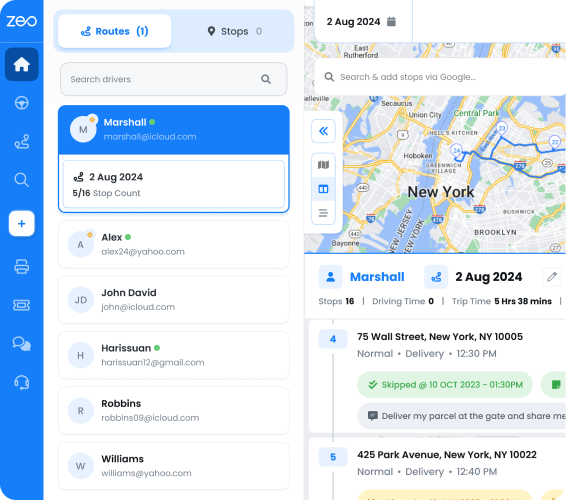
- Photo capture at the point of service, useful for documenting the location, the document, or the person served
- Digital signature collection, when a recipient acknowledges receipt
- Delivery notes, so servers can log specifics like “served to spouse,” “refused service,” or “no answer, third attempt”
- Automatic timestamps and GPS location data, tied to every attempt, not just successful ones
This creates a paper trail that’s far harder to dispute than a handwritten log. If a case does go to court, the agency can pull up the exact time, location, and documentation of every attempt, successful or not.
This kind of documentation aligns with growing court expectations around electronic proof of service. Many state courts, including several California and New York jurisdictions, have published guidance encouraging more detailed affidavits of service, including location and time verification. Route optimization software with built-in proof of service tools helps agencies meet that bar without adding extra paperwork for servers.
From Dispatcher to Server: How Fleet Managers and Process Servers Work Together in One System
One of the biggest advantages of route optimization software is that it connects the office to the field in real time.
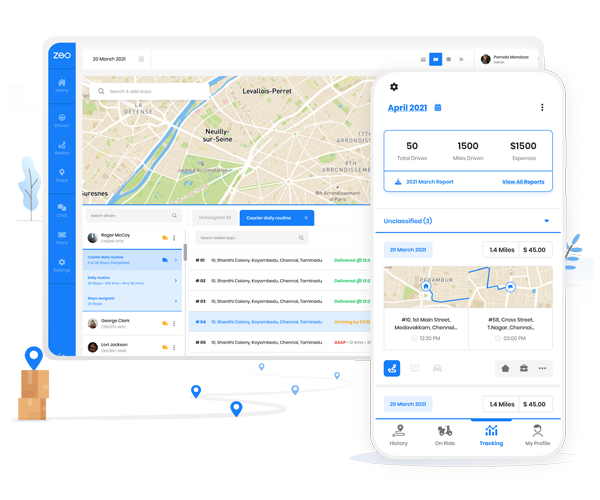
Agency owners and dispatchers build and assign multi-stop routes on the Zeo web platform. They can see the full day’s workload across every server, adjust assignments based on priority, and monitor progress without picking up the phone.
Each process server, meanwhile, receives their optimized route directly on Zeo’s mobile app. From there, they navigate stop-to-stop with turn-by-turn directions, view customer and case details, and capture photos or signatures as proof of service. They log delivery notes right from their phone, whether that’s “served to spouse” or “refused service,” and every attempt gets timestamped automatically.
This creates a real-time, GPS-verified record without extra paperwork on either end. Dispatchers aren’t chasing servers for updates, and servers aren’t filling out separate affidavits after the fact. The documentation builds itself as the route happens.
For agencies managing 5 to 40 servers, this dispatcher-to-server connection is often the single biggest efficiency and compliance upgrade they can make.
A Practical Checklist: Evaluating Route Planning Software for Legal Delivery Compliance and Efficiency
If you’re comparing route optimization tools for a process serving or legal courier operation, evaluate them against these criteria:
- Does it support multi-stop route optimization for 20+ stops per server, factoring in real-world traffic and distance?
- Can you flag priority stops for time-sensitive court filings, separate from standard-priority deliveries?
- Does it offer skill-based assignment so specific servers can be matched to specific jurisdictions or document types?
- Does it include real-time GPS tracking so dispatchers can monitor every server’s location and progress throughout the day?
- Does it capture proof of service with photos, digital signatures, and delivery notes, all timestamped automatically?
- Can it handle dynamic route adjustments mid-shift, if a priority subpoena comes in after routes are already assigned?
- Does it offer a mobile app for servers, separate from a web platform for dispatchers, so both sides of the operation are connected?
- Can it import addresses in bulk from Excel, CSV, or Google Sheets, so you’re not manually entering dozens of stops each morning?
- Does it provide analytics and reporting on completed attempts, mileage, and server performance over time?
Run any software you’re evaluating through this list before committing. A tool that’s missing even two or three of these capabilities will likely leave gaps in either your efficiency or your compliance documentation.
Getting Started: Optimizing Your First Week of Legal Delivery Routes
You don’t need to overhaul your entire operation on day one. Start small and build from there.
Day 1-2: Import your existing address list in bulk using a CSV or Excel file. Set up your servers as drivers in the system, assigning skills or zones based on their current territories.
Day 3: Run your first optimized route for a single server. Compare the AI-generated sequence against how that route would have been planned manually. Most agencies immediately notice reduced backtracking and tighter stop sequencing.
Day 4-5: Roll out proof of service capture across your team. Have servers practice logging photos, signatures, and delivery notes for every attempt, successful or not.
End of week 1: Review your analytics. Look at total mileage, completed versus missed attempts, and average time per stop. Compare this against your prior week’s manual numbers.
Most agencies see the mileage and time savings within the first week. The documentation benefits compound over time, especially the first time a case hinges on your proof of service record and it holds up without question.
Legal document delivery optimization isn’t a luxury for large agencies anymore. With rising court expectations around documentation and tightening margins on courier work, it’s becoming the operational standard for any agency handling meaningful volume.
Frequently Asked Questions
Q: How many times must a process server attempt service before it’s considered failed?
This varies by state and case type, but most jurisdictions expect at least 2-3 documented attempts at different times of day before service is deemed unsuccessful. Courts generally want to see variety in attempt times (morning, evening, weekend) to demonstrate a genuine effort. Detailed logs of each attempt, including time, location, and outcome, strengthen an agency’s position if service is later challenged.
Q: What information needs to be included in a proof of service affidavit?
A valid affidavit of service typically includes the date, time, and exact location of service, a description of how service was completed (personal, substitute, or posting), and identifying details about the person served. Many state courts now expect GPS-verified location data alongside traditional written affidavits. Zeo’s proof of service tools capture automatic timestamps and GPS location data for every attempt, giving agencies a documented record to support their affidavits.
Q: How can process serving agencies reduce wasted mileage between stops?
Reducing wasted mileage starts with sequencing stops geographically instead of assigning them in the order they arrive. AI-powered route optimization can sequence 20-40 stops per server in minutes, factoring in real-world traffic and distance to minimize backtracking. Zeo Route Planner’s route optimization has helped field teams save 2+ hours daily that would otherwise go to manual route planning.
Q: What happens if a defendant claims they were never served?
If a defendant disputes service, the burden falls on the process server or agency to provide evidence, typically an affidavit plus any supporting documentation like photos, signatures, or GPS timestamps. Weak or handwritten documentation is far easier for opposing counsel to challenge than time-stamped, location-verified records. This is why many agencies are shifting toward digital proof-of-service systems rather than relying on a server’s written notes alone.
Q: Can one route optimization platform work for both dispatchers and process servers?
Yes. Platforms built for legal delivery typically offer a web-based dashboard for dispatchers to build and monitor routes, paired with a mobile app for servers to navigate stops and capture proof of service. Zeo Route Planner uses this dual-platform structure, letting managers assign and track 25+ servers from one screen while drivers log delivery notes and signatures directly from their phones.
—
Start a free trial of Zeo Route Planner to optimize your process serving and legal courier routes, track proof of service in real time, and build a documentation trail that holds up in court. No credit card required.
Are you a fleet owner?
Want to manage your drivers and deliveries easily?
Grow your business effortlessly with Zeo Routes Planner – optimize routes and manage multiple drivers with ease.

increase fuel savings
Save 2 Hours on Deliveries, Everyday!
Optimize routes with our algorithm, reducing travel time and costs efficiently.
Get Started for Free