


# Equipment Delivery Management: The Complete Workflow, Features & KPIs
> TL;DR: Equipment delivery management requires two-way logistics planning, proof-of-condition documentation, and strict time-window scheduling, which standard parcel delivery software isn’t built to handle. Route optimization platforms like Zeo Route Planner address this with pickup-delivery linking, capacity-based routing, and photo/signature proof of delivery, helping field service and rental teams save 2+ hours daily on scheduling and dispatch.
Equipment delivery management is harder than standard parcel delivery. You’re not just dropping a package on a porch.
You’re scheduling deliveries and pickups, tracking high-value assets, and hitting narrow job site windows. One missed delivery can shut down a construction crew for a day.
Most equipment rental, medical supply, and heavy machinery companies still run this process on spreadsheets and phone calls. That approach breaks down fast once you’re managing more than a handful of trucks.
This guide defines equipment delivery management as its own discipline. Then it shows you the exact workflow, features, and KPIs that fix the scheduling, accountability, and efficiency problems unique to moving equipment.
What Is Equipment Delivery Management? (And Why It’s Different From Standard Delivery Logistics)
Equipment delivery management is the process of scheduling, dispatching, tracking, and confirming the delivery, pickup, and return of specialized or high-value equipment.
Think forklifts, generators, hospital beds, excavators, scaffolding, or medical imaging devices. This is fundamentally different from standard package delivery logistics.
Here’s why:
Two-way logistics, not one-way. A courier drops off a package and moves on. Equipment delivery requires planning for the eventual pickup or return too, often days or weeks later.
Asset accountability. A $40,000 generator or a hospital-grade ventilator needs documented proof of condition at drop-off and pickup. Disputes over damage or missing parts are common, and costly.
Job site time windows. Construction sites and hospitals often have strict delivery windows tied to crew schedules, permits, or patient care. Miss the window, and you’ve cost your customer real money. OSHA’s construction site guidelines highlight just how tightly coordinated activity on active job sites needs to be, which is part of why delivery timing matters so much.
Vehicle and equipment constraints. Heavy machinery needs flatbeds, liftgates, or specific vehicle capacity. Not every truck in your fleet can handle every job.
Standard delivery software wasn’t built for this. Equipment delivery management requires routing logic, proof-of-condition tools, and scheduling flexibility that generic last-mile tools don’t offer.
The Hidden Costs of Managing Equipment Deliveries Manually
If you’re coordinating routes with spreadsheets, sticky notes, and group texts, you’re paying for it in ways that don’t always show up on a P&L.
Missed time windows. A late delivery to a job site can delay an entire crew. According to the Associated General Contractors of America, project delays from logistics issues are a recurring source of dispute between contractors and suppliers. Understanding why on-time delivery matters for your business is the first step to fixing it.
Condition disputes. Without photo and signature proof, you’re stuck in he-said-she-said arguments about who dented the equipment or lost a part. These disputes eat up staff hours and damage customer trust.
Inefficient routing. Manual dispatch rarely accounts for vehicle capacity, driver skills, or real-time traffic. Drivers backtrack, burn extra fuel, and finish fewer jobs per day.
No real-time visibility. When a customer calls asking “where’s my equipment?”, your dispatcher is calling the driver to find out. That’s wasted time on both ends.
Driver inefficiency. The U.S. Bureau of Labor Statistics reports that delivery and driving occupations are projected to see continued demand growth, which means every hour a driver wastes on poor routing is an hour you can’t easily replace with more labor.
Add it up, and manual equipment delivery management costs you in fuel, labor, disputes, and lost customer trust, every single week.
The Modern Equipment Delivery Workflow: Planning, Dispatching, Tracking, and Confirming Delivery
A modern equipment delivery process has four stages. Each one solves a specific failure point in the manual process.
1. Planning. Import your day’s delivery and pickup orders, whether that’s a spreadsheet of job sites, a CSV from your rental software, or manually entered addresses. Build routes that account for time windows, vehicle capacity, and driver skills, not just shortest distance.
2. Dispatching. Assign the optimized routes to specific drivers based on who has the right vehicle (flatbed, liftgate, refrigerated) and the right experience for the job. Push the route straight to the driver’s phone.
3. Tracking. Monitor driver location and delivery progress in real time with driver tracking software. If a job site isn’t ready or a driver hits traffic, you see it immediately instead of finding out after the fact.
4. Confirming. Capture signature, photo, and delivery notes at both delivery and pickup. This closes the loop on proof of condition and gives you a record if a dispute comes up later.
This workflow turns equipment delivery from a reactive scramble into a repeatable, trackable process.
Must-Have Features in Equipment Delivery Management Software
Not every route planning tool is built for equipment delivery. Here’s the feature checklist that matters for your use case:
- AI-powered route optimization that factors in time windows, stop priority, and vehicle capacity, not just distance
- Pickup-delivery linking so related pickup and delivery stops are automatically paired and sequenced correctly, critical for equipment returns
- Capacity-based routing to match loads with the right vehicle, so you don’t send a sedan to pick up a mini excavator
- Skill-based driver assignment for jobs that need certified or experienced drivers
- Time window constraints to respect strict job site or hospital delivery slots
- Proof of delivery tools, including photo capture, digital signatures, and delivery notes, to document equipment condition at every stop
- Real-time GPS tracking so you always know where a vehicle and its equipment are
- Customer notifications with live ETA updates, so job sites know exactly when to expect delivery
- Scheduled and recurring routes, useful for equipment on long-term rental with regular maintenance or swap visits
- Blackout dates to pause a recurring route without deleting the schedule, useful when a rental pauses temporarily
- Day plan and date override options to assign different drivers to specific days of a scheduled route, without rebuilding the whole plan
- Avoid params to route around highways, tunnels, or bridges that oversized equipment trucks can’t use
Zeo Route Planner includes all of these in one platform, serving teams across 150+ countries, which means you’re not stitching together three different tools to manage one delivery.
How Route Optimization and Driver Apps Work Together to Streamline Equipment Delivery
Route optimization software only solves half the problem if your drivers can’t act on it in the field. That’s where the connection between the web platform and the mobile app matters.
Here’s how it plays out in practice. An operations manager builds the day’s equipment delivery and pickup routes on the Zeo web platform, factoring in time windows, vehicle capacity, and driver skills.

increase fuel savings
Hassle Free Deliveries & Pickups!
Optimize routes with our algorithm, reducing travel time and costs efficiently.
Get Started for Free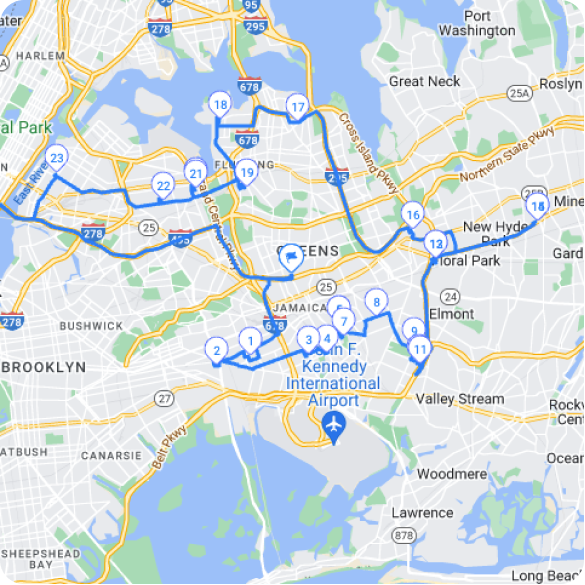
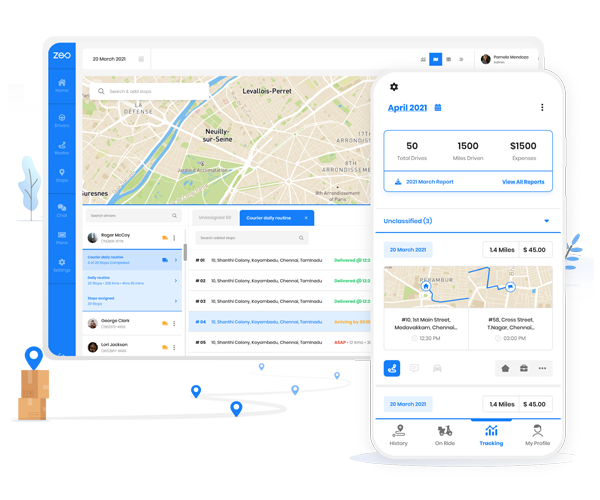
Once the manager assigns the routes, each driver receives their stops directly on the Zeo mobile app. From there, the driver gets turn-by-turn navigation to every job site, along with customer details and delivery instructions.
At each stop, the driver captures a photo and digital signature as proof of delivery or pickup. For high-value equipment, this record is what protects you if a customer later disputes the condition of a returned machine.
Drivers can also log delivery notes directly in the app, flagging anything unusual, like a damaged pallet or a missing attachment. If a job site isn’t ready to receive equipment, the driver messages the manager in real time through in-app chat, instead of waiting until they’re back at the depot to explain the delay.
This back-and-forth between planning and execution is what turns a route plan into a reliable, documented delivery process.
KPIs That Prove Your Equipment Delivery Process Is Working
You can’t improve what you don’t measure. Track these KPIs to know whether your equipment delivery management is actually working:
On-time delivery rate. The percentage of deliveries and pickups completed within the promised window. This is your most direct measure of customer satisfaction.
Proof-of-delivery completion rate. How many stops have a signature, photo, or note attached. Gaps here are where disputes start.
Miles and fuel per route. Track whether optimized routing is reducing distance traveled per delivery compared to your manual baseline.
Stops per driver per day. A good indicator of routing efficiency. More completed stops in the same shift means your routes are tighter.
Dispute rate on equipment condition. Track how often customers dispute damage or missing equipment, and whether that rate drops after you start capturing photo and signature proof.
Driver utilization. Compare planned hours to actual hours worked, factoring in breaks and drive time, to spot inefficiencies in scheduling.
Zeo’s route analytics and reporting give you visibility into most of these metrics directly from the dashboard, so you’re not pulling numbers manually from five different spreadsheets.
Industry Spotlight: Construction Equipment Rental, Medical Equipment, and Heavy Machinery Logistics
Construction equipment rental. A regional rental company might deliver a scissor lift to a job site Monday, then need to pick it up and move it to a second site Thursday. Pickup-delivery linking keeps these connected in the route plan, so the pickup doesn’t get missed or double-booked. Photo and signature capture at both ends protects the company if the lift comes back with new damage. For a deeper look at site scheduling challenges, see this construction delivery management playbook.
Medical equipment supply. Hospitals and home health patients often need delivery within tight, sometimes same-day windows, similar to the scheduling demands covered in this medical courier guide. Time window constraints and live ETA notifications help dispatchers keep hospitals and patients informed, while skill-based assignment ensures drivers who know proper handling procedures are matched to sensitive equipment like hospital beds or oxygen concentrators.
Heavy machinery distribution. Moving an excavator or a skid steer requires a flatbed and often a route that avoids low bridges or weight-restricted roads. Avoid params let dispatchers build routes that stay compliant with vehicle restrictions, while capacity-based routing ensures the right vehicle is assigned before the truck ever leaves the yard.
Across all three industries, the common thread is the same: equipment delivery management isn’t about getting from point A to point B. It’s about scheduling two-way logistics, documenting condition, and keeping every stakeholder, driver, customer, and manager, on the same page in real time.
Frequently Asked Questions
Q: How do you track equipment during delivery and pickup?
Most companies use a combination of GPS-enabled vehicle tracking and proof-of-condition documentation (photos, signatures, delivery notes) captured at both drop-off and pickup. This creates a timestamped record of where the equipment was and what condition it was in at each stage. Route planning platforms like Zeo Route Planner combine real-time GPS tracking with photo and signature capture, so dispatchers always know the equipment’s location and have condition records if a dispute comes up later.
Q: What’s the difference between equipment delivery and standard parcel delivery?
Equipment delivery is two-way logistics, meaning the same item typically needs to be picked up or returned later, unlike a parcel that’s dropped off once and forgotten. It also requires vehicle capacity matching (flatbeds, liftgates), strict job site time windows, and documented proof of condition because the items are high-value and reusable. Standard last-mile delivery software usually isn’t built to handle these pickup-delivery pairings or capacity constraints.
Q: How much does poor equipment delivery scheduling cost a rental business?
While exact costs vary by business size and equipment type, the main cost drivers are missed job site windows, condition disputes without photo proof, inefficient routing that wastes fuel and driver hours, and staff time spent manually coordinating pickups. According to the Bureau of Labor Statistics, demand for delivery and driving roles continues to grow, which makes every hour lost to poor routing harder to offset with additional labor.
Q: How do you manage recurring equipment rentals that need regular swaps or maintenance visits?
Recurring equipment relationships are best managed with scheduled or recurring routes rather than rebuilding the plan manually every time. Zeo Route Planner supports scheduled and recurring routes along with blackout dates, so a rental company can pause a scheduled pickup when a rental is temporarily extended without deleting the entire route plan. Day plan and date override features also let managers swap in a different driver for a single day without disrupting the rest of the schedule.
Q: What proof is needed to resolve equipment damage disputes?
The strongest evidence is a timestamped photo and digital signature captured at both delivery and pickup, along with written delivery notes describing the equipment’s condition. Without this documentation, disputes often come down to one party’s word against another’s, which costs staff time and damages customer trust. Capturing this proof consistently, at every stop, is what actually prevents disputes from escalating rather than just resolving them after the fact.
—
Start a free trial of Zeo Route Planner to build optimized equipment delivery routes, assign jobs to your drivers, and capture proof of delivery, all from one dashboard. Book a demo to see how Zeo handles multi-stop equipment delivery and pickup scheduling for teams of any size.
Are you a fleet owner?
Want to manage your drivers and deliveries easily?
Grow your business effortlessly with Zeo Routes Planner – optimize routes and manage multiple drivers with ease.
increase fuel savings
Hassle Free Deliveries & Pickups!
Optimize routes with our algorithm, reducing travel time and costs efficiently.
Get Started for Free