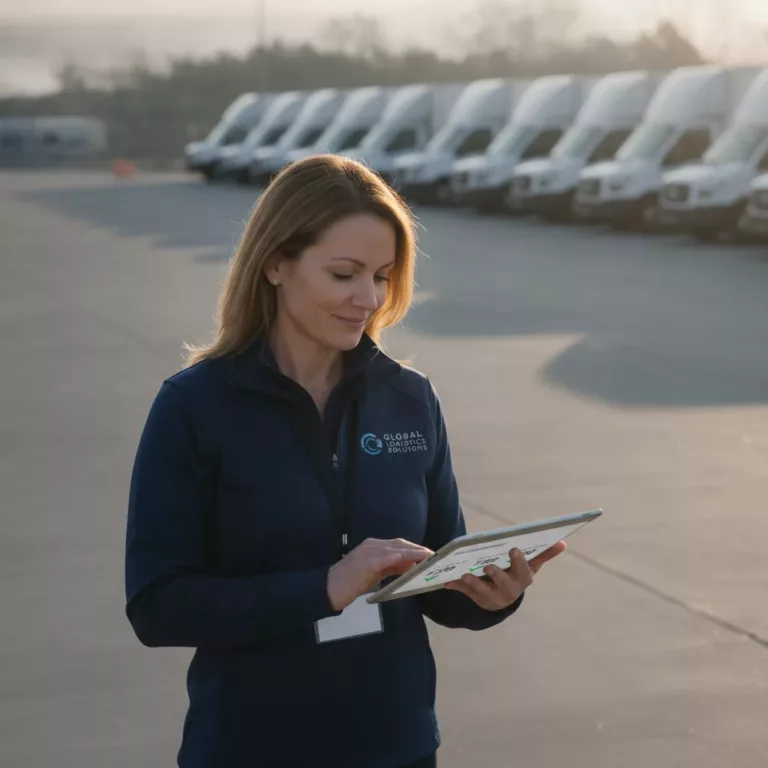



# Financial Document Delivery: A Dispatcher’s Guide to Compliance-Grade Routing
> TL;DR: Financial document delivery requires routing software that enforces hard deadlines and documents chain-of-custody at every stop, not just fast driving. Missed bank cutoffs and undocumented handoffs create real compliance and financial risk, which is why dispatchers are shifting to time-window-based routing with built-in proof of delivery. Zeo Route Planner addresses this with time window constraints, priority stops, and photo/signature proof of delivery, helping courier and bank dispatch teams save 2+ hours daily on manual route planning.
Financial document delivery isn’t like dropping off a package on a porch. When you’re moving loan documents, bank deposits, checks, or legal notices, a 20-minute delay can trigger a compliance violation or a lost deal. If you manage dispatch for a courier company, a bank’s internal delivery team, or a title company’s logistics, you already know the margin for error is close to zero.
This guide covers what makes financial document delivery different, where manual routing breaks down, and how route optimization software closes the gaps — from compliance-grade proof of delivery to scaling during tax season surges.
What Makes Financial Document Delivery Different (and Higher-Stakes) Than Standard Courier Work
Standard courier work tolerates some flexibility. A late furniture delivery is annoying. A late loan closing document can kill a real estate deal or trigger a regulatory issue. The challenges here overlap closely with legal document delivery optimization, where courthouse filings and notarized documents carry similarly strict deadlines.
Financial document delivery has three traits that raise the stakes:
Hard deadlines with real consequences. Bank deposits often need to arrive before a specific cutoff time to count for that business day. Loan documents tied to closing dates have zero flexibility. Miss the window, and you’re not just apologizing — you’re explaining a financial loss.
Chain-of-custody requirements. Many financial and legal documents need documented proof of who handled them, when, and where. This isn’t optional paperwork — it’s often required for audits, disputes, or regulatory reviews.
Multi-stop complexity across sensitive locations. A single route might include five bank branches, two title offices, and a courthouse drop-off, each with different hours, security protocols, and contact requirements. Sequencing matters as much as speed.
According to the Federal Reserve’s 2026 Payments Study, same-day and time-sensitive financial transactions continue to grow as a share of total payment volume — which means the operational pressure on document and deposit couriers is increasing, not easing. Add in stricter audit expectations from financial institutions, and the old way of doing things — a driver with a paper log and a mental map of branch locations — doesn’t hold up anymore.
The Hidden Costs of Manual Routing: Missed Windows, Chain-of-Custody Gaps, and Inefficient Bank Runs
Most courier operations don’t realize how much manual routing costs them until something goes wrong. Here’s where the cracks usually show up.
Missed deadlines from poor sequencing. When dispatchers plan routes by memory or a static spreadsheet, they can’t account for real-time traffic, branch closures, or last-minute priority stops. A driver who should have hit the downtown branch first ends up stuck across town when the 2 PM cutoff arrives.
Chain-of-custody gaps. Paper logs get lost, signatures get skipped during rushed stops, and timestamps get estimated instead of recorded. When a client disputes a delivery time or a document goes missing, you’re left with incomplete records and no way to prove what actually happened.
Inefficient bank runs. Without optimization, drivers often backtrack across the same areas multiple times a day. A route that should take four hours stretches to six, cutting into capacity for additional stops and increasing overtime costs.
No audit trail during disputes. If a bank or client asks “where was this document at 11:47 AM,” most manual systems can’t answer with precision. That uncertainty becomes a liability during compliance reviews.
Scaling breaks the system entirely. A dispatcher who can manually route 8 drivers struggles badly at 20. Manual planning doesn’t scale linearly — it gets exponentially harder as stop count and driver count grow.
The U.S. Bureau of Labor Statistics projects continued growth in courier and messenger employment through the decade, reflecting rising demand for exactly this kind of time-sensitive delivery work. More volume on a manual system means more risk, not more efficiency.
How Route Optimization Software Solves the Core Financial Delivery Challenges
Route optimization software addresses these problems directly, not by adding more staff but by making existing routes and drivers more effective.
AI-powered routing cuts planning time and tightens windows. Zeo Route Planner’s AI-powered route optimization saves 2+ hours daily that dispatchers would otherwise spend manually sequencing stops. For a bank run with hard cutoff times, that means routes get built around deadlines, not guesswork.
Time window constraints keep deadlines non-negotiable. You can set time windows for each stop — a branch that closes at 3 PM, a title office that only accepts deliveries before noon — and the system builds routes that respect those limits instead of treating every stop the same.
Priority stops handle urgent documents correctly. Not every delivery carries equal weight. Marking a stop as ASAP versus Normal priority ensures the time-critical loan package gets sequenced ahead of routine paperwork.
Dynamic adjustments handle the unexpected. When a branch calls with a last-minute deposit request mid-shift, dispatchers can adjust routes on the fly instead of radioing drivers and hoping they can rework their day manually.
Skill-based assignment matches the right driver to the right route. If certain drivers are bonded, background-checked, or trained for high-security deliveries, you can assign stops based on those qualifications instead of whoever’s available.
This is where the shift from reactive to proactive operations happens. Instead of dispatchers firefighting missed windows, they’re building optimized routes in minutes and monitoring execution in real time.
Compliance, Proof-of-Delivery, and Audit Trails: What Your Software Needs to Track
For financial document delivery, proof of delivery isn’t a nice-to-have — it’s your defense in a dispute and your evidence in an audit. Here’s what a compliant system needs to capture at every stop:
- Timestamped arrival and departure. Exact time the driver reached and left each location.
- Digital signature capture. A recorded signature from the person who accepted the document or deposit.
- Photo documentation. Visual proof of the document, envelope, or deposit bag at time of handoff.
- Delivery notes. Context the driver can log on the spot — who received it, any issues encountered, special instructions followed.
- Geofenced location data. GPS confirmation that the driver was actually at the branch or office, not just that the app says “delivered.”
Zeo’s proof of delivery tools — photo capture, digital signatures, and delivery notes — give you a documented record for every stop, not just a checkbox. When a bank branch disputes a deposit time weeks later, you have a timestamped, geofenced record instead of a driver’s memory.
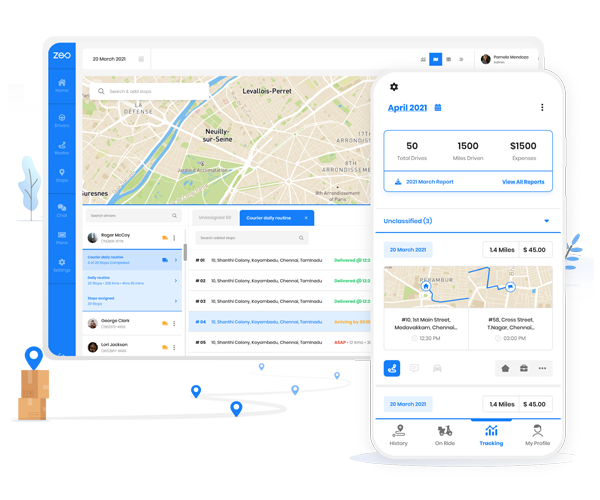
Here’s how this works in practice. Dispatchers build and assign optimized routes from the Zeo web platform, setting time windows for each branch and prioritizing urgent document stops. Couriers carrying the actual documents use the Zeo mobile app in the field — they get turn-by-turn navigation to each stop, capture a signature and photo at the point of handoff, and their geofenced arrival and departure times log automatically.
That data flows straight into your audit trail. No driver has to fill out a paper log at the end of the shift, and no dispatcher has to reconstruct a timeline from memory when a client calls asking about a specific delivery. If a title company questions whether a loan document arrived before a 4 PM deadline, you can pull the exact timestamp and photo instead of guessing.
Building an In-House Delivery Team vs. Outsourcing: A Decision Framework
Operations leaders managing financial document delivery eventually face this question: build an in-house fleet, or outsource to a courier company? Here’s a framework based on volume, control, and risk tolerance.
Build in-house if:
- You handle 15+ daily stops consistently across fixed branch locations.
- Chain-of-custody requirements demand direct employee accountability (not subcontracted drivers).
- You need tight integration with internal systems — scheduling, branch communication, or compliance reporting.
- Your document volume is predictable enough to justify dedicated vehicles and staff.
Outsource if:
- Your volume fluctuates heavily and doesn’t justify full-time drivers year-round.
- You need geographic coverage beyond your current footprint without hiring regionally.
- You’re testing a new delivery service line and want to validate demand before investing in infrastructure.
The hybrid approach many teams land on: Keep a core in-house team for your highest-liability, most frequent routes (daily bank deposits, recurring branch runs) and use outsourced couriers for overflow or one-off deliveries during volume spikes.
Whichever model you choose, the routing and compliance infrastructure matters more than headcount. Zeo Route Planner’s driver management tools let fleet managers assign vehicles, skills, and stores to drivers, which makes the hybrid model easier to run — you can route core in-house staff and overflow drivers through the same system, with the same proof-of-delivery standards applied to both.
Scaling for Peak Season: Handling Tax Deadlines, Loan Closing Surges, and Volume Spikes
Financial document delivery isn’t steady year-round. Tax season, quarter-end closings, and loan surges create predictable spikes that stress-test your operation.

increase fuel savings
Hassle Free Deliveries & Pickups!
Optimize routes with our algorithm, reducing travel time and costs efficiently.
Get Started for Free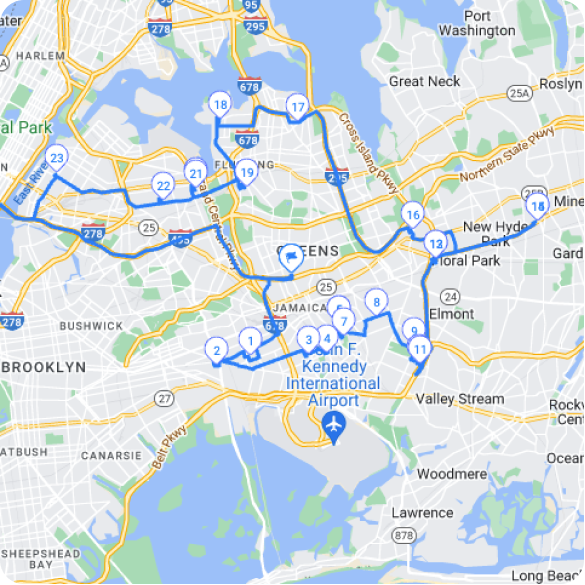
Tax season (January–April). Volume for tax filing deliveries and accountant-to-client document runs climbs sharply, often doubling normal stop counts in some markets.
Loan closing surges. Mortgage rate drops or seasonal real estate activity can create sudden spikes in title and loan document deliveries, often with same-day deadlines.
Quarter and year-end. Bank deposit volume and financial reporting document runs tend to spike as businesses close out books.
Manual routing systems buckle under these surges because dispatchers simply run out of time to plan efficiently as stop counts climb. Route optimization software scales differently.
Bulk address import lets dispatchers upload a spreadsheet of 50 new delivery addresses in minutes instead of entering them one by one during a crunch.
Scheduled and recurring routes handle predictable daily or weekly bank runs automatically, freeing up dispatcher time to handle surge volume manually.
Capacity-based routing accounts for vehicle limits when document and deposit volume per stop increases during peak periods, so routes don’t overload a single driver.
Favorites let you save frequently used stops — the same 12 branches you visit daily — so building a new route during a surge takes minutes, not an hour of re-entering addresses.
The Consumer Financial Protection Bureau has noted that mortgage origination volume can shift by double digits month-to-month based on rate movement, which means loan document delivery teams need routing systems that flex quickly, not rigid schedules built for average-volume days.
A Day in the Life: Running Bank Deposit and Document Runs with Zeo Route Planner
Here’s what a typical day looks like for a dispatch lead and courier team running financial document delivery and banking logistics on Zeo.
6:30 AM — Route planning. The dispatcher opens the Zeo web platform and reviews the day’s stops: 14 bank branches for deposit pickups, three title offices with loan documents due by noon, and two courthouse filings. Using time window constraints, the dispatcher sets hard cutoffs for each stop and marks the loan documents as priority stops.
6:45 AM — Optimization and assignment. Zeo’s AI-powered route optimization builds four driver routes in under five minutes, sequencing stops to hit every bank cutoff and prioritizing the time-sensitive loan deliveries first. The dispatcher assigns routes based on driver skills — one driver is bonded for high-value deposit runs, so that route goes to her.
7:00 AM — Drivers head out. Each courier opens the Zeo mobile app and sees their optimized route with turn-by-turn navigation and stop details. No paper manifest, no memorized branch list.
9:15 AM — Mid-shift adjustment. A branch manager calls in an urgent same-day deposit that wasn’t on the original route. The dispatcher adds the stop and reassigns it to the nearest available driver without disrupting the rest of the route.
11:50 AM — Proof of delivery at a title office. A courier arrives to drop off loan documents ahead of the noon deadline. She captures a photo of the document packet, collects a digital signature from the office manager, and logs a delivery note confirming receipt. The geofenced timestamp logs automatically.
1:30 PM — Dispatcher visibility. Back at the office, the dispatcher uses real-time GPS tracking to confirm all drivers are on pace. Live ETA updates mean no one has to call drivers for status checks.
4:45 PM — End of day. All deposits and documents are delivered on time, with full photo and signature proof logged for every stop. If a branch has a question tomorrow about today’s deposit time, the dispatcher pulls the record in seconds instead of searching through paper logs.
This is the operational shift route optimization makes possible: fewer missed deadlines, a documented chain of custody for every stop, and a dispatch team that scales without adding headcount for every new branch or client.
Frequently Asked Questions
Q: How long should financial document delivery take from pickup to drop-off?
Most financial document couriers aim to complete bank deposit and document runs within a 4–6 hour window, but the real constraint is hitting specific cutoff times rather than total duration. A deposit that arrives one minute after a 3 PM cutoff may not post until the next business day, regardless of how fast the overall route ran.
Q: What proof of delivery is legally required for financial document couriers?
Requirements vary by institution and document type, but most banks and title companies expect a timestamped record of who received the document, when, and where. Many courier operations now use digital signature capture and photo documentation at the point of handoff instead of paper logs to create a defensible record for disputes or audits.
Q: How do couriers handle bank deposit runs during tax season volume spikes?
Teams typically rely on recurring route templates for their daily stops and bulk address import to quickly add new accountant or client pickup locations as volume climbs. Zeo Route Planner’s bulk address import lets dispatchers upload a spreadsheet of new stops in minutes rather than entering them one at a time during a surge.
Q: What’s the difference between courier chain-of-custody and standard delivery tracking?
Standard delivery tracking usually just confirms a package arrived. Chain-of-custody for financial documents requires a documented, timestamped sequence of who handled the item at each stage, often including signature and photo evidence, because the record may need to hold up in an audit or legal dispute.
Q: Can route optimization software help with same-day loan closing deliveries?
Yes — route optimization software with time window constraints and priority stop settings can sequence urgent loan documents ahead of routine paperwork so they reach title offices before hard deadlines. Zeo Route Planner’s priority stops feature (ASAP vs. Normal) is built specifically for this kind of deadline-sensitive sequencing.
—
Financial document delivery leaves no room for guesswork — not in routing, not in timing, and not in proof of what happened at every stop. Manual systems can get you through a slow week, but they break down exactly when you need reliability most: during peak season, during a compliance review, or during a dispute over a missed deadline.
Start a free trial of Zeo Route Planner to build compliant, optimized financial document delivery routes with photo and signature proof of delivery — or book a demo to see how fleet managers run audit-ready bank and document runs at scale.
Are you a fleet owner?
Want to manage your drivers and deliveries easily?
Grow your business effortlessly with Zeo Routes Planner – optimize routes and manage multiple drivers with ease.
increase fuel savings
Hassle Free Deliveries & Pickups!
Optimize routes with our algorithm, reducing travel time and costs efficiently.
Get Started for Free