


# Construction Delivery Management: Why Route Optimization Fixes What Spreadsheets Can’t
> TL;DR: Construction delivery management means getting materials to active job sites on time despite unaddressed locations, tight access windows, and oversized loads — problems standard project management tools were never built to solve. Freight bottlenecks and inefficient routing cost the trucking industry billions in wasted hours annually, and construction fleets with specialized loads are especially exposed. Route optimization software like Zeo Route Planner addresses this with capacity-based routing and real-time GPS tracking, helping dispatchers plan multi-site routes in minutes instead of hours.
Construction delivery management is the process of getting materials, equipment, and supplies to active job sites on time, every time. For building materials suppliers, lumber yards, concrete producers, and equipment rental companies, this means coordinating 5, 15, or 40 drivers across job sites that move, change, or disappear from the map entirely.
If you’re running this operation on spreadsheets or a generic project management tool, you already know the pain. Late deliveries stall framing crews. Wasted fuel eats into margins. And when a contractor calls asking “where’s my load?” you have no good answer.
This guide breaks down what makes construction delivery different, why typical tools fall short, and how route optimization software fixes the real problems.
What Is Construction Delivery Management (And Why It’s Different From Project Delivery Methods)
Construction delivery management is often confused with construction project delivery methods, like design-bid-build or design-build. Those frameworks define who manages a construction project and how contracts are structured. They have nothing to do with getting a truckload of lumber to a job site by 7 a.m.
Construction delivery management is logistics. It’s the daily operational work of:
- Routing drivers to multiple active job sites
- Scheduling deliveries around access windows and crew needs
- Tracking trucks carrying heavy or oversized loads
- Confirming materials arrived at the right site, on time
This is a distinct discipline from project management. A project manager cares about schedules, budgets, and subcontractor coordination across the life of a build. An operations manager at a materials supplier cares about dispatching the right truck, to the right site, with the right load, today.
The tools needed for each job are different too. Project management software like Procore or Buildertrend tracks submittals, RFIs, and schedules. It was never built to optimize driver routes or track a concrete truck’s live location. That gap is where most delivery delays start.
The Real Challenges Behind Late and Inefficient Construction Deliveries
Construction deliveries face obstacles that standard last-mile delivery doesn’t. Here’s what actually causes the delays.
Job Sites Don’t Have Formal Addresses
New construction sites often lack a mailable address. Drivers get directions like “turn at the second dirt road past the water tower.” Standard GPS tools can’t route to that. Dispatchers end up texting drivers coordinates or hand-drawn maps, which slows down planning and increases wrong turns. The same problem shows up in adjacent fields like construction site portable toilet logistics, where service providers face identical unaddressed-location challenges.
Access Windows Are Tight and Unforgiving
Many sites only allow deliveries during specific hours, often tied to crew shifts or city noise ordinances. A concrete pour scheduled for 6 a.m. has zero tolerance for a late truck. Miss the window, and the whole crew sits idle, burning labor costs while they wait.
Loads Are Heavy, Oversized, and Route-Sensitive
A flatbed carrying steel beams or an aggregate truck loaded with gravel can’t take the same route as a delivery van. Low bridges, weight-restricted roads, and narrow residential streets near a site can turn a 20-minute drive into an hour-long detour if the route wasn’t planned around the load.
Multi-Site Routing Gets Complicated Fast
Most suppliers aren’t delivering to one site. They’re juggling five, ten, or more active jobs in a single day, each with different drop times and access rules. Planning this manually in a spreadsheet means a dispatcher spends hours each morning just figuring out driver order, let alone optimizing for distance or fuel.
Zero Visibility Once the Truck Leaves the Yard
Without real-time tracking, dispatchers find out about a delay only when a contractor calls to complain. That reactive cycle damages relationships and makes it impossible to proactively re-route around traffic or a site access problem.
According to the U.S. Department of Transportation’s Federal Highway Administration, freight bottlenecks and inefficient routing cost the trucking industry billions in wasted hours annually. Construction delivery fleets, with their tight windows and specialized loads, are especially exposed to that cost.
How Route Optimization Software Solves Construction Logistics
Project management tools weren’t built for any of this. Route optimization software was.
Multi-stop route planning that accounts for real constraints. Zeo Route Planner’s AI-powered route optimization builds efficient multi-stop routes in minutes, factoring in time windows, priority stops, and vehicle capacity. Instead of a dispatcher manually sequencing 15 job site stops by guesswork, the software calculates the most efficient order automatically, saving drivers and dispatchers 2+ hours daily.
Capacity-based routing for heavy loads. If a truck is already loaded with 80% of its weight capacity in rebar, it shouldn’t be assigned three more heavy stops. Zeo’s capacity-based routing factors vehicle weight and volume limits into route assignments, so dispatchers don’t overload trucks or waste a trip’s remaining capacity.
Real-time tracking that replaces the “where’s my truck” phone call. Zeo’s live GPS tracking and live ETA updates let dispatchers see exactly where every truck is, and let contractors see it too, through a branded tracking page. No more guessing games when a site supervisor wants a status update.
Proof of delivery for material disputes. Construction deliveries often get disputed. Did the load actually arrive? Was it the right quantity? Zeo’s proof of delivery feature lets drivers capture a photo, collect a digital signature, and add delivery notes at the site. That documentation resolves disputes fast instead of turning into a week-long back-and-forth.
Priority stops for urgent job site needs. When a crew is waiting on an emergency material drop to keep a pour on schedule, Zeo lets dispatchers flag that stop as ASAP priority, moving it ahead of standard-priority deliveries in the route.
Favorites for recurring job sites. Active job sites often need repeat deliveries over weeks or months. Zeo’s Favorites feature lets dispatchers save frequently used stops, including sites without formal addresses, so planning the next load there doesn’t start from scratch.
None of this exists in Procore, Buildertrend, or a shared spreadsheet. Those tools manage the project. Route optimization software manages the delivery.
Building a Delivery Workflow: Route Planning for Dispatchers + the Driver App for Your Team
A real construction delivery workflow has two sides: the dispatcher planning routes, and the driver executing them. Zeo is built for both.
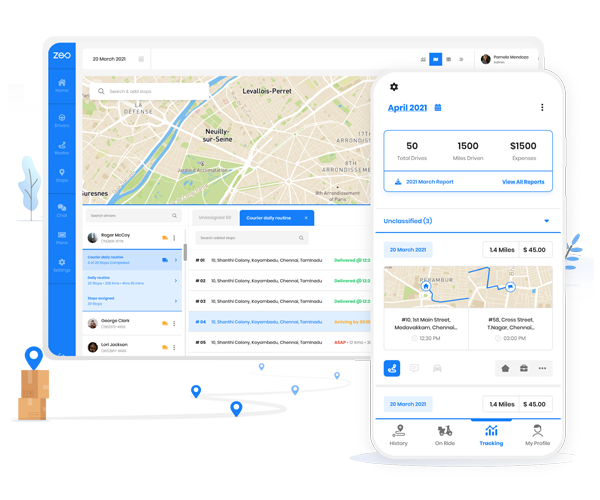
On the web platform, dispatchers plan the day. A logistics coordinator at a lumber yard can import that morning’s orders, whether from a bulk spreadsheet, a Shopify order, or a manual entry, and let Zeo’s AI build optimized routes across all active drivers in minutes. Capacity limits, time windows, and priority stops all factor into the plan automatically. Scheduled and recurring routes also mean a supplier delivering to the same five job sites every week doesn’t need to rebuild that plan from scratch each morning.
On the mobile app, drivers get what they actually need on-site. Once a route is assigned, drivers receive their stop sequence directly in the Zeo mobile app, complete with turn-by-turn navigation and site-specific notes, like gate codes, access windows, or material drop instructions for a specific loading area. This matters most on construction sites, where “the office” and “the actual drop point” can be two different locations on a sprawling site.
At each stop, drivers capture photo and signature proof of delivery before leaving. That’s critical when a site supervisor later disputes whether a load of rebar arrived complete, or a subcontractor claims a material never showed up. A timestamped photo and signature settles that conversation in seconds instead of escalating into a finger-pointing match between the supplier and the job site.
Dispatchers can also message drivers directly through in-app chat if a site’s access window changes mid-shift, and dynamic route adjustments let the whole day’s plan shift without starting over.
Example scenario: A concrete and aggregate supplier runs 18 trucks across 25 active job sites on a Monday morning. Instead of a dispatcher manually sequencing stops in a spreadsheet, routes are built and assigned in Zeo before 6 a.m. Drivers get their stops on the app, navigate directly to GPS-pinned locations (even unaddressed ones saved from a previous delivery), and confirm each drop with a photo. By 9 a.m., the dispatcher has live visibility into which trucks are ahead of schedule and which need rerouting around a closed access road, without a single phone call.
Project Management Software vs. Dedicated Route Optimization: Which Do You Actually Need?
This is the comparison most construction content skips, because most construction content is written for project managers, not delivery operations.
| Need | Project Management Software | Route Optimization Software |
|—|—|—|

increase fuel savings
Save $200 on fuel, Monthly!
Optimize routes with our algorithm, reducing travel time and costs efficiently.
Get Started for Free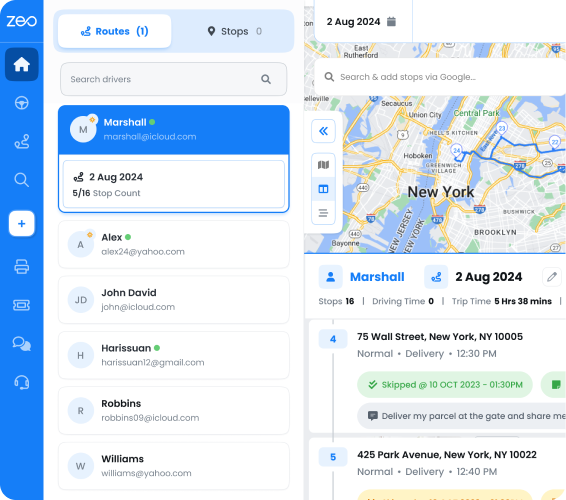
| Track project schedules, budgets, submittals | Yes | No |
| Coordinate subcontractors and RFIs | Yes | No |
| Plan multi-stop driver routes | No | Yes |
| Optimize routes for time, fuel, and capacity | No | Yes |
| Real-time truck GPS tracking | Limited or none | Yes |
| Proof of delivery (photo/signature) | No | Yes |
| Customer/contractor delivery notifications | No | Yes |
| Driver navigation app | No | Yes |
If your core problem is managing the construction project itself, project management software is the right tool. But if your core problem is getting trucks to the right site, on time, with proof it happened, that’s a logistics problem. Project management tools don’t solve it because they weren’t built to.
Many materials suppliers end up running both: project management software for the build side of the business, and a dedicated route optimization tool like Zeo for the delivery side. They solve different problems, and trying to force one tool to do both usually means neither works well.
The ROI of Optimized Construction Delivery Routes
Route optimization isn’t a nice-to-have. For a mid-size materials supplier, it’s a direct line to lower costs and fewer angry phone calls.
Time savings. Zeo’s AI-powered route optimization saves 2+ hours daily, time a dispatcher previously spent manually sequencing stops and texting drivers directions to unaddressed sites. Multiply that across a 40-driver fleet, and the labor savings alone justify the switch.
Fuel savings. Inefficient routing means trucks backtrack, idle at job sites waiting for access windows, or take longer routes because no one accounted for weight restrictions. The U.S. Energy Information Administration reports that diesel prices remain a top variable operating cost for fleets, meaning even a 10-15% improvement in route efficiency has a measurable impact on fuel spend across a fleet of concrete mixers or flatbeds.
Fewer site delays. A late delivery doesn’t just cost the supplier, it costs the contractor an idle crew. The Associated General Contractors of America has reported labor costs as one of contractors’ top-cited pressures, and idle crew time waiting on materials compounds that pressure directly. Reliable, trackable deliveries protect the relationship between supplier and contractor, which is often the difference between repeat business and a lost account.
Fewer disputes, faster resolution. Photo and signature proof of delivery means a disputed load gets resolved with evidence, not a phone argument. That protects billing accuracy and reduces the admin time spent chasing down “did this actually arrive” questions.
Better visibility, less reactive management. When dispatchers can see live truck locations and ETAs, they can proactively notify a site about a delay instead of waiting for the contractor to call first. That shift from reactive to proactive communication changes how contractors perceive a supplier’s reliability.
For an operations manager running 10-40 drivers, these savings compound daily. A tool that saves 2+ hours per driver, reduces fuel waste, and cuts delivery disputes pays for itself fast, and keeps job sites moving instead of stalling.
Frequently Asked Questions
Q: How do you schedule construction material deliveries around unpredictable job site access?
Most suppliers build in buffer windows and confirm access hours directly with the site superintendent before dispatch, since gate hours and crew shifts can change daily. Route optimization software with time window constraints lets dispatchers encode those access hours into the route plan itself, so a driver isn’t sent to a site during a restricted window in the first place.
Q: What’s the difference between a dispatcher and a construction project manager when it comes to deliveries?
A dispatcher owns same-day logistics: which truck, which driver, which route, and confirming the load arrived. A project manager owns the broader build schedule, budget, and subcontractor coordination over weeks or months. The two roles overlap only at the moment a delivery either keeps a crew working or stalls them.
Q: Why do construction deliveries get delayed more often than standard retail deliveries?
Construction sites often lack formal addresses, have narrow or restricted access windows tied to crew shifts, and involve oversized loads that can’t take standard routes due to weight or height restrictions. Standard delivery planning tools and consumer GPS apps aren’t built to account for these constraints, which is where most delays originate.
Q: Can route optimization software track whether a delivery actually reached the correct job site?
Yes. Zeo’s proof of delivery feature lets drivers capture a timestamped photo, collect a digital signature, and add delivery notes at the exact GPS location of the drop, creating a verifiable record that resolves “did it arrive” disputes without a phone call. This is especially useful on multi-site jobs where materials for one site are sometimes mistakenly dropped at another.
Q: How many job sites can one driver realistically cover in a day for a materials supplier?
It depends on site spacing, load size, and access window overlap, but manual spreadsheet planning typically limits a driver to far fewer stops than an optimized route could support. Zeo’s AI-powered route optimization factors in time windows, vehicle capacity, and priority stops to sequence more deliveries per driver without missing access windows, helping dispatchers plan routes in minutes instead of hours.
—
Late deliveries, wasted fuel, and zero visibility into your fleet aren’t problems a spreadsheet or project management tool can fix. They’re logistics problems, and they need a logistics solution.
Start a free Zeo Route Planner trial to map your first multi-site delivery route in minutes, or book a demo to see how fleet teams cut delivery delays on active construction sites.
Are you a fleet owner?
Want to manage your drivers and deliveries easily?
Grow your business effortlessly with Zeo Routes Planner – optimize routes and manage multiple drivers with ease.

increase fuel savings
Save 2 Hours on Deliveries, Everyday!
Optimize routes with our algorithm, reducing travel time and costs efficiently.
Get Started for Free