


# Construction Delivery Management: A Logistics Guide for Job Site Deliveries
> TL;DR: Construction delivery management, in the operational sense, means getting materials and equipment to the right job site, through the right access point, in the right time window — not managing contracts. Job sites with restricted access and shifting unloading windows cause the majority of delivery delays and disputes for suppliers and contractors running multiple sites. Route optimization tools like Zeo Route Planner address this with time-window-based routing and photo/signature proof of delivery, helping construction logistics teams save 2+ hours daily in driver time.
Search “construction delivery management” and you’ll get two completely different answers. One is about contracts. The other is about trucks, job sites, and missed delivery windows.
This guide is about the second one.
If you’re an operations manager juggling deliveries to 3, 10, or 20+ active job sites, you don’t need another article about design-bid-build versus design-build contracts. You need to know why your driver sat outside a site for 40 minutes waiting for a gate code, and how to stop it from happening again tomorrow. That’s what construction delivery management, in the logistics sense, is actually about.
Let’s fix that.
What Is Construction Delivery Management? Clarifying Two Very Different Meanings
“Construction delivery management” means two unrelated things, and mixing them up wastes your time.
Meaning #1: Project delivery methods. This is a contracts and procurement term. It refers to how a construction project is structured — design-bid-build, design-build, construction manager at risk, and similar frameworks. This is what most Google results show you. It has nothing to do with trucks or schedules.
Meaning #2: Delivery logistics management. This is the operational side — getting materials, equipment, and supplies to the right job site, at the right time, through the right gate. This includes routing trucks, scheduling unloading windows, tracking what got delivered where, and coordinating with site supervisors who change plans without warning.
If you’re a logistics coordinator, dispatcher, or ops manager at a building materials supplier, equipment rental company, or general contractor, meaning #2 is your daily headache. This guide stays there.
The confusion matters because most content written for this keyword talks about contract structures. It skips the actual problem: how do you get a truck full of rebar to the right site, at the right time, without your driver calling you three times asking where to park?
Why Material and Equipment Deliveries Break Down on Construction Job Sites
Construction deliveries fail differently than typical last-mile deliveries. Job sites aren’t static addresses — they’re active, changing, and often hard to reach.
Narrow or restricted site access. Many job sites have one gate, a single access road, or height/weight restrictions that block standard trucks. Drivers who don’t know this in advance show up at the wrong entrance and lose 20-30 minutes rerouting.
Tight, ever-changing unloading windows. A site might only allow deliveries between 7-9 a.m. before pours start, or after 3 p.m. once a crane is free. When those windows shift — and they shift constantly — nobody downstream gets the update in time.
Multi-site coordination with limited trucks. Most suppliers and contractors don’t have unlimited vehicles. Dispatchers are manually trying to sequence stops across a dozen sites, often with a whiteboard, a spreadsheet, and a lot of phone calls. Real-time visibility into where each truck actually is — through driver tracking software — closes a lot of that gap.
No proof of what arrived, or when. When a site supervisor disputes a delivery — wrong quantity, late arrival, damaged materials — most companies have no timestamped record. That turns into billing disputes and strained subcontractor relationships. A digital proof of delivery record settles most of these disputes before they escalate.
Idle crews and equipment. According to the Associated General Contractors of America surveys on labor and material shortages, materials and labor shortages have been cited as ongoing disruptors of project schedules in recent industry surveys. When a delivery is late, a crew of 6-10 workers can sit idle, and that cost compounds fast.
Manual routing doesn’t scale. Spreadsheets and driver instinct might work with 3 job sites. At 15 or 20, dispatchers are re-planning routes from scratch every time a site calls to push back a delivery.
None of these problems are about contracts. They’re about logistics — and logistics problems need logistics solutions.
How Route Optimization Reduces Delays, Fuel Costs, and Site Congestion
Route optimization software wasn’t built for construction specifically, but the problems it solves map directly onto construction delivery headaches.
Sequencing stops around real constraints. Instead of routing by gut feel, optimization software builds routes around time windows, site priority, and vehicle capacity. If Site A needs materials before 8 a.m. and Site B can’t be accessed until noon, the software sequences the route accordingly — automatically.
Cutting wasted mileage. Every unnecessary mile costs fuel and driver hours. Zeo Route Planner’s AI-powered route optimization saves drivers 2+ hours daily by eliminating backtracking and inefficient stop order — time that adds up fast across a fleet running multiple sites daily.
Matching the right vehicle and driver to the right site. Not every truck fits every access road, and not every driver is cleared for every site. Skill-based assignment and capacity-based routing let you match flatbeds, box trucks, or specialty equipment haulers to the sites they can actually reach.
Reducing on-site congestion. When multiple suppliers or subcontractors show up at the same site within the same hour, trucks queue up, block access, and slow everyone down. Scheduling deliveries with defined time windows spreads arrivals out, which keeps site entrances clear.
Creating a paper trail automatically. Proof of delivery — photo capture, digital signatures, and delivery notes — gives you a timestamped record for every drop-off. That record is what settles billing disputes before they escalate into a real conflict with a subcontractor or client.
The Federal Highway Administration’s research on freight and fleet efficiency has noted that inefficient routing and idle time are among the largest controllable cost factors in commercial fleet operations. For a construction supplier running 5-10 trucks a day, even a 15% reduction in idle and drive time is meaningful money.
Step-by-Step: Building a Delivery Scheduling and Routing System for Multiple Job Sites
Here’s how to move from manual routing to a real system, without overhauling everything at once.
Step 1: Map your active job sites and their constraints.
List every site you deliver to regularly. Note access restrictions, delivery windows, gate codes, and site contacts. This becomes your baseline data.
Step 2: Import your stops in bulk.
Rather than entering addresses one at a time, use bulk address import from Excel, CSV, or Google Sheets to load all your job sites at once. If you’re managing recurring deliveries to the same sites, save them as favorites so dispatchers don’t re-enter them every week.
Step 3: Set time windows and priorities for each site.
Mark which deliveries are ASAP (crew is waiting on-site) versus normal priority. Add time windows for sites with restricted access hours, like early-morning pours or after-hours drop-offs.
Step 4: Assign based on vehicle capacity and driver skill.
If certain drivers are certified for equipment hauling, or certain trucks can’t fit down narrow site roads, use capacity-based routing and skill-based assignment to avoid mismatched dispatches.
Step 5: Let the software optimize the route.
Once your stops, windows, and constraints are in, AI-powered route optimization sequences the day’s deliveries to minimize drive time and avoid conflicts between overlapping windows.
Step 6: Push routes to drivers and monitor in real time.
Drivers receive their optimized route, stop-by-stop, directly on their phones. Dispatchers track progress with real-time GPS and get live ETA updates if a site visit runs long.
Step 7: Capture proof of delivery at every stop.
Photo capture, signatures, and delivery notes get logged the moment material is dropped off — no more “I don’t remember what time that truck showed up” conversations.
Step 8: Review analytics weekly.

increase fuel savings
Save $200 on fuel, Monthly!
Optimize routes with our algorithm, reducing travel time and costs efficiently.
Get Started for Free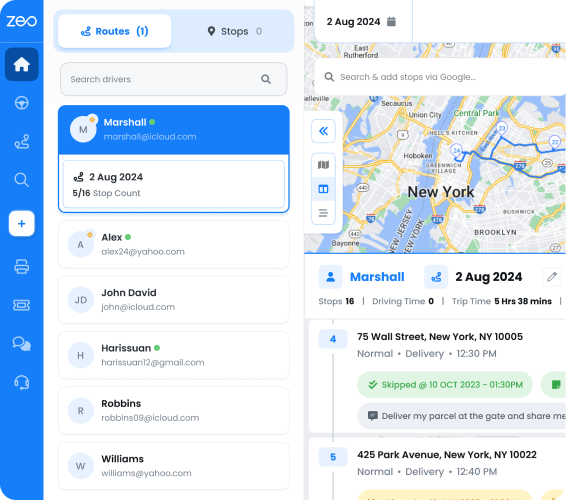
Use route analytics and reporting to spot patterns — which sites consistently run late, which drivers are most efficient, and where recurring routes need adjusting.
Set up recurring routes for sites you visit daily or weekly, so you’re not rebuilding the same schedule from scratch every morning.
From Dispatch to Drop-Off: How Managers and Drivers Coordinate in Real Time
The gap between planning a route and executing it is where most construction deliveries fall apart. Here’s how it works when dispatch management and drivers are actually connected.
Operations managers build and assign delivery routes from the Zeo web platform, factoring in site access windows, load capacity, and which drivers are qualified for which sites. This is where the day’s plan comes together — sequencing 15 stops across 6 job sites so nobody’s idle and no truck shows up outside its allowed window.
From there, drivers and material haulers receive their stops, gate codes, and site notes directly on the Zeo mobile app. They navigate using whatever maps app they already trust — Google Maps, Waze, or Apple Maps — so there’s no learning curve on turn-by-turn directions.
At the drop-off, drivers capture photo proof of delivery and collect signatures right from their phone. That record — timestamped, photographed, signed — becomes your evidence if a site super later claims materials never arrived, or arrived short.
If a site is inaccessible, a gate code doesn’t work, or a delivery window shifts because a pour got delayed, drivers message dispatch in real time through in-app chat. No more pulling over to make a phone call, or a dispatcher wondering why a truck went dark for 20 minutes. That real-time loop is what turns a rigid morning plan into a system that adapts as job sites change throughout the day.
Choosing the Right Software: Delivery Routing Tools vs. Construction PM Platforms
A common mistake: buying a construction project management (PM) platform expecting it to solve delivery logistics. It won’t, and it isn’t supposed to.
Construction PM platforms (like Procore, Buildertrend, or similar tools) manage the project — budgets, schedules, RFIs, punch lists, and subcontractor coordination. They’re built around the job, not the truck.
Delivery routing software manages the logistics — which vehicle goes where, in what order, carrying what, and with proof it arrived. This is a fundamentally different job. Field crews with similarly complex site logistics, like those managing construction site portable toilet logistics, run into the exact same routing gap.
Some companies try to force PM software to handle delivery scheduling. It usually results in a calendar entry that says “deliver materials to Site 4” with no routing logic, no live tracking, and no proof of delivery. That’s not a system — it’s a reminder.
If you’re evaluating tools, ask these questions:
- Does it optimize multi-stop routes based on time windows and priority, or just list appointments?
- Can drivers get routes on a mobile app with live navigation, or do they need printed directions?
- Does it capture proof of delivery (photo, signature) automatically at each stop?
- Can dispatchers see real-time GPS location and get live ETA updates?
- Does it integrate with your existing systems — Shopify, WooCommerce, or CRM tools like HubSpot — through Zapier or API, so order data flows in without manual entry?
Zeo Route Planner is built specifically to answer yes to all five. It’s not a replacement for your construction PM platform — it’s the piece that PM software doesn’t cover: getting materials from your yard to the job site, on time, with proof.
Real-World Example: What Route Optimization Saves on a Multi-Site Project
Consider a mid-sized building materials supplier running deliveries to 12 active job sites across a metro area, using 4 trucks and 4 drivers.
Before route optimization:
A dispatcher manually plans routes each morning using a spreadsheet and knowledge of which sites are “usually” accessible when. Drivers call in when they hit a locked gate or a site that pushed its delivery window. Two trucks often cross paths driving to opposite sides of the city because routes weren’t planned together. When a subcontractor disputes a delivery, there’s no photo or timestamp — just a driver’s memory.
Estimated daily cost of this setup: 45-60 minutes of wasted drive time per truck from inefficient sequencing, plus 1-2 hours of dispatcher time spent re-routing after site changes, plus occasional billing disputes that take days to resolve without proof of delivery. Labor productivity losses like these align with broader trends the Bureau of Labor Statistics tracks for the construction industry, where scheduling inefficiencies remain a persistent drag on output.
After route optimization:
The dispatcher imports all 12 sites in bulk, sets time windows for the 5 sites with restricted access hours, and assigns drivers based on which trucks fit which site’s access road. The system builds optimized routes in minutes instead of the 30-45 minutes it used to take manually.
Drivers get routes and site notes on their phones through the Zeo app, and dispatchers watch progress via live GPS tracking. When a site pushes back a delivery by two hours, the driver flags it through in-app chat, and the dispatcher can see downstream impact on the rest of the route immediately instead of finding out at day’s end.
Every delivery gets a photo and signature at drop-off, stored and searchable if a billing question comes up later.
The measurable difference:
With AI-powered route optimization saving 2+ hours daily in aggregate driver time across the fleet, that’s roughly 10 hours a week freed up — enough for an extra 2-3 delivery runs without adding a truck or driver. Add in fewer billing disputes from having proof of delivery on every stop, and the ROI shows up within the first month.
This is the kind of return that spreadsheets and phone calls simply can’t produce, because they were never built to optimize anything — they just record what dispatchers already decided.
Frequently Asked Questions
Q: How do you schedule material deliveries across multiple construction job sites?
Start by mapping each site’s access restrictions, gate codes, and allowed delivery windows, then group stops by priority and geographic proximity. Software that supports time windows and bulk address import lets dispatchers build a full day’s schedule in minutes instead of manually sequencing stops on a whiteboard. Zeo Route Planner’s AI-powered route optimization sequences deliveries around these constraints automatically, which is especially useful once you’re coordinating more than 8-10 active sites.
Q: What causes late or missed construction material deliveries?
The most common causes are restricted site access (single gates, height/weight limits), unloading windows that shift without notice, and manual routing that doesn’t account for real-time changes on the job site. Poor communication between dispatch and drivers compounds the problem, since a driver stuck at a locked gate often has no fast way to alert dispatch or get rerouted.
Q: How can construction suppliers prove a delivery was made on time and complete?
A timestamped record with a photo and signature at the moment of drop-off is the strongest evidence for resolving disputes over quantity, damage, or arrival time. Zeo’s proof of delivery feature captures photo, signature, and delivery notes at each stop, giving dispatchers a searchable record if a subcontractor disputes what arrived or when.
Q: Is construction delivery logistics different from project delivery methods?
Yes — “project delivery methods” refers to contract structures like design-build or design-bid-build, while construction delivery logistics is about physically getting materials and equipment to job sites on time. They’re unrelated topics that happen to share a name, and most search results default to the contracts meaning.
Q: Can route optimization software replace a construction project management platform?
No, and it isn’t meant to. PM platforms like Procore or Buildertrend manage budgets, schedules, and subcontractor coordination, while route optimization software handles the logistics layer — vehicle routing, driver assignment, and proof of delivery. Most construction suppliers need both working together, not one replacing the other.
The Bottom Line
Construction delivery management, in the logistics sense, isn’t about contracts or project structures. It’s about solving a specific, recurring problem: getting the right materials to the right site, through the right access point, in the right window — with proof it happened.
Manual routing worked when you had 3 job sites and one truck. At 10, 15, or 20+ sites, it breaks down into wasted mileage, idle crews, and disputes you can’t win because you have no record.
Route optimization software fixes the operational side of construction delivery — the side spreadsheets were never designed to handle.
Start a free Zeo Route Planner trial to build your first optimized multi-site delivery route in under 10 minutes, or book a demo to see how fleet dispatch, driver tracking, and proof of delivery work together for construction logistics.
Are you a fleet owner?
Want to manage your drivers and deliveries easily?
Grow your business effortlessly with Zeo Routes Planner – optimize routes and manage multiple drivers with ease.
increase fuel savings
Save $200 on fuel, Monthly!
Optimize routes with our algorithm, reducing travel time and costs efficiently.
Get Started for Free