



# Financial Document Delivery: A Dispatcher’s Playbook for Cutoffs & Chain-of-Custody
> TL;DR: Financial document delivery requires enforced time windows and a verifiable chain-of-custody, not just fast drivers — one missed bank cutoff can delay fund availability by a full business day. Route optimization software like Zeo Route Planner addresses this with hard time window constraints, priority stop tagging, and photo/signature proof of delivery, helping courier fleets protect SLAs without hiring a second dispatch shift.
Financial document delivery isn’t like dropping off packages. One late signature set at a title company can delay a home closing by a day. One missed cutoff at a bank branch can push a settlement to the next business day.
If you manage dispatch for a bank courier fleet, financial courier company, or title/escrow service, you already know the stakes. Manual routing and generic courier apps weren’t built for hard deadlines or audit trails. This guide shows you how to fix that — a challenge shared across regulated courier work, including legal document delivery optimization.
We’ll cover what makes financial document delivery different, how route optimization software enforces cutoffs and chain-of-custody, and how to scale during tax season and loan-closing surges without blowing an SLA.
What Counts as Financial Document Delivery (And Why It’s Riskier Than Standard Courier Work)
Financial document delivery covers any time-sensitive, legally significant paperwork moving between banks, title companies, law firms, and escrow offices. This includes:
- Checks and interbank cash letters
- Loan closing packages and signed notes
- Title documents and deeds
- Settlement statements
- Notarized legal documents
- Tax filings during peak season
Each of these carries a hard deadline. Banks run on settlement windows set by the Federal Reserve’s ACH and settlement processing schedules. Title and escrow firms work against closing times negotiated by buyers, sellers, and lenders. Miss either, and the fallout isn’t just a late delivery fee.
A missed bank cutoff can delay fund availability by a full business day, triggering client complaints and potential breach-of-contract exposure for the courier. A missed loan closing deadline can cost a buyer their rate lock or delay a property transfer entirely.
Standard courier work tolerates some flexibility. A late grocery delivery is an inconvenience. A late title package can unravel a six-figure transaction.
That’s why financial document delivery also demands proof. You need to show exactly who handled a document, when, and where, from pickup to final signature. Regulators, lenders, and insurers may all ask for this trail after the fact. Generic courier software rarely captures it in a way that holds up to scrutiny.
According to the American Land Title Association’s claims research, title and settlement errors tied to document handling are among the top sources of post-closing claims. That risk sits squarely on the courier’s process, not just the lender’s paperwork.
How Route Optimization Software Enforces Bank Cutoff Times and Chain-of-Custody
Manual dispatching relies on a dispatcher’s memory, a whiteboard, or a shared spreadsheet. That works until volume spikes or a driver calls in sick. Route optimization software replaces guesswork with enforced rules — a shift that’s also reshaping how dispatchers handle medical courier routes, where timing is equally critical.
Time windows stop cutoffs from slipping. Zeo lets you set hard time window constraints on every stop. A bank that closes its settlement window at 2 PM gets a stop marked with that exact deadline, not a general “afternoon” placeholder. The route planner builds the day around that constraint instead of treating it as optional.
Priority tagging protects your most urgent stops. Not every document is equally time-sensitive. Zeo’s priority stops feature lets you flag loan closing packages or same-day interbank items as ASAP, so they get sequenced ahead of routine pickups even when a driver’s day gets reshuffled.
Dynamic adjustments handle real-world chaos. Traffic, a flat tire, or a last-minute rush pickup can throw off a route in minutes. Zeo’s dynamic route adjustments mid-shift let dispatchers re-sequence stops on the fly, keeping cutoff-bound deliveries protected even when the day doesn’t go as planned.
Proof of delivery builds your audit trail. This is where financial document delivery differs most from standard courier work. Zeo captures a photo, a digital signature, and delivery notes at every stop. For a courier carrying a signed loan package into a title office, that means a GPS-stamped signature confirms exactly who received the document and when.
This isn’t a vague “compliance automation” claim. It’s a factual record: timestamp, location, signature, and photo evidence tied to a specific stop. If a bank or lender disputes when a document arrived, you have a verifiable record instead of a driver’s memory.
Live tracking adds a second layer of accountability. Real-time GPS tracking shows dispatchers exactly where every courier is, and live ETA updates let you warn a title office if a courier is running behind, instead of letting them find out at the deadline.
Together, these features turn financial document delivery from a process you hope goes right into one you can verify after the fact.
In-House Courier vs. Outsourced Courier vs. Software-Powered Dispatch: Cost & Risk Comparison
Operations leaders typically choose between three models. Each has a different cost and risk profile.
In-house courier fleet, managed manually. You hire and train drivers, assign routes by hand or spreadsheet, and absorb all liability for missed cutoffs. Costs include driver wages, vehicle expenses, and dispatcher time spent manually sequencing stops every morning. Risk is high: there’s no systematic enforcement of time windows, and proof of delivery often depends on paper logs that are easy to lose or falsify.
Fully outsourced courier service. You hand off deliveries to a third-party courier company. This reduces your payroll overhead, but you lose visibility into real-time status and have limited control over how proof of delivery is captured. During tax season or loan-closing surges, outsourced couriers may prioritize other clients’ volume over yours, and you have no dispatch lever to pull when a deadline is at risk.
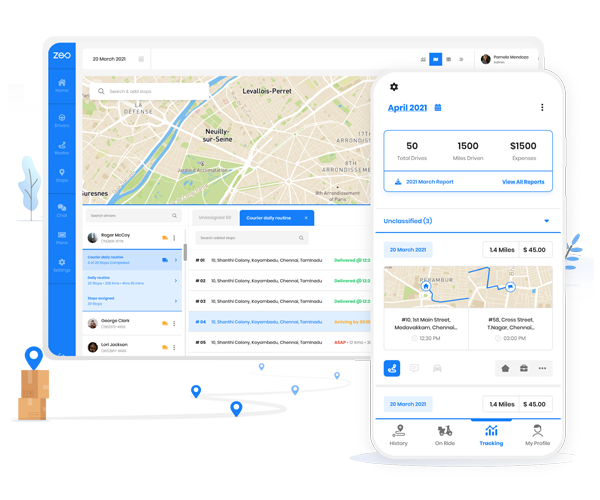
Software-powered in-house dispatch. You keep your own drivers and own the client relationship, but run dispatch through route optimization software like Zeo. Dispatchers assign and monitor routes from a web dashboard, while drivers receive stops on the Zeo mobile app with built-in time window enforcement and proof-of-delivery capture.
Here’s how the three stack up on the factors that matter most for financial document delivery:
| Factor | In-House Manual | Outsourced | Software-Powered In-House |
|—|—|—|—|
| Cutoff enforcement | Dispatcher memory only | Limited, third-party priorities | Built into route logic |
| Proof of delivery | Paper or none | Varies by vendor | Photo, signature, GPS timestamp |
| Peak-season scaling | Breaks down fast | Capacity-dependent, costly | Auto-assignment absorbs spikes |
| Audit trail | Weak or missing | Vendor-controlled | Dispatcher-owned, exportable |
| Cost control | High labor overhead | Per-delivery fees add up | Fixed software cost, existing fleet |
The software-powered model wins on the two things financial courier work actually requires: provable chain-of-custody and the ability to scale without hiring a second shift. Zeo’s AI-powered route optimization saves drivers 2+ hours daily, time that matters when you’re squeezing in extra stops during a loan-closing rush.
Scaling for Peak Season: Tax Deadlines, Loan Closings, and EOM Volume Without Missing a Cutoff
Financial document delivery isn’t steady year-round. Tax season, month-end settlement cycles, and loan-closing waves can double or triple daily stop counts in a matter of weeks.
The IRS reports that over 140 million individual returns are filed each year, with volume concentrated heavily in the weeks before the April deadline. Courier fleets supporting accounting firms and tax preparers feel that spike directly, with far more time-sensitive document runs than a normal week.
Manual dispatching breaks under this kind of surge. A dispatcher who can sequence 30 stops by hand struggles to do the same for 90, especially when half of them carry hard cutoffs.

increase fuel savings
Save 2 Hours on Deliveries, Everyday!
Optimize routes with our algorithm, reducing travel time and costs efficiently.
Get Started for Free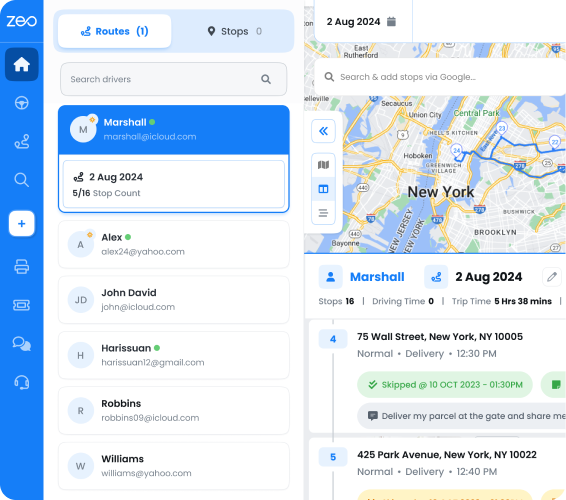
Here’s how to handle peak volume without missing an SLA:
Use capacity-based routing to avoid overloading drivers. Zeo’s capacity-based routing accounts for how many stops and how much volume each driver and vehicle can realistically handle, so dispatchers don’t overcommit a route during a surge week.
Lean on auto-assignment instead of manual sequencing. When stop counts spike, auto-assignment of stops to drivers distributes the extra volume across your fleet automatically, instead of forcing a dispatcher to manually rebalance routes stop by stop.
Set up scheduled recurring routes for predictable peak patterns. If you know every tax season brings a surge of courier runs to the same accounting firms, Zeo’s scheduled and recurring routes let you set that pattern up once and adjust volume as needed, rather than rebuilding routes from scratch each day.
Use blackout dates for planned slowdowns. If a bank branch or title office is closed for a holiday during a loan-closing wave, blackout dates let you pause a scheduled route for that day without deleting the whole route plan.
Assign different drivers to different days with Day Plan. During a surge, you may need to bring in backup drivers for specific high-volume days. Day Plan lets you assign different agents to specific days within the same scheduled route, so you’re not rebuilding the entire plan to add temporary coverage.
Use skill-based assignment for specialized stops. Not every driver is equipped to carry notarized legal documents or handle a high-value interbank item. Skill-based driver assignment lets you match sensitive stops to drivers trained or bonded for that kind of work.
None of these features guarantee a perfect peak season. But they replace manual, error-prone scaling with a system that absorbs volume spikes instead of buckling under them, similar to how dynamic route adjustments help other regulated fleets handle mid-shift disruptions.
Step-by-Step: Setting Up a Compliant Daily Financial Document Route in Zeo
Here’s what a typical morning looks like for a dispatcher running financial document delivery routes through Zeo.
Step 1: Import the day’s stops. Pull in pickup and delivery addresses from a spreadsheet, CSV, or Google Sheet using bulk address import. For a bank courier route, this might include ten branch pickups and five title office drop-offs.
Step 2: Set hard time windows on cutoff-sensitive stops. For every stop tied to a settlement deadline or closing time, enter the exact cutoff as a time window constraint. A branch with a 2 PM Fed cutoff gets that deadline locked into the route.
Step 3: Flag ASAP priority stops. Loan packages needed for a same-day closing get tagged as priority stops, ensuring the route optimization sequences them ahead of routine pickups.
Step 4: Link pickups to their deliveries. For document runs that involve picking up a signed package at one office and delivering it to another, pickup-delivery linking automatically pairs the two stops and sequences them in the correct order.
Step 5: Let Zeo optimize the route. The AI-powered route optimization builds the most efficient sequence across all drivers, factoring in time windows, priorities, and vehicle capacity.
Step 6: Assign routes to drivers from the web dashboard. As the dispatcher, you review and confirm the plan, then push it out to your courier fleet directly from the Zeo web platform.
Step 7: Drivers receive the route on the Zeo mobile app. Each courier sees their stop list, turn-by-turn navigation, and any special notes, like “collect signature from branch manager only.”
Step 8: Couriers capture proof at every stop. At each bank or title office, the driver captures a GPS-stamped photo and digital signature through the app. This becomes the audit-trail record for that specific document handoff.
Step 9: Dispatchers get real-time cutoff risk alerts. If a courier is running behind and at risk of missing a bank’s 2 PM cutoff, live ETA updates flag the risk so the dispatcher can reroute another nearby driver or notify the branch in advance.
Step 10: Review proof-of-delivery records at day’s end. Every signature, photo, and timestamp is stored and searchable, giving you a defensible record if a client or auditor asks about a specific delivery weeks later.
This workflow turns a process that used to live in a dispatcher’s head into a system with built-in accountability at every handoff.
Frequently Asked Questions
Q: What’s the difference between a courier service and financial document delivery?
Standard courier services prioritize speed and cost, with flexible delivery windows and low stakes if a drop-off runs late. Financial document delivery involves hard regulatory deadlines (like Fed settlement cutoffs) and legally significant paperwork, so timing failures can trigger financial penalties, breach-of-contract exposure, or delayed fund availability. The process also requires a verifiable chain-of-custody record, which most standard courier workflows don’t capture.
Q: How long do banks keep records of courier deliveries for audit purposes?
Record retention requirements vary by institution and jurisdiction, but many banks and title companies retain delivery and audit records for several years to satisfy regulatory and dispute-resolution needs. Courier fleets should confirm specific retention periods with each client’s compliance team. Using route optimization software with exportable proof-of-delivery records, like Zeo’s photo, signature, and GPS-timestamp capture, makes it easier to produce that history on demand.
Q: What happens if a loan closing package arrives after a title company’s cutoff?
A missed cutoff can delay fund disbursement, push a closing to the next business day, or in some cases jeopardize a buyer’s rate lock. The financial impact typically falls on whichever party caused the delay, which is why couriers increasingly need documented proof of exactly when and where a handoff occurred. Zeo’s live ETA updates help dispatchers flag at-risk stops before the cutoff passes, giving them a chance to reroute a nearby driver.
Q: Can one driver handle both bank deliveries and title company drop-offs in the same route?
Yes, as long as the route accounts for each stop’s specific deadline and handling requirements. Mixing stop types works best when time windows are enforced individually rather than treated as a single block of “morning” or “afternoon” deliveries. Skill-based driver assignment can also help ensure only trained or bonded drivers handle sensitive items like notarized documents or high-value interbank transfers.
Q: Do financial couriers need a different app than standard delivery drivers use?
Not necessarily a different app, but they need one with features standard delivery tools often lack, like hard time window enforcement, GPS-stamped proof of delivery, and real-time rerouting. Generic courier apps built for retail or food delivery typically don’t support the audit-trail requirements financial and legal document couriers need. Zeo’s mobile app includes photo capture, digital signatures, and time window constraints in one workflow, built for this kind of regulated courier work.
Financial document delivery carries real regulatory and financial risk when cutoffs slip or proof is missing. Manual dispatching and generic courier apps weren’t built to enforce hard deadlines or hold up under an audit.
Start a free Zeo trial to build your first compliant financial document route, or book a demo with our team to see how dispatch, time-window enforcement, and proof-of-delivery work for regulated courier fleets.
Are you a fleet owner?
Want to manage your drivers and deliveries easily?
Grow your business effortlessly with Zeo Routes Planner – optimize routes and manage multiple drivers with ease.
increase fuel savings
Save 2 Hours on Deliveries, Everyday!
Optimize routes with our algorithm, reducing travel time and costs efficiently.
Get Started for Free