



# Legal Document Delivery Optimization: A Dispatch Playbook for Process Servers
> TL;DR: Legal document delivery optimization requires routing that accounts for legally mandated attempt windows and court-defensible proof of service, not just the shortest driving path. Improper service of process remains one of the most common grounds for motions to vacate default judgments, making dispatch and documentation a legal risk function, not just an operational one. Zeo Route Planner addresses this with AI-powered route optimization, GPS-tagged photo capture, and digital signatures, helping process serving teams reclaim 2+ hours of daily windshield time.
Legal document delivery optimization means more than picking the fastest route between addresses. For process serving agencies, every stop carries legal weight, a deadline, and a potential courtroom challenge.
If you’re still dispatching through spreadsheets, group texts, or legal software that can’t actually optimize routes, you’re losing hours every day. Worse, you might be creating gaps in your proof of service that a defense attorney can exploit.
This guide gives you a practical toolkit: how to fix dispatch chaos, build a court-defensible proof of service workflow, and scale your team without losing control. We’ll also compare Zeo Route Planner against generic route tools and legal-specific dispatch software, so you know exactly where the gaps are.
Why Legal Document Delivery Is Different From Standard Route Optimization
Standard delivery routing cares about one thing: getting a package from point A to point B fast. Process serving has different rules.
First, timing is legally sensitive. Many jurisdictions require service within a specific window before a hearing date. Miss it, and the whole case can be delayed or dismissed.
Second, attempts matter. Most states require multiple documented attempts at different times of day before alternative service (like posting or publication) is allowed. Your route plan needs to account for morning, afternoon, and evening windows, not just the shortest driving path.
Third, proof of service has to survive scrutiny. A UPS driver doesn’t need a GPS-timestamped photo to prove a package was dropped off. A process server does, because defendants regularly challenge service in court, claiming they were never served or weren’t served properly.
According to the National Center for State Courts research on default judgments, improper service of process remains one of the most common grounds for motions to vacate default judgments. That means your dispatch and documentation process isn’t just operational, it’s a legal risk management function.
This is why generic route optimization tools fall short. They’re built for efficiency, not evidence. You need both.
The Real Cost of Manual Dispatch: Failed Attempts, Wasted Mileage, and Missed Deadlines
Manual dispatch feels manageable when you have 3 servers covering one county. It falls apart fast once you’re running 15-30 servers across a metro area or multiple states.
Here’s what manual dispatch actually costs you:
Wasted mileage from poor sequencing. When a dispatcher manually assigns addresses by gut feel, servers end up crisscrossing the same neighborhood three times in one shift. That’s wasted fuel, wasted hours, and fewer serves completed per day.
Failed attempts from bad timing. If your spreadsheet doesn’t track when a defendant is likely home, servers show up at empty houses. Each failed attempt means a repeat trip, more mileage, and a closer deadline.
Missed service deadlines. During an eviction wave or subpoena surge, order volume can double overnight. Manual systems that worked fine at low volume become a bottleneck exactly when speed matters most.
Dispatcher burnout. Someone has to manually match servers to addresses, track attempts, and follow up on status. At scale, this becomes a full-time job prone to errors. Legal support staffing pressures are well documented; the Bureau of Labor Statistics data on legal support occupations shows how administrative overhead in legal services continues to grow alongside caseloads.
A 2023 Thomson Reuters legal operations report found that manual, paper-based workflows in legal support services add measurable delay and error rates compared to digitized processes. Process serving is no exception.
Zeo Route Planner’s AI-powered route optimization addresses the mileage and sequencing problem directly, saving drivers 2+ hours daily by building the most efficient stop order automatically. For a team of 20 servers, that’s 40+ hours of reclaimed time every single day, time you can reinvest into more serves, not more windshield time.
Building a Court-Defensible Proof of Service Workflow (GPS Timestamps, Photos, Signatures)
If your proof of delivery documentation can be challenged, your whole case can stall. Here’s what a defensible workflow actually requires.
GPS-verified location. You need proof your server was physically at the correct address at the time of service, not just a claim. Real-time GPS tracking creates a location record tied to the actual serve.
Accurate timestamps. Courts often require specifics: date, time, and sometimes the day of the week. A manual affidavit written hours later from memory is weaker than a system-generated timestamp logged at the moment of service.
Photo evidence. A photo of the property, the door, or the person served (where legally permitted) adds a layer of proof beyond a written affidavit.
Signatures, when applicable. For certain types of service or acknowledgments, a digital signature adds another verification layer.
Detailed notes on attempts and conditions. “No answer, lights on, dog barking, 7:42 PM” is far more useful in court than “attempted, no answer.”
Here’s a real scenario: a process server attempts service at 9 AM, gets no answer, and logs it with a note and photo of the empty porch. They return at 6 PM, the defendant answers, and the server completes service, capturing a signature and a GPS-stamped photo. If that defendant later claims they were never served, the agency has a documented, timestamped sequence across two attempts, not just one person’s word.
This doesn’t replace your affidavit of service. It strengthens it with evidence that’s harder to dispute.
Zeo Route Planner vs. Generic Route Tools vs. Legal-Specific Dispatch Software: A Feature Comparison
Most agencies choose between three options. Here’s how they actually stack up.
Generic route optimization tools (built for general delivery or field service):
- Strong at route sequencing and GPS tracking
- No legal-specific workflow for attempts, affidavits, or service windows
- Often lack proof-of-service features tailored to court requirements
- Not built to integrate with legal case management systems
Legal-specific dispatch software (built for process serving):
- Understands legal terminology and attempt rules
- Often weak or missing on actual route optimization, dispatchers still manually assign stops
- Can be expensive and rigid, with slow development cycles
- Mobile apps are often clunky for field use
Zeo Route Planner:
- AI-powered route optimization that factors in time windows, priority stops, and capacity, so you can prioritize urgent subpoenas or eviction notices as ASAP stops
- Proof of service via photo capture, digital signatures, and delivery notes, with GPS tracking tied to each stop
- Bulk address import from Excel, CSV, or Google Sheets, so case lists can move into route planning without manual re-entry
- Skill-based driver assignment, useful if certain servers handle sensitive case types or specific counties
- Dynamic route adjustments mid-shift, so a dispatcher can reroute a server when a rush subpoena comes in
- Scheduled/recurring routes for agencies with standing weekly service runs
- Zapier integration to connect with other tools in your stack
The honest gap: Zeo is a route optimization and proof-of-service platform, not a legal case management system. It won’t generate affidavits or track statute-specific attempt rules for you. But it solves the operational bottleneck, dispatch and documentation, better than legal-specific tools that lack real optimization, and better than generic tools that lack proof-of-service depth.
For most agencies, the winning setup is Zeo for routing and field documentation, paired with your existing legal case management system for legal recordkeeping.
Connecting Your Case Management System: From Order Intake to Optimized Route in Minutes
Here’s the workflow that eliminates manual re-entry between your case management system and your route planner.
Step 1: Export your order list. Most legal case management systems let you export pending serves as a spreadsheet, including names, addresses, case numbers, and deadlines.
Step 2: Bulk import into Zeo. Upload that spreadsheet directly into Zeo Route Planner. Zeo supports bulk address import from Excel or CSV and Google Sheets, so a 50-address eviction batch doesn’t need to be typed in one by one.
Step 3: Set priority and time windows. Flag urgent subpoenas as ASAP stops. Add time windows for addresses where you know the defendant’s likely schedule (for example, evening-only for a working professional).

increase fuel savings
Save 2 Hours on Deliveries, Everyday!
Optimize routes with our algorithm, reducing travel time and costs efficiently.
Get Started for Free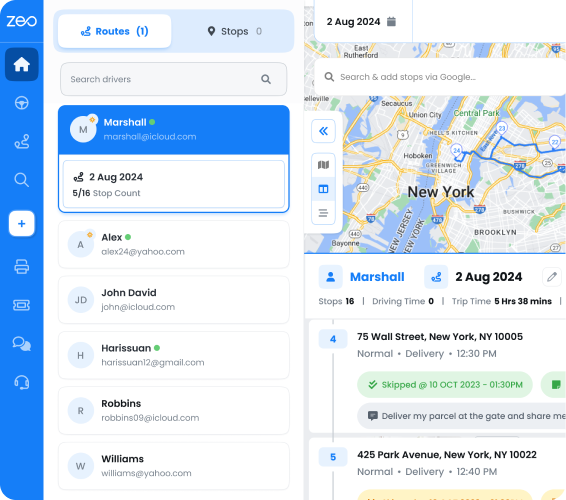
Step 4: Auto-assign by skill or territory. Use skill-based assignment to route serves to the right server, whether that’s based on county familiarity, case sensitivity, or language needs.
Step 5: Optimize and dispatch. Zeo’s AI builds the most efficient route per server in minutes, factoring in all constraints you’ve set.
Step 6: Sync completions back. For agencies using Zapier, proof-of-service data and completion status can be pushed into other connected tools, reducing manual status updates back into your case management system.
If your case management platform isn’t natively supported, Zeo’s API allows custom integration work for agencies that want a fully connected pipeline from order intake to completed affidavit.
This matters most during volume surges. When an eviction wave hits and your order count triples overnight, manual re-entry becomes the bottleneck. A connected intake-to-route pipeline keeps dispatch moving at the same pace, no matter how fast orders come in.
Common Dispatch Mistakes That Get Service of Process Challenged in Court
Even agencies with solid intentions make dispatch mistakes that create legal vulnerability. Watch for these.
Relying on memory for attempt logs. If a server writes up their attempt notes hours or days later, details get fuzzy. Fuzzy details are easy for opposing counsel to pick apart.
No location proof. An affidavit that simply states an address without any GPS or photo backup is weaker evidence than one with a timestamped location record.
Inconsistent attempt timing. Serving at 9 AM every time doesn’t satisfy “diligent effort” standards in most states. Courts often expect attempts at varying times and days.
Overloading servers during surges. When volume spikes and dispatch stays manual, servers get overloaded routes with unrealistic time windows. Rushed serves lead to skipped steps, like failing to confirm identity or logging insufficient notes.
Lost paper trails. Physical notebooks or disconnected apps mean proof-of-service records can go missing, get damaged, or simply not match what’s filed with the court.
No centralized audit trail. If a challenge comes months after service, can you pull up the exact GPS location, timestamp, and photo in minutes? If that data lives across several disconnected tools, you’re at a disadvantage.
The American Bar Association’s analysis of civil procedure challenges has noted that service of process disputes are a recurring source of procedural delay, particularly in high-volume civil matters like evictions and debt collection. Agencies that can quickly produce clean, timestamped documentation are in a far stronger position when service is challenged.
Scaling From Solo Server to Multi-State Team Without Losing Control
Growth is where manual systems break down fastest. What works for 3 servers in one city collapses at 20 servers across three states.
Here’s how the fleet-plus-app model keeps scaling manageable.
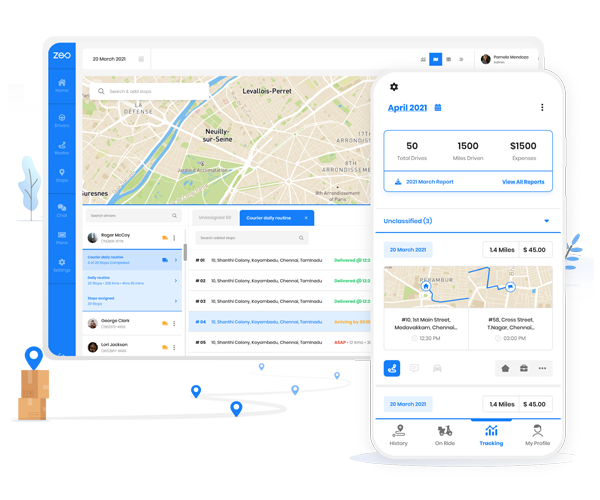
As operations manager, you build and assign routes through the Zeo web platform. You can bulk-import addresses straight from case file exports or CMS reports, set time windows for each serve, and assign stops based on server skill or territory, whether that’s a server who covers rural counties or one fluent in a second language for serving non-English-speaking defendants.
Your individual process servers receive their optimized route directly on the Zeo mobile app. They get turn-by-turn navigation, stop order, and case details on their phone, no need to call the office for the next address. At each stop, they log GPS-timestamped photos and signatures on the spot, and flag failed attempts in real time. Dynamic route adjustments mean a dispatcher can shift that day’s plan the moment a rush order or a failed attempt comes in.
That means the office has instant, audit-ready documentation without a single phone call back and forth. If a server hits a failed attempt at 9 AM, the dispatcher sees it immediately and can adjust that day’s plan, maybe reassigning an evening attempt to a different server who’s already in that zone.
This structure also supports multi-state growth. Driver performance analytics let you compare completion rates and attempt efficiency across regions, so you can spot which territories need more servers or better time-window planning. Work hours and break time settings keep scheduling compliant as your team grows beyond a handful of people you can track by memory.
The goal isn’t just speed. It’s keeping visibility and documentation consistent whether you have 5 servers or 50.
Frequently Asked Questions
Q: How many service attempts are legally required before alternative service is allowed?
This varies by state and sometimes by county, but most jurisdictions require two to three documented attempts at different times of day (morning, afternoon, evening) before a court will approve alternative service like posting or publication. Courts generally want to see “diligent effort,” which means attempts can’t all happen at the same time of day. Always confirm the specific rule in your jurisdiction, since requirements differ for eviction notices, subpoenas, and civil complaints.
Q: What information should a process server log at every attempt, not just successful service?
At minimum, log the date, exact time, address, a description of the location condition (lights on, car in driveway, no answer), and the server’s GPS location at that moment. Photo evidence of the property at the time of attempt adds another layer of proof if service is later challenged. Zeo’s proof of service tools let servers capture GPS-tagged photos and delivery notes directly at each stop, creating a timestamped record instead of a memory-based summary written later.
Q: Can route optimization software actually help with legal document delivery, or is it only useful for package delivery?
Route optimization helps any field operation that needs to visit multiple addresses efficiently, and process serving is no exception, since poor sequencing wastes mileage and creates missed attempt windows. Zeo Route Planner’s AI-powered route optimization factors in time windows and priority stops, which lets dispatchers flag urgent subpoenas as ASAP serves while still optimizing the full day’s route. It doesn’t replace legal-specific case management, but it solves the dispatch and sequencing problem that generic case management tools typically don’t address.
Q: What makes proof of service “court-defensible” versus just a written affidavit?
A court-defensible proof of service combines a written affidavit with supporting evidence: a GPS-verified location, a system-generated timestamp (not one written from memory later), and ideally a photo of the property or person served. This layered documentation is harder for opposing counsel to challenge than a single handwritten claim. Agencies that can quickly produce this evidence when service is disputed months later are generally in a stronger legal position.
Q: How do process serving agencies scale dispatch operations without losing documentation quality?
Scaling requires separating route planning from field execution: a dispatcher builds and assigns optimized routes centrally, while individual servers receive routes and log proof of service from the field in real time. Zeo’s web platform for dispatchers paired with the mobile app for servers supports this model, with driver performance analytics letting managers compare completion rates across growing, multi-state territories. The key is keeping documentation centralized and consistent whether you’re running 5 servers or 50.
Build Your Dispatch System Today
Legal document delivery optimization isn’t about choosing between speed and legal defensibility. The right system gives you both: faster routes and stronger proof of service, together.
Manual dispatch and disconnected legal software both create gaps, whether that’s wasted mileage or weak documentation. Zeo Route Planner closes both gaps with AI-powered routing, GPS-backed proof of service, and a mobile app your servers can use in the field without calling the office.
Download the free Process Server Dispatch SOP + Proof of Service Checklist to put these practices into action this week, or start a free Zeo Route Planner trial to optimize your next batch of serves today.
Are you a fleet owner?
Want to manage your drivers and deliveries easily?
Grow your business effortlessly with Zeo Routes Planner – optimize routes and manage multiple drivers with ease.

increase fuel savings
Save $200 on fuel, Monthly!
Optimize routes with our algorithm, reducing travel time and costs efficiently.
Get Started for Free