


# Legal Document Delivery Optimization: A 2026 Guide for Process Serving Agencies
> TL;DR: Legal document delivery optimization means building routes around court deadlines, multiple attempt requirements, and defensible proof of service — not just shortest driving distance. Poor sequencing can add 20-30% in unnecessary mileage for multi-stop operations, and agencies running 10+ servers manually often lose thousands of dollars a month in wasted attempts and dispatcher time. Route optimization tools like Zeo Route Planner address this with priority-based stop sequencing, skill-based driver assignment, and built-in proof of service capture, helping process serving teams save 2+ hours daily on manual planning.
If you’re running a process serving agency, you already know the stakes are higher than a typical delivery business. A missed service attempt doesn’t just cost you gas money. It can blow a court deadline, delay a case, or trigger a malpractice claim against your client’s attorney.
Legal document delivery optimization means building routes and workflows specifically designed around these risks. It’s not the same as optimizing a pizza delivery route or a parcel courier’s day. This guide walks you through what makes legal delivery different, how much inefficient routing is actually costing you, and how to build a system that scales as your team grows from 5 servers to 50.
What Legal Document Delivery Optimization Really Means (And Why Standard Delivery Routing Falls Short)
Most route planning tools are built for simple drop-and-go deliveries. Get to the address, hand off the package, move on. Process serving doesn’t work that way.
Legal document delivery has requirements that standard delivery routing ignores:
- Multiple attempts at different times of day. Courts often require proof that you tried to serve someone at varying hours, not just once at 2 PM.
- Strict time windows tied to court deadlines. A summons served one day late can get a case dismissed or a default judgment thrown out.
- Defensible proof of service. You need documentation that holds up if opposing counsel challenges it in court, not just a delivery confirmation.
- Skip tracing and re-routing. When a recipient isn’t home, servers often need to adjust their route on the fly, not wait for tomorrow’s plan.
- Skill and jurisdiction matching. Not every server can serve in every county, and some documents require specific certifications.
A generic mapping app or delivery-focused route planner treats every stop the same. Legal document delivery optimization means building routes around deadlines, attempt history, and evidentiary requirements first, and driving distance second.
According to the National Center for State Courts research on procedural dismissals, procedural errors — including improper or late service — remain one of the most common reasons cases face delay or dismissal. That risk sits squarely on your agency’s shoulders every time a route is planned badly.
The Hidden Costs of Inefficient Process Serving: Missed Attempts, Wasted Mileage, and Dispatcher Overload
If you’re still assigning routes through spreadsheets, phone calls, or a basic maps app, you’re likely absorbing costs you haven’t fully measured. Let’s break them down.
Missed service attempts. Every failed attempt means a server drives to an address, finds no one home, and has to come back. If your average server makes 15 attempts a day and 20% fail due to poor timing or sequencing, that’s 3 wasted trips daily. Multiply that across a 10-person team, and you’re looking at 30 wasted stops every single day.
Wasted mileage. Manual routing rarely accounts for real-time traffic, optimal stop order, or clustering by geography. Servers crisscross the same neighborhoods multiple times a week. The U.S. Bureau of Transportation Statistics data on route inefficiency has repeatedly shown that poor route sequencing can add 20-30% in unnecessary mileage for multi-stop delivery operations. For a process serving fleet, that’s real fuel and vehicle wear-and-tear cost, plus more hours billed for less output.
Dispatcher overload. If a dispatcher spends 2-3 hours a day manually building routes, checking addresses, and calling servers for updates, that’s 10-15 hours a week that could go toward client relationships, quality control, or growing the business instead. Real-time visibility through driver tracking software can cut a significant chunk of that manual check-in time.
Liability exposure. Paper logs, texted photos, and verbal confirmations don’t hold up well when a case gets contested. Without centralized, timestamped proof of service, your agency is exposed every time a defendant’s attorney claims service was never properly completed.
Here’s a quick way to estimate your real cost:
- Missed attempts per week × average cost per re-attempt (fuel + labor) = weekly waste
- Dispatcher hours per week on manual routing × hourly rate = admin cost
- Extra mileage per driver per week × mileage rate = fleet cost
Most agencies running 10+ servers manually are losing thousands of dollars a month once you add these up. And that’s before factoring in the reputational cost of a botched service that delays a client’s case.
Step-by-Step: Building an Optimized Multi-Stop Legal Delivery Route That Meets Court Deadlines
Here’s how to build a route that respects both efficiency and legal risk.
Step 1: Import your addresses in bulk. Instead of typing addresses one by one, upload your day’s service list from Excel, CSV, or Google Sheets. Zeo Route Planner’s bulk address import handles this in seconds, even for lists of 50+ addresses at once.
Step 2: Set priority levels for time-sensitive documents. Not every document has the same deadline pressure. Mark subpoenas due today as “ASAP” and routine notices as “Normal” so your route optimization engine sequences the most urgent stops first.
Step 3: Apply time window constraints. If a recipient is known to be home only between 5 PM and 8 PM, or a business only accepts service during business hours, set that window. The route should build around these constraints automatically, not force your server to guess.
Step 4: Match servers to skills and jurisdiction. If certain servers are certified for specific counties or document types (like eviction notices vs. subpoenas), use skill-based job assignment so the right server gets the right job.
Step 5: Let the AI optimize stop order. Once addresses, priorities, and time windows are set, route optimization software should calculate the most efficient sequence automatically. Zeo’s AI-powered routing saves servers and dispatchers 2+ hours daily by removing this manual planning step entirely.
Step 6: Push routes to servers’ phones. Once the route is built, it should land directly in each server’s hands — not require a phone call or printed sheet. More on this in the dispatch section below.
Step 7: Monitor and adjust mid-shift. If a server hits a failed attempt or a rush job comes in, dynamic route adjustments let you insert new stops or re-sequence the day without starting over.
Example scenario: Say your agency gets a rush subpoena at 10 AM that needs to be served before a 2 PM hearing. Instead of calling five servers to ask who’s nearby, a dispatcher can drop the address into the system, mark it ASAP, and the optimization engine slots it into the closest available server’s route — accounting for their current location and existing stops.
Proof of Service That Holds Up: Capturing GPS Timestamps, Photos, and Signatures Automatically
Proof of service is the single most important output of your entire operation. If it doesn’t hold up in court, everything else you did right doesn’t matter.
Manual proof of service — a handwritten affidavit, a texted photo, a verbal confirmation to dispatch — creates gaps. Dates get transcribed wrong. Photos get lost. Servers forget details by the time they fill out paperwork at the end of a 12-hour day.
Zeo’s proof of delivery tools help close these gaps by capturing documentation at the moment of service, not hours later:
- Photo capture at the point of service, timestamped and attached to the specific stop
- Digital signature collection when a recipient accepts service directly
- Delivery notes for details a photo can’t show — like a description of who accepted the document if it wasn’t the named recipient
- GPS location data tied to the stop, showing where the server was when service was logged
This kind of documentation, captured automatically instead of manually, helps build a stronger evidentiary record. If a case is later contested, you have timestamped, geo-tagged proof rather than a server’s memory or a handwritten note filled out days later.
To be clear: Zeo doesn’t generate legal affidavits or file court paperwork for you. What it does is give your servers a fast, consistent way to capture the evidence your agency needs to complete that paperwork accurately — every time, for every stop.
For an agency handling hundreds of services a month, this consistency matters. It’s the difference between a proof-of-service file that’s ready in minutes and one that requires chasing down a server for details they’ve since forgotten.
Choosing Route Optimization Software for Process Serving: A Feature Checklist
Not all route optimization tools are built with legal delivery in mind. Here’s what to actually look for.

increase fuel savings
Save 2 Hours on Deliveries, Everyday!
Optimize routes with our algorithm, reducing travel time and costs efficiently.
Get Started for Free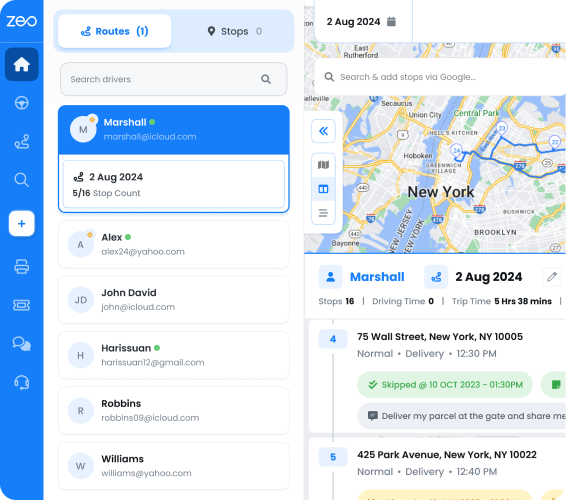
Multi-stop optimization with priority and time windows. Your software needs to handle ASAP vs. normal priority stops and hard time windows, not just shortest-distance routing.
Bulk import for daily service lists. If you’re still manually entering addresses one at a time, you’re wasting dispatcher hours every day. Look for Excel, CSV, and Google Sheets import.
Skill-based assignment. Confirm the software lets you tag servers by jurisdiction, certification, or document type, and route accordingly.
Photo, signature, and note capture built into the app. This should happen at the point of service on the server’s phone, not as a separate app or paper process.
Real-time GPS tracking. Dispatchers should be able to see where every server is at any moment, especially useful when a rush job comes in and you need to find the closest available person.
Customer/client notifications. For attorneys or clients waiting on status updates, live tracking links and automated notifications reduce the “any update?” phone calls to your office. This same principle applies across other sensitive delivery categories, like financial document delivery routes, where clients also expect status visibility.
Dynamic re-routing. When a server hits a locked gate, an empty house, or a refused service, the system should let dispatch adjust the route immediately, not wait until end of day.
Analytics and reporting. You should be able to pull reports on attempt success rates, mileage, and driver performance to identify bottlenecks and improve over time.
Integration options. If you’re pulling service requests from a case management system or a client portal, look for Zapier or API integration so you’re not manually re-entering data twice.
When evaluating vendors, ask directly: “Can your platform handle skill-based routing for a 20-person team with mixed jurisdictions?” and “What does proof of service capture look like on the driver’s app?” If they can’t answer specifically, keep looking.
Scaling Your Process Serving Team: Centralized Dispatch, Driver Coordination, and What Happens Next
The real test of your routing system comes when you grow. What works for 5 servers coordinated by phone calls falls apart at 15, and completely breaks at 30 or more.
This is where centralized dispatch management matters most. With Zeo, dispatchers plan and assign routes from the web platform — building out the day’s service list, setting priorities, and matching jobs to servers based on skill and location. Each process server then receives their optimized route, turn-by-turn navigation, and proof-of-service tools directly on the Zeo mobile app.
This split matters as you scale. A dispatcher managing 30 servers can’t call each one individually to walk them through their day. Instead, routes get pushed to phones automatically. Servers open the app, see their stops in order, navigate with their preferred app (Google Maps, Waze, or Apple Maps), and capture proof of service on-site — photo, signature, GPS timestamp, all in one place.
As your team grows, a few things become non-negotiable:
- In-app chat between dispatchers and servers, so status updates don’t require phone tag
- Driver performance analytics, so you can see which servers have high success rates and which need coaching or route adjustments
- Recurring and scheduled routes, useful for agencies with standing client relationships or regular service days
- Miles tracking, which matters both for reimbursement accuracy and expense records at tax time
Consider a mid-sized agency going from 8 to 25 servers over a year. At 8 servers, a dispatcher can reasonably manage assignments by phone and memory. At 25, that same dispatcher is now responsible for triple the deadlines, triple the proof-of-service files, and triple the chance something falls through the cracks. According to U.S. Bureau of Labor Statistics data on courier and messenger occupations, coordination overhead is one of the most commonly cited scaling challenges in this line of work. Centralized dispatch through a shared platform — where routes are assigned once and updates flow automatically to servers’ phones — is what makes that growth manageable instead of chaotic.
The agencies that scale successfully treat routing infrastructure as seriously as they treat hiring. Adding servers without adding the systems to coordinate them just multiplies your existing inefficiencies.
Frequently Asked Questions
Q: How many attempts are process servers legally required to make before service is considered exhausted?
Requirements vary by state and county, and there’s no single national standard — some jurisdictions expect three attempts at different times of day before allowing alternative service methods like posting or publication. Always confirm the specific rule for the court where the case is filed, since a missed requirement can invalidate the service entirely. Local court rules or a jurisdiction’s civil procedure code are the most reliable source, not general guidance.
Q: What’s the difference between process serving software and regular delivery route planning tools?
Regular delivery route apps optimize for shortest distance and fastest drop-off, treating every stop the same. Process serving software needs to account for time windows tied to court deadlines, multiple attempt scheduling, skill/jurisdiction matching, and evidentiary proof of service — factors a generic mapping app doesn’t handle. Zeo Route Planner supports this with priority-based stop sequencing and skill-based driver assignment, letting agencies route by legal urgency rather than pure geography.
Q: Can GPS timestamps and photos actually be used as evidence in a contested service case?
Courts generally accept timestamped, geo-tagged documentation as supporting evidence for an affidavit of service, though it typically supplements rather than replaces a signed affidavit. The stronger and more consistent the documentation — photo, location, time, and notes captured at the moment of service — the harder it is for opposing counsel to successfully challenge that service occurred. Zeo’s proof of service tools capture photo, GPS location, and delivery notes at the point of service, giving agencies a consistent record to support their affidavits.
Q: How much does inefficient routing actually cost a process serving agency per month?
For a 10-server agency, wasted mileage from poor route sequencing alone can add 20-30% in unnecessary driving, according to Bureau of Transportation Statistics research on multi-stop operations. Combined with dispatcher hours spent manually building routes and the cost of repeat attempts from bad timing, agencies running 10+ servers manually often lose thousands of dollars monthly once fuel, labor, and admin time are added together.
Q: Do process servers need special certification to use route optimization software?
No — route optimization software itself doesn’t require any legal certification to use, since it’s a scheduling and navigation tool, not a legal service. However, the servers using the software still need to hold whatever certification or licensing their state or county requires for process serving, and the software should support tagging servers by those credentials so jobs get routed to the right person.
Getting Started
Legal document delivery optimization isn’t about shaving a few minutes off drive time. It’s about protecting your agency from missed deadlines, building proof of service that holds up under scrutiny, and giving your team room to grow without dispatcher burnout.
Start a free Zeo Route Planner trial to build your first optimized legal delivery route in minutes, or book a demo to see how multi-server dispatch and proof of service work for process serving teams.
Are you a fleet owner?
Want to manage your drivers and deliveries easily?
Grow your business effortlessly with Zeo Routes Planner – optimize routes and manage multiple drivers with ease.
increase fuel savings
Hassle Free Deliveries & Pickups!
Optimize routes with our algorithm, reducing travel time and costs efficiently.
Get Started for Free