

# Furniture Delivery Scheduling Challenges: Complete Solutions Guide
> TL;DR: Furniture delivery scheduling challenges stem from complex logistics involving bulky items, assembly coordination, and strict customer time windows that manual planning cannot efficiently handle. Poor scheduling causes 15-20% failed delivery rates, costing retailers $18+ per failure plus customer service overhead. Route optimization software like Zeo Route Planner addresses these furniture delivery scheduling challenges with AI-powered capacity-based routing and real-time customer notifications, helping furniture retailers save 2+ hours daily.
Furniture delivery scheduling challenges can make or break your business operations. Between coordinating assembly teams, managing bulky item logistics, and meeting strict customer time windows, operations managers face a complex puzzle that costs both time and money.
The stakes are higher than ever. According to the National Retail Federation, furniture and home goods e-commerce sales reached $176 billion in 2026, putting unprecedented pressure on delivery operations. Failed deliveries don’t just cost money—they damage your reputation and customer relationships.
The Hidden Costs of Furniture Delivery Scheduling Problems
Manual scheduling creates a cascade of expensive problems that many furniture retailers underestimate. When you’re juggling 15-25 delivery routes daily, the complexity multiplies quickly.
Failed deliveries represent your biggest hidden cost. Industry data shows that furniture delivery companies typically experience 15-20% failed delivery rates without proper scheduling systems. Each failed delivery costs an average of $18 in direct costs, plus the indirect costs of customer service calls and rescheduling efforts.
Customer no-shows happen when appointment windows are too vague or customers don’t receive proper notifications. Without real-time communication systems, customers often forget appointments or aren’t available when drivers arrive.
Vehicle capacity miscalculations occur when schedulers don’t account for bulky furniture dimensions. A sectional sofa that seemed manageable on paper might not fit with other scheduled deliveries, forcing drivers to make extra trips or reschedule deliveries.
Assembly team coordination becomes a nightmare when delivery and installation teams aren’t synchronized. Two-person delivery scheduling software becomes essential for white glove services that require precise timing—delivery teams need to arrive when assembly technicians are available and customers are prepared.
Driver overtime increases when routes aren’t optimized for traffic patterns, delivery complexity, and setup time requirements. Poor scheduling often results in 10-15 hours of weekly overtime across your fleet.
Advanced Scheduling Algorithms: How AI Optimizes Multi-Stop Furniture Routes
Modern route optimization technology transforms furniture delivery scheduling from guesswork into a science. AI-powered algorithms consider dozens of variables that human schedulers simply cannot process simultaneously.
Capacity-based routing accounts for both weight and volume constraints. The system calculates how a king-size mattress, dining table, and bookshelf fit together in your delivery vehicle while leaving space for protective materials and dollies.
Time window optimization balances customer preferences with operational efficiency. Instead of offering broad 4-hour windows that frustrate customers, advanced algorithms can narrow windows to 2 hours while maintaining route efficiency.
Assembly time calculations factor in delivery complexity. The system recognizes that a bedroom set delivery with assembly requires 90 minutes, while a simple mattress delivery takes 20 minutes, and schedules accordingly.
Zeo Route Planner solves these furniture delivery scheduling challenges through AI-powered optimization that saves 2+ hours daily per route. The system automatically assigns deliveries to drivers based on vehicle capacity, skill requirements, and geographic efficiency.
Consider a typical furniture retailer scenario: You have 40 deliveries scheduled across 8 drivers. Manual scheduling might take 2-3 hours and still result in suboptimal routes. AI optimization completes this task in minutes while considering traffic patterns, delivery time requirements, and vehicle constraints simultaneously.
Priority stop designation ensures urgent deliveries (like replacements for damaged items) get scheduled appropriately without disrupting the entire day’s route structure.
Furniture Delivery Scheduling Solutions: Driver Communication Systems
Effective communication between dispatch, drivers, and customers eliminates most delivery failures. Modern systems create transparent information flow that keeps everyone informed and prepared.
Real-time GPS tracking gives you visibility into delivery progress throughout the day. When a morning delivery runs long due to complex assembly, you can immediately notify afternoon customers about adjusted arrival times.
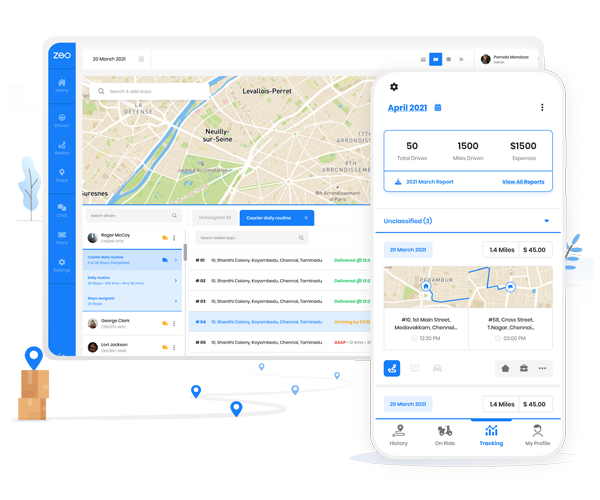
Your delivery teams receive optimized routes directly on their phones via the Zeo mobile app, complete with turn-by-turn navigation and customer details. This eliminates confusion about delivery addresses, special instructions, and contact information.
Customer notification systems automatically send SMS and email updates when drivers are en route. These notifications include live tracking links so customers can monitor delivery progress and prepare accordingly.
Proof of delivery documentation protects your business and improves customer satisfaction. Drivers capture photos of delivered items, collect digital signatures, and record any delivery notes directly through their mobile devices.
Two-way communication between drivers and dispatch prevents small problems from becoming failed deliveries. When a driver encounters access issues or discovers an address problem, they can instantly communicate with dispatch for resolution guidance.
Consider this real scenario: A driver arrives at an apartment complex but can’t access the building. Instead of marking it as a failed delivery, they message dispatch through the app. Dispatch contacts the customer, gets the building code, and the delivery completes successfully—all within 10 minutes.
Pre-delivery confirmation calls work best when integrated with your scheduling system. Customers receive automated calls 2-4 hours before delivery with specific arrival time estimates and preparation instructions.
Integration Strategies: Connecting E-commerce, Warehouse, and Delivery Systems
Seamless data flow between your sales, inventory, and delivery systems eliminates scheduling errors and reduces manual work. Integration strategies create a unified operation where information flows automatically between departments.
E-commerce platform connections automatically import order details into your delivery scheduling system. When customers place furniture orders online, their delivery preferences, item specifications, and contact information transfer directly into route planning software.
Zeo’s Shopify and WooCommerce integrations eliminate double data entry by automatically importing delivery orders with customer details and item specifications. This reduces scheduling errors and saves administrative time.
Warehouse management system integration ensures delivery schedules align with inventory availability. The system prevents scheduling deliveries for items that haven’t arrived or completed quality inspection.
Customer relationship management (CRM) integration provides drivers with complete customer history. This information helps drivers prepare for customers who prefer specific delivery procedures or have special requirements.
API connections enable custom integrations with specialized furniture industry software. Whether you use specific inventory systems or custom order management platforms, modern route scheduling software can connect through standardized APIs.
Zapier integration connects Zeo to over 1,000 business applications, enabling furniture retailers to create custom workflows between their existing software systems and delivery operations.

increase fuel savings
Save $200 on fuel, Monthly!
Optimize routes with our algorithm, reducing travel time and costs efficiently.
Get Started for Free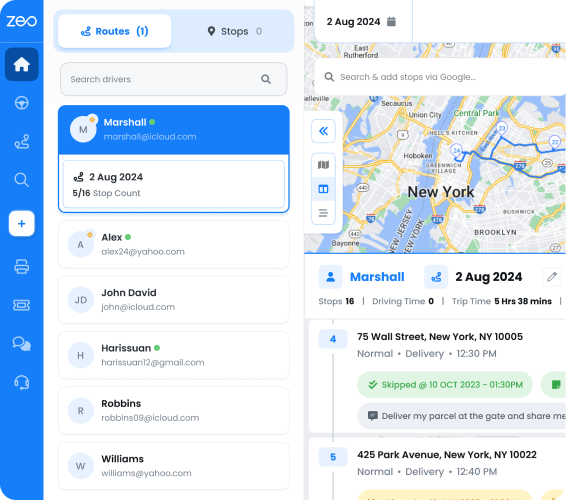
Real-time inventory updates prevent scheduling items that become unavailable due to damage or supply chain delays. Integration between warehouse systems and delivery scheduling prevents customer disappointment and wasted driver time.
Peak Season Capacity Planning: Scaling Delivery Operations for Holidays
Holiday seasons and promotional periods can overwhelm furniture delivery operations without proper capacity planning. The period between Black Friday and New Year’s Day typically sees 200-300% increases in delivery volume.
Demand forecasting based on historical data helps you prepare for peak periods. According to the Department of Transportation, retailers who analyze previous years’ delivery volumes during major sales events can predict staffing and vehicle needs with 85% accuracy.
Temporary driver onboarding requires systems that can quickly add seasonal workers without disrupting existing operations. Modern delivery scheduling software accommodates temporary team members with appropriate skill assignments and vehicle allocations.
Extended delivery windows during peak periods maintain customer satisfaction while managing operational constraints. Instead of standard 2-hour windows, offering 3-4 hour windows during busy periods keeps routes manageable.
Weekend delivery expansion helps distribute peak period volume across more available days. Many furniture customers prefer weekend deliveries, making Saturday and Sunday operations valuable during busy seasons.
Subcontractor integration allows you to scale capacity without permanent staff increases. Route optimization systems can manage both employee drivers and contracted delivery teams within the same scheduling framework.
Load balancing across your fleet prevents driver burnout during intense periods. Smart scheduling distributes complex deliveries (requiring assembly) evenly rather than overloading specific team members.
Peak season communication becomes critical when delivery volumes increase. Automated customer notifications become even more valuable when manual communication becomes impractical due to volume.
Advanced route optimization helps maximize existing capacity before adding resources. During peak periods, Zeo’s AI-powered routing can often handle 20-30% more deliveries using your existing fleet through better route efficiency.
ROI Analysis: Measuring the Business Impact of Delivery Scheduling Software
Calculating return on investment for delivery scheduling software requires tracking both direct cost savings and indirect operational improvements. The Bureau of Labor Statistics reports that route optimization typically reduces fuel costs by 15-20% and vehicle wear by similar percentages.
Labor cost reduction represents the largest ROI component. When route optimization saves 2+ hours daily per driver, a 10-driver fleet saves 100+ labor hours weekly. At $20/hour average labor cost, that’s $2,000 weekly in direct savings.
Failed delivery elimination provides immediate cost benefits. Reducing failed deliveries from 15% to 5% saves substantial money. For a company completing 200 deliveries weekly, that’s 20 fewer failed deliveries, saving $360 weekly in direct costs plus customer service overhead.
Customer satisfaction improvements create long-term value through repeat business and referrals. White glove delivery experiences are often relationship-driven—satisfied delivery experiences lead to future sales and positive reviews.
Fuel savings add up quickly with optimized routing. A delivery fleet averaging 1,000 miles daily can save 150-200 miles through route optimization. At current fuel prices, this represents $30-40 daily savings per vehicle.
Administrative time reduction frees managers for strategic work instead of daily route planning. When scheduling automation reduces planning time from 3 hours to 30 minutes daily, managers can focus on customer service, team development, and business growth.
Vehicle maintenance cost reduction occurs when optimized routes reduce total mileage and eliminate stop-and-go driving patterns that increase wear.
Insurance cost reductions may be available when telematics data from route optimization systems demonstrates improved safety records and reduced accident risk.
Frequently Asked Questions
Q: What causes most furniture delivery failures and how can they be prevented?
The primary causes of furniture delivery failures include poor route planning (35%), inadequate vehicle capacity calculations (28%), and lack of customer communication (22%). These issues can be prevented through AI-powered route optimization that considers furniture dimensions, real-time customer notifications, and proper capacity planning that accounts for both weight and volume constraints.
Q: How much time does manual furniture delivery scheduling typically waste per day?
Manual furniture delivery scheduling typically wastes 2-4 hours daily for operations managers, plus an additional 15-30 minutes per route for drivers dealing with inefficient sequences. Zeo Route Planner’s AI-powered optimization reduces this planning time from hours to minutes while improving route efficiency by 20-30%.
Q: What’s the average cost impact of a failed furniture delivery?
Each failed furniture delivery costs an average of $18 in direct expenses (fuel, labor, vehicle wear), plus indirect costs of $25-40 for customer service, rescheduling, and potential customer loss. For companies with 15-20% failed delivery rates, this can represent $8,000-15,000 in monthly losses for a mid-sized operation.
Q: How do furniture retailers handle peak season delivery volume increases?
Most furniture retailers experience 200-300% volume increases during peak seasons from Black Friday through New Year’s. Successful companies use advanced scheduling software to extend delivery windows from 2 hours to 3-4 hours during busy periods, add weekend delivery options, and integrate temporary drivers seamlessly into existing route optimization systems.
Q: What integration capabilities should furniture delivery scheduling software have?
Essential integrations include e-commerce platforms (Shopify, WooCommerce) for automatic order import, CRM systems for customer history access, and warehouse management systems for inventory synchronization. Zeo Route Planner offers these core integrations plus Zapier connectivity to over 1,000 business applications, enabling custom workflows between existing software systems.
Start your free trial of Zeo Route Planner and see how furniture delivery scheduling automation can reduce your planning time from hours to minutes. Join 1.5M+ users across 150+ countries who’ve transformed their delivery operations with AI-powered route optimization.
Are you a fleet owner?
Want to manage your drivers and deliveries easily?
Grow your business effortlessly with Zeo Routes Planner – optimize routes and manage multiple drivers with ease.
increase fuel savings
Save $200 on fuel, Monthly!
Optimize routes with our algorithm, reducing travel time and costs efficiently.
Get Started for Free