



# Equipment Delivery Management: The Complete Workflow, Software, and ROI Guide
> TL;DR: Equipment delivery management requires capacity-based routing, crew assignment, and installation proof — not just stop sequencing like standard parcel delivery. Companies running 5-50 vehicles that switch from spreadsheets to purpose-built routing software, like Zeo Route Planner’s capacity-based routing and photo/signature proof of delivery, typically save 2+ hours daily in dispatcher planning time.
Equipment delivery management is harder than parcel delivery. You’re not just dropping a box on a porch.
You’re matching a forklift or hospital bed to the right vehicle. You’re scheduling a two-person crew for an installation window. You’re tracking a serial number. And you’re proving the job was installed correctly, not just delivered.
If you’re running 5-50 vehicles for a rental, medical device, or industrial equipment company, spreadsheets and generic route planners eventually break down. This guide walks through what equipment delivery management actually involves, the exact workflow to follow, the software features that matter, and how to measure the return before you switch tools.
What Is Equipment Delivery Management? (And Why It’s Different from Standard Delivery)
Equipment delivery management is the process of planning, dispatching, and tracking deliveries that involve bulky, high-value, or installation-required items. Think generators, hospital beds, scaffolding, HVAC units, or industrial compressors.
Standard parcel delivery is simple: scan, drop, sign, done. Equipment delivery adds layers most route planners weren’t built to handle.
Here’s what makes it different:
- Capacity matters more than stop count. A van that fits 20 packages might fit zero pallets. Routing has to account for vehicle weight and volume limits, not just address proximity.
- Crews, not just drivers. Many installs need two people. Your routing has to assign the right pair, not just the nearest driver.
- Time windows are contractual. A hospital expecting a bed at 9 AM for a patient discharge isn’t flexible. Missed windows can mean canceled procedures or lost rental days.
- Delivery isn’t the finish line. Installation sign-off, serial number logging, and asset condition notes matter as much as the drop-off itself.
- Disputes follow the data. When a customer claims equipment arrived damaged or wasn’t installed, you need photos, timestamps, and signatures to resolve it fast.
Generic route planners optimize for distance and time. They weren’t designed to track a serial number or confirm a technician got sign-off from a facilities manager. That gap is where most of these companies run into trouble.
The Equipment Delivery Workflow: From Order Intake to Installation Sign-Off (Step-by-Step Checklist)
A reliable equipment delivery process follows a consistent sequence. Skipping steps is usually where missed windows and billing disputes start.
1. Order intake and validation
Capture the order details: item type, dimensions, weight, requested delivery window, and whether installation is required. Flag any site access restrictions (loading docks, freight elevators, stairs).
2. Capacity and crew matching
Match the order to a vehicle with enough capacity and a driver (or two-person crew) with the right skills. A one-person van shouldn’t get assigned a 400-lb compressor install.
3. Route building with time windows
Build the day’s route around confirmed installation windows, not just shortest distance. A job that takes 90 minutes to install needs that time blocked, not just a drive-time estimate.
4. Dispatch and driver notification
Send the finalized route to the driver or crew lead with full stop details: contact name, access notes, and equipment specs.
5. En route tracking and customer notification
Customers get a live ETA so facilities staff or patients aren’t waiting around. This cuts down on “where’s my delivery” calls to dispatch.
6. Delivery and installation
The crew installs the equipment, tests it if required, and documents the job on-site.
7. Proof of delivery and sign-off
Capture a photo of the installed unit, collect a digital signature from the customer, and log the serial number and any notes. A solid proof of delivery process at this step is what separates a documented install from a he-said-she-said dispute later.
8. Billing and close-out
Use the captured proof and timestamps to invoice accurately and resolve any disputes before they escalate.
Most failures happen between steps 2 and 3 — assigning the wrong vehicle or ignoring the installation window — and between steps 6 and 7, when proof of install is weak or missing entirely.
Must-Have Features in Equipment Delivery Management Software
If you’re evaluating software, these are the non-negotiables for equipment delivery specifically — not just general delivery routing.
Capacity-based routing
The system should account for vehicle weight and volume limits when assigning stops, so a route never overloads a vehicle or wastes space. Zeo Route Planner builds routes around these constraints automatically, instead of leaving dispatchers to guess at capacity by hand.
Time window constraints
Installation appointments and pickup windows need to be hard constraints in the route, not an afterthought. Look for software that lets you set priority stops (ASAP vs. normal) so urgent jobs don’t get buried behind routine ones.
Skill-based and crew assignment
Some jobs need a certified installer or a two-person crew. Your routing tool should support skill-based job assignment so drivers are matched by qualification and vehicle type, not just proximity.
Proof of delivery beyond a signature
For equipment, proof needs to include a photo of the installed unit, a signature, and delivery notes — ideally with a field for serial numbers or asset IDs. This is what protects you in a billing dispute.
Real-time tracking and live ETAs
Customers and facilities managers want to know when the crew is arriving, especially for time-sensitive installs like medical equipment. Driver tracking software with live tracking links reduces check-in calls to your dispatch team.
Dynamic mid-shift adjustments
When a job runs long or a crew member calls out, dispatchers need to re-assign stops without rebuilding the whole day’s schedule from scratch.
Driver-dispatcher communication
In-app chat between the driver and manager matters when a job needs a second crew member or runs into an access issue on-site.
Reporting and analytics
You need visibility into on-time rates, driver performance, and miles driven to catch problems before they become patterns.
Generic parcel-focused route planners often handle the routing math but miss capacity constraints, crew assignment, and proper installation sign-off. That gap shows up as missed windows and weak documentation when disputes happen.
Industry Use Cases: How Construction Rental, Medical Device, and Industrial Equipment Companies Solve Delivery Challenges
Construction equipment rental
A regional rental company delivering scaffolding, generators, and lifts to job sites deals with constantly shifting schedules. Weather delays push installs back, and job sites often lack clear addresses. For a deeper look at how these scheduling pressures play out, see this guide to construction delivery management.

increase fuel savings
Save 2 Hours on Deliveries, Everyday!
Optimize routes with our algorithm, reducing travel time and costs efficiently.
Get Started for Free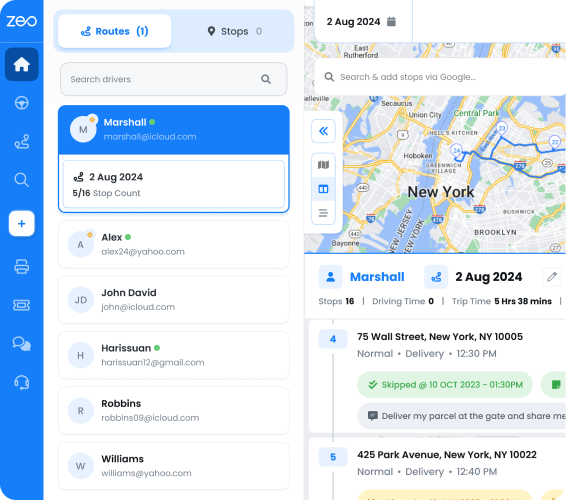
Capacity-based routing matters here because a single truck might carry mixed equipment with very different weight profiles. Dynamic mid-shift adjustments let dispatchers re-route when a foreman calls to push a delivery back two hours.
Medical device supply
Hospital bed deliveries, oxygen concentrators, and diagnostic equipment installs come with strict time windows tied to patient discharge or procedure schedules. A missed window here isn’t just inconvenient — it can delay patient care. Many of the same scheduling principles apply to optimizing medical courier routes, where time-critical windows are also non-negotiable.
Proof of delivery with photo capture and signature collection matters most in this segment, since equipment often needs sign-off from a facilities or biomed staff member confirming installation and function testing.
Industrial equipment and machinery
Compressors, HVAC units, and industrial machinery deliveries often require two-person crews and specialized vehicles. Skill-based assignment ensures a certified technician — not just any available driver — handles the install.
Serial number logging during proof of delivery also protects both the company and customer when equipment needs warranty service later.
Across all three industries, the common thread is this: delivery and installation are treated as one job, not two. Software that separates them creates gaps where disputes and missed windows happen.
The ROI of Route Optimization for Equipment Delivery: Time, Fuel, and Missed-Window Costs
The cost of inefficient equipment delivery shows up in three places: wasted driver time, excess fuel spend, and the downstream cost of missed windows.
Time savings
Manual route planning and spreadsheet scheduling eat up hours every day for dispatchers juggling vehicle capacity and crew availability by hand. AI-powered route optimization, like what Zeo Route Planner provides, saves 2+ hours daily by automating stop sequencing and driver assignment instead of building routes stop-by-stop.
Fuel costs
The U.S. Energy Information Administration’s diesel price data shows diesel prices fluctuating significantly year over year, and fuel remains one of the largest variable costs for delivery fleets. Poorly sequenced multi-stop routes mean more idle time, more backtracking, and more fuel burned per delivery. Optimized routing reduces unnecessary mileage by sequencing stops logically instead of in the order they were booked.
Missed-window costs
According to American Transportation Research Institute’s operational cost benchmarking report, operational inefficiencies like poor scheduling and routing are among the top cost drivers for commercial fleets. For equipment deliveries tied to installation appointments, a missed window often means a rescheduled crew, an unhappy customer, and in some cases, a canceled rental day or delayed patient procedure.
Billing disputes
Weak proof of delivery leads to disputes that take staff hours to resolve. Companies that capture photos, signatures, and serial numbers at the point of install resolve these disputes faster, with documentation instead of back-and-forth phone calls. Industry employment and wage trends from the Bureau of Labor Statistics’ transportation and warehousing data also show rising labor costs, which makes minimizing dispatcher hours spent on disputes even more valuable.
When you add up dispatcher time, fuel, and the cost of even a handful of missed windows per month, the case for route optimization software becomes a numbers conversation, not just a convenience upgrade.
Choosing the Right Tool: Equipment Delivery Software vs. Generic Route Planners vs. Enterprise TMS
Companies in this space usually evaluate three categories of tools. Here’s how they actually compare for equipment delivery.
Generic route planners (consumer-grade apps)
These tools optimize for distance and stop count. They work fine for parcel delivery but typically lack capacity-based routing, skill-based crew assignment, and installation-specific proof of delivery. If your deliveries involve weight limits, time windows, or sign-off requirements, you’ll outgrow these quickly.
Enterprise TMS (transportation management systems)
Built for large freight and logistics operations, enterprise TMS platforms offer deep supply chain features but come with long implementation timelines and pricing built for much larger fleets. For a 5-50 vehicle operation, this is often more complexity and cost than you need.
Purpose-built equipment delivery software
This middle category is built for companies with capacity constraints, time windows, crews, and installation sign-off requirements, without the overhead of enterprise freight systems. Zeo Route Planner fits here, serving 1.5M+ users across 150+ countries with features built around exactly this workflow: capacity-based routing, time windows, skill-based assignment, and proof of delivery with photo, signature, and notes.
A simple framework for deciding:
- If your deliveries are small parcels with no installation step, a generic planner may be enough.
- If you’re running hundreds of vehicles across complex freight networks, enterprise TMS may be justified.
- If you’re running 5-50 vehicles delivering bulky, scheduled, or installation-required equipment, you need software built specifically for that job.
Getting Started: How Managers and Drivers Work Together in One System
The best equipment delivery operations run manager and driver workflows in one connected system, instead of a spreadsheet for planning and a separate app for navigation.
Here’s how that looks in practice with Zeo Route Planner. A dispatcher builds the day’s equipment delivery routes on the Zeo web platform, factoring in vehicle capacity, crew size, and each customer’s installation time window. Once the routes are finalized, they’re assigned directly to drivers.
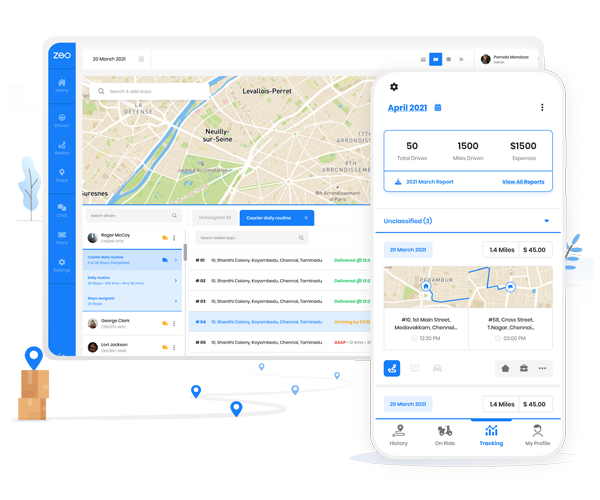
Drivers and installers then receive their stops on the Zeo mobile app. From there, they can navigate using their preferred maps app, capture photos of the installed equipment, collect a digital signature for installation sign-off, and log serial numbers or delivery notes on-site. If a job runs long or needs a second crew member, drivers can message dispatch directly through the app instead of relying on phone calls.
This keeps planning and execution connected. Dispatchers see real-time status updates as jobs are completed, and the proof of delivery — photos, signatures, notes — syncs back automatically for billing and dispute resolution.
For an operations manager overseeing 15 trucks delivering medical beds and oxygen equipment, this means less time spent calling drivers for status updates and more confidence that every installation is documented the moment it’s done.
Frequently Asked Questions
Q: How is equipment delivery management different from standard field service scheduling?
Equipment delivery management combines logistics (getting a bulky or high-value item to a site) with installation and sign-off requirements that standard field service scheduling doesn’t always address. It requires capacity-based vehicle routing, crew coordination, and documentation like serial numbers and installation photos, not just an appointment calendar.
Q: What size company needs dedicated equipment delivery software instead of spreadsheets?
Most companies running 5-50 vehicles hit a breaking point with spreadsheets once they’re juggling vehicle capacity limits, crew assignments, and time-sensitive installation windows across multiple daily stops. Below that scale, manual planning can work short-term; above it, missed windows and documentation gaps tend to multiply quickly.
Q: How do you prevent assigning the wrong vehicle to an equipment delivery?
The most reliable way is using capacity-based routing software that checks weight and volume limits before assigning a stop to a vehicle, rather than relying on a dispatcher’s memory. Zeo Route Planner builds routes around these constraints automatically, which helps prevent overloaded trucks or wasted capacity on mixed-equipment routes.
Q: What proof of delivery is needed for equipment installation, not just drop-off?
For equipment installs, proof typically needs to go beyond a signature to include a timestamped photo of the installed unit, delivery notes, and ideally a serial number or asset ID. Zeo Route Planner’s proof of delivery captures photos, digital signatures, and notes in one record, which helps resolve billing disputes faster with documentation instead of back-and-forth calls.
Q: How much time does route optimization actually save for equipment delivery teams?
Teams that switch from manual scheduling to AI-powered route optimization commonly report saving significant dispatcher time by automating stop sequencing, capacity checks, and driver assignment instead of building routes by hand. Zeo Route Planner, for example, is built to save 2+ hours daily for teams managing multi-stop, capacity-constrained routes.
Start Managing Equipment Deliveries the Right Way
Equipment delivery isn’t parcel delivery, and the tools you use shouldn’t treat it that way. Capacity-based routing, time windows, crew assignment, and real proof of installation aren’t nice-to-haves — they’re what prevent missed windows, failed installs, and billing disputes.
Start a free trial of Zeo Route Planner to build your first capacity-based, time-window-optimized equipment delivery route in minutes. Or book a demo to see the driver app’s proof-of-delivery tools and the fleet dashboard in action.
Are you a fleet owner?
Want to manage your drivers and deliveries easily?
Grow your business effortlessly with Zeo Routes Planner – optimize routes and manage multiple drivers with ease.

increase fuel savings
Save $200 on fuel, Monthly!
Optimize routes with our algorithm, reducing travel time and costs efficiently.
Get Started for Free