



# Construction Delivery Management: Beyond Scheduling
> TL;DR: Effective construction delivery management requires more than a scheduling calendar — it needs route optimization, live tracking, and proof of delivery working together to actually get materials to job sites on time. Late deliveries and idle crews quietly erode project margins, with large construction projects typically running 20% over schedule according to industry research. Route optimization tools like Zeo Route Planner address this with AI-powered routing that accounts for time windows, vehicle capacity, and priority stops, helping materials suppliers save 2+ hours of drive time per driver, per day.
A concrete truck sits idle at a job site gate for 45 minutes because the crew wasn’t ready. Meanwhile, a lumber delivery to a different site is running two hours late, and the foreman has already called dispatch three times.
This is construction delivery management without a system behind it.
If you run a lumber yard, aggregate supply company, equipment rental firm, or a contracting business moving materials to multiple job sites daily, you already know scheduling software alone doesn’t fix this. Booking a time slot doesn’t guarantee a truck gets there on time, takes the best route, or leaves proof anyone can point to when something goes wrong.
This guide breaks down what real construction delivery management looks like in 2026 — and where most companies are still leaving money, fuel, and labor hours on the table.
What Is Construction Delivery Management (And Why Scheduling Alone Isn’t Enough)
Construction delivery management is the process of planning, routing, tracking, and confirming deliveries of materials and equipment to active job sites. It covers everything from the moment an order leaves your yard to the moment a crew signs for it.
Most companies start with basic scheduling: a dispatcher assigns a delivery window, maybe a driver name, and calls it done. That works fine with two trucks and three job sites.
It breaks down fast once you’re running 10, 20, or 30 vehicles across job sites that are miles apart, hard to access, or have narrow delivery windows tied to crew shifts.
Scheduling answers “when.” It doesn’t answer:
- What’s the fastest route between five job sites and two supply yards today?
- Which driver has the right vehicle and load capacity for this delivery?
- Where is the truck right now, and will it make the 7 a.m. window?
- Can we prove the delivery happened, on time, undamaged?
True construction delivery management combines scheduling with route optimization, live GPS tracking, and proof of delivery. Without those three pieces working together, you’re still just guessing and hoping traffic cooperates. Similar coordination challenges show up in equipment delivery management, where rental firms face the same gap between booking a slot and actually confirming the drop-off.
The Real Cost of Poor Delivery Coordination: Site Delays, Idle Crews, and Wasted Fuel
Poor delivery coordination doesn’t just create a bad morning. It creates a chain reaction of costs that are easy to underestimate.
Idle crews cost real money. When materials show up late, framing crews, concrete finishers, or electricians stand around waiting. Labor costs keep running whether or not work is happening. According to McKinsey’s research on construction productivity, large construction projects typically take 20% longer to finish than scheduled — and delivery delays are a recurring contributor.
Site congestion creates safety risks. When multiple trucks arrive at the same site within the same window, gates jam, forklifts idle, and drivers back up onto access roads. OSHA’s construction safety data consistently lists struck-by incidents involving vehicles as a leading cause of construction site injuries, and congested job sites raise that risk.
Wasted fuel and drive time eat into margins. Drivers running inefficient, manually-planned routes between suppliers and job sites burn extra fuel and hours every week. The U.S. Department of Energy’s fuel economy research estimates that inefficient routing and excessive idling can increase fleet fuel costs by 10-15% or more.
Disputes with no paper trail cost trust. When a contractor claims a delivery was late, short, or damaged and you have no timestamped proof, you’re stuck taking their word for it — or losing the argument entirely.
Add it up: idle labor, wasted fuel, safety incidents, and disputed invoices. None of these show up as a single line item, but together they quietly erode margins on every job.
Key Features to Look for in Construction Delivery Management Software
Not all delivery software is built for construction logistics. Here’s what actually matters when you’re moving materials to job sites instead of doorsteps in a subdivision.
AI-powered route optimization. Software should calculate the most efficient sequence of stops across multiple job sites and supply points — not just list addresses in the order they were entered.
Time window and priority handling. Job sites often need deliveries within tight crew-shift windows. Look for software that supports time constraints and lets you mark urgent deliveries as priority stops.
Capacity-based routing. A flatbed hauling lumber and a dump truck hauling aggregate have different load limits. Good software accounts for vehicle capacity when assigning stops.
Real-time GPS tracking. Dispatchers and site supervisors need to see exactly where a truck is, not just where it’s scheduled to be.
Proof of delivery. Photo capture, digital signatures, and delivery notes create a record you can point to when disputes come up.
Driver communication tools. In-app chat between dispatch and drivers means fewer phone calls and faster problem-solving when a site is inaccessible or a gate code changes.
Bulk import and integrations. If you’re pulling orders from Shopify, WooCommerce, or a CRM like HubSpot, your delivery software should connect to those systems instead of requiring manual re-entry.
Most scheduling tools cover maybe one or two of these. Full construction delivery management requires all of them working together.
Route Optimization: The Missing Piece for Multi-Site, Multi-Supplier Deliveries
Here’s the gap most construction delivery software has: it schedules deliveries but doesn’t optimize the actual routes drivers take to complete them.
That gap matters more in construction than almost any other industry. You’re not delivering to fixed addresses on paved city streets. You’re routing trucks between supply yards, job sites still under development, and locations that may not even show up correctly on standard maps.
A dispatcher manually planning routes for 15 trucks across 40 daily stops is working from experience and guesswork. They can’t realistically calculate the most efficient sequence, account for vehicle capacity, and factor in time windows all at once — not without spending hours doing it.
This is exactly the layer Zeo Route Planner is built for. Zeo’s AI-powered route optimization takes your day’s deliveries — multiple job sites, multiple supply pickups, multiple trucks — and builds the most efficient sequence in minutes, factoring in time windows, priority stops, and vehicle capacity. Fleet teams using Zeo report saving 2+ hours per driver, per day, just from eliminating inefficient manual routing.
For a materials supplier running 20 trucks, that’s 40+ hours of drive time recovered daily — time that translates directly into more deliveries completed and less overtime paid.
How to Reduce Site Congestion and Delays with Smart Scheduling + Live Route Planning
Reducing site congestion isn’t just about spacing out delivery windows. It requires scheduling and routing to work together, in real time.
Start with realistic time windows, not guesses. Talk to site supervisors about actual crew shift times and access restrictions before setting delivery slots. A concrete pour that starts at 6 a.m. needs materials well before the crew arrives, not during shift start.
Optimize routes with our algorithm, reducing travel time and costs efficiently.
increase fuel savings
Save 2 Hours on Deliveries, Everyday!
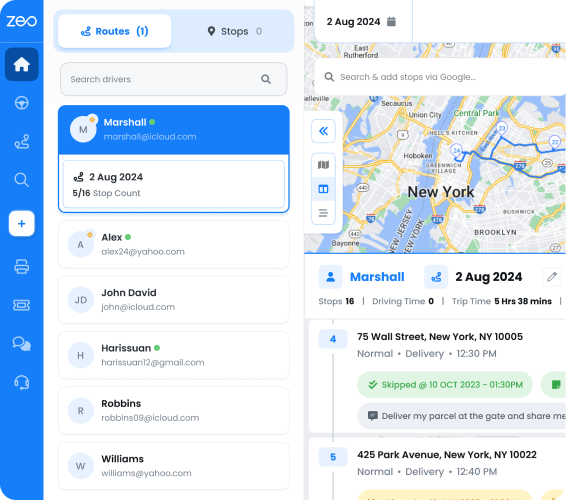
Assign priority levels to urgent deliveries. Zeo lets dispatchers mark stops as ASAP versus normal priority, so time-sensitive deliveries — like a crane rental needed before a specific inspection window — get routed first without disrupting the rest of the day’s plan.
Let route optimization sequence the day, not manual dispatch. Once time windows and priorities are set, AI-generated routes can sequence stops so trucks aren’t crisscrossing back and forth between the same two areas of town. This alone reduces the odds of multiple trucks converging on one site at once.
Adjust routes dynamically when plans change. Construction schedules shift constantly — a pour gets delayed, a site closes for weather, a rush order comes in. Zeo supports dynamic route adjustments mid-shift, so dispatchers can add or reorder stops without starting the day’s plan over.
Use skill-based and vehicle-based assignment. If certain drivers are certified for oversized loads or certain trucks are the only ones with a flatbed, skill-based assignment makes sure the right driver and vehicle get matched to the right delivery automatically.
The combination — realistic scheduling, priority sequencing, AI-optimized routing, and mid-day flexibility — is what actually prevents the pileups at job site gates, not a calendar with time slots on it.
Real-Time Tracking, Proof of Delivery, and the Digital Audit Trail Contractors Need
When a general contractor calls asking where their rebar delivery is, “I’ll check with the driver” isn’t a good enough answer anymore. Neither is a shrug when they claim a delivery of lumber arrived short or damaged.
This is where the combination of live tracking and proof of delivery closes the loop that basic scheduling never could.
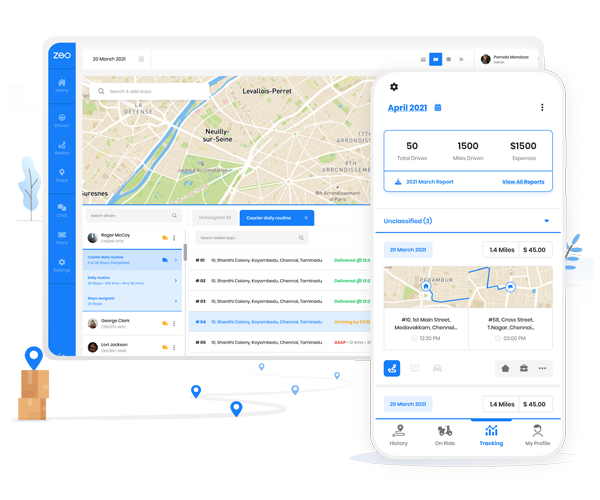
Here’s how it works in practice. Your dispatcher or logistics coordinator builds and assigns the day’s routes from the Zeo web platform — sequencing stops across job sites and supply yards, assigning drivers by skill and vehicle capacity, setting time windows for each delivery.
Drivers then receive their optimized multi-stop route directly on the Zeo mobile app. They navigate each leg using their preferred GPS app — Google Maps, Waze, or Apple Maps — with full turn-by-turn directions and job site details already loaded in.
At each stop, drivers capture proof of delivery on the spot: a photo of materials placed at the site, a digital signature from the site super, or a note like “materials placed at north entrance per foreman.” Every status update — en route, arrived, completed — syncs back to the office in real time.
The result: your office staff sees exactly where every truck is, without picking up the phone. If a contractor disputes a delivery, you pull up the timestamped photo and signature instead of relying on someone’s memory. Real-time ETA updates and live tracking links can also be shared directly with site supervisors, so they know exactly when to expect a truck instead of guessing.
That digital audit trail matters more than most companies realize until they’re in a dispute. According to the Associated General Contractors of America, material delivery delays and disputes remain among the top disruptions cited by contractors managing active job sites. A verifiable record turns a “he said, she said” argument into a two-minute resolution.
Case Example: Optimizing a Multi-Site Construction Delivery Route with Zeo
Consider a mid-sized aggregate and lumber supplier running 18 trucks out of two yards, delivering to an average of 45 job sites per day across a metro area and surrounding rural sites. This mirrors patterns seen across other route optimization case studies involving multi-stop, multi-vehicle operations.
Before optimizing their routing, dispatch assigned trucks manually each morning based on driver familiarity with certain routes. Drivers frequently backtracked between yards, some job sites received deliveries an hour outside their crew’s window, and the office fielded 15-20 “where’s my delivery” calls daily.
Using Zeo, the dispatcher imports the day’s delivery list in bulk via a CSV export from their order system. Each stop includes the job site address, required time window, and load type. Zeo’s AI-powered optimization sequences the 45 stops across 18 trucks in minutes, accounting for vehicle capacity and priority deliveries — like an urgent equipment drop needed before a scheduled inspection.
Drivers receive their routes on the Zeo mobile app and start their day already knowing their full stop sequence and navigation path. As deliveries happen, each driver captures a photo and signature at the site, with notes when needed. The dispatcher watches live GPS tracking from the web platform, catching a potential delay at stop 12 and re-routing a nearby truck to cover an urgent request without disrupting the rest of the plan.
By the end of the week, the supplier cuts average daily drive time by roughly two hours per driver, reduces “where’s my delivery” calls significantly since site supervisors get live tracking links directly, and resolves a damaged-pallet dispute in minutes using timestamped photo proof instead of a drawn-out phone debate.
This is what moving from scheduling to true delivery management looks like in practice — not a bigger calendar, but a system where routing, tracking, and proof work together. The same principles apply to related job-site logistics, such as construction site portable toilet servicing, where recurring stops and access windows create similar scheduling challenges.
Frequently Asked Questions
Q: What’s the difference between delivery scheduling and delivery management?
Scheduling assigns a time slot to a delivery. Delivery management covers the full process — route planning, live tracking, driver communication, and proof of delivery — so the scheduled time actually gets met and documented.
Q: Can route optimization work for job sites without formal addresses?
Yes. Zeo supports bulk address import from Excel, CSV, or Google Sheets, and you can save frequently used job sites as favorites, which helps with sites that are new, temporary, or hard to pin down on standard maps.
Q: How does proof of delivery help with disputes over damaged or late materials?
Photo capture, digital signatures, and delivery notes create a timestamped record for every stop. Instead of relying on memory or a verbal account, you have documentation you can reference immediately when a contractor questions delivery condition or timing.
Q: Do drivers need special training to use route optimization software?
No. Drivers receive their optimized route directly on the Zeo mobile app and navigate using GPS apps they already know, like Google Maps or Waze. The learning curve is minimal since it fits into their existing workflow rather than replacing it.
Q: How many delivery vehicles does a construction supplier need before route optimization makes sense?
Even fleets as small as 5-10 vehicles typically see meaningful time and fuel savings, since manual routing gets inefficient fast once you’re covering multiple job sites and supply points daily. Materials suppliers running 15+ trucks across scattered job sites tend to see the largest gains from AI-powered sequencing.
—
Coordinating deliveries across multiple job sites doesn’t have to mean idle crews, wasted fuel, and disputed invoices. Start a free Zeo Route Planner trial to build your first optimized multi-site delivery route in minutes — or book a demo to see how fleet dispatch, live tracking, and proof of delivery work together for construction logistics.
Are you a fleet owner?
Want to manage your drivers and deliveries easily?
Grow your business effortlessly with Zeo Routes Planner – optimize routes and manage multiple drivers with ease.
increase fuel savings
Save 2 Hours on Deliveries, Everyday!
Optimize routes with our algorithm, reducing travel time and costs efficiently.
Get Started for Free