


# Route Planner App: Complete Business Guide for 2026
> TL;DR: The right route planner app transforms business operations by solving multi-driver coordination challenges that consumer apps like Google Maps can’t handle. Professional route optimization typically saves 2+ hours daily per driver through AI-powered routing, real-time tracking, and automated customer communication. Tools like Zeo Route Planner address these needs with verified features used by 1.5M+ users across 150+ countries.
Managing routes for your growing business with basic apps creates more problems than it solves. When you have multiple drivers or technicians, consumer route planner apps like Google Maps leave you blind to your operations and waste hours every day.
You need a professional route planner app that bridges the gap between basic consumer tools and complex enterprise software. This guide shows you exactly what to look for and how to choose the right solution for your business size and industry.
Why Basic Route Apps Fail for Business Operations
Google Maps works perfectly for personal trips, but it breaks down the moment you need to manage multiple drivers. The fundamental problem is visibility and coordination.
With basic apps, you have no idea where your drivers are during the day. When customers call asking for ETAs, you’re guessing. When drivers get stuck in traffic or finish early, you can’t reassign stops to optimize the rest of their routes.
Basic route apps also optimize for the shortest path, not business needs. They don’t consider time windows when customers are available, driver skills for specific services, or vehicle capacity limits. A pest control technician might get routed to commercial accounts requiring special certifications, or a delivery driver might get assigned stops that exceed their vehicle’s weight capacity.
The coordination overhead becomes crushing as you scale. According to the American Trucking Associations, fleet managers spend an average of 2.5 hours daily on route planning and coordination tasks. You’re manually texting drivers about route changes, fielding customer complaints about missed time windows, and constantly playing catch-up with delays.
Most critically, basic apps provide no accountability or proof of delivery. When customers claim service wasn’t completed or deliveries weren’t made, you have no documentation to resolve disputes.
Essential Features Every Business Route Planner App Must Have
Professional route planner apps solve business problems that consumer apps ignore. Here are the non-negotiable features you need:
Multi-stop optimization goes beyond finding the shortest path. The app should consider time windows, priority stops marked as ASAP, and real-world constraints like traffic patterns throughout the day. This single feature typically saves 2+ hours daily per driver by eliminating backtracking and inefficient routing.
Real-time tracking and communication keeps you connected to field operations. You need live GPS tracking of all drivers, automatic ETA updates for customers, and instant communication channels between managers and field teams. Professional driver tracking software ensures when routes change, everyone stays informed automatically.
Proof of service documentation protects your business and improves customer relationships. Look for apps that capture photos, digital signatures, and detailed notes at each stop. This eliminates disputes and provides professional documentation for service completion.
Customer communication tools reduce your administrative workload. The app should automatically send notifications to customers with arrival times and allow them to track drivers in real-time through a branded tracking page with your company logo.
Driver assignment and management becomes critical once you have multiple team members. You need tools to assign routes based on driver skills, vehicle types, work hours, and geographic territories. The app should handle the complexity of matching the right driver to the right customers.
For example, an HVAC company using a professional route planner app can ensure that commercial equipment repair calls only go to certified technicians, while residential maintenance visits get assigned to any available team member. The system optimizes routes while respecting these business rules.
Route Planner App Comparison Matrix: Free vs Professional vs Enterprise
Understanding the three tiers of route planner apps helps you choose the right investment level for your business size and growth stage.
Free consumer apps like Google Maps, Apple Maps, and Waze work for single-driver operations with simple routing needs. They excel at turn-by-turn navigation and real-time traffic updates. However, they offer no business features, no multi-driver coordination, and no service documentation. Use these only if you’re a solo operator with straightforward routes.
Professional route planner apps serve small to medium businesses with 3-25 drivers. These solutions typically cost $20-50 per driver monthly but deliver immediate ROI through time savings and improved customer service. They include multi-stop optimization, basic tracking, proof of delivery, and customer notifications.
Zeo Route Planner fits this category, providing AI-powered route optimization, real-time GPS tracking, and proof of service features used by over 1.5 million users in 150+ countries. The platform includes both web-based fleet management tools and mobile apps for drivers, making it suitable for companies ready to scale professionally.
Enterprise route optimization platforms cost $100+ per driver monthly and target large fleets with complex requirements. These systems include advanced analytics, compliance automation, and extensive integrations. However, they often require lengthy implementation periods and dedicated IT support.
The key decision point is driver count and operational complexity. If you have fewer than 25 drivers and need immediate deployment, professional apps deliver the best value. Enterprise platforms make sense only when you have dedicated fleet management staff and complex regulatory requirements.
Industry-Specific Route Planning: Finding Apps Built for Your Business Type
Different industries have unique routing requirements that generic apps handle poorly. Understanding your industry’s specific needs helps you evaluate route planner app features more effectively.
Delivery and logistics companies prioritize capacity optimization and proof of delivery. Look for apps that handle weight and volume constraints, support cash-on-delivery tracking, and integrate with e-commerce platforms. The app should automatically import orders from Shopify or WooCommerce and optimize routes based on package sizes and delivery time windows.
Field service businesses like HVAC, plumbing, and electrical contractors need skill-based routing and service documentation. Your route planner app should assign jobs based on technician certifications and capture detailed service notes with photos. Integration with CRM systems like HubSpot helps maintain customer service records.
Healthcare and home services require strict appointment scheduling and customer communication. Look for apps with robust time window management and automatic customer notifications through delivery scheduling software. The ability to send SMS updates and provide live tracking links reduces no-shows and improves patient satisfaction.
Food delivery operations need speed optimization and temperature-sensitive routing. While route planner apps don’t typically include temperature monitoring, features like priority stop designation for time-sensitive deliveries and real-time ETA updates help maintain food quality and customer satisfaction.
Consider a landscaping company managing both residential lawn care and commercial property maintenance. A professional route planner app can ensure that large commercial accounts requiring specialized equipment get assigned to crews with the proper vehicles, while residential routes get optimized for geographic efficiency. The app coordinates these different route types automatically.
Mobile App Performance: Ensuring Your Drivers Can Actually Use the Technology
The best route optimization means nothing if drivers can’t use the mobile app effectively. Mobile performance often determines whether your route planner investment succeeds or fails.
Optimize routes with our algorithm, reducing travel time and costs efficiently.
increase fuel savings
Save 2 Hours on Deliveries, Everyday!
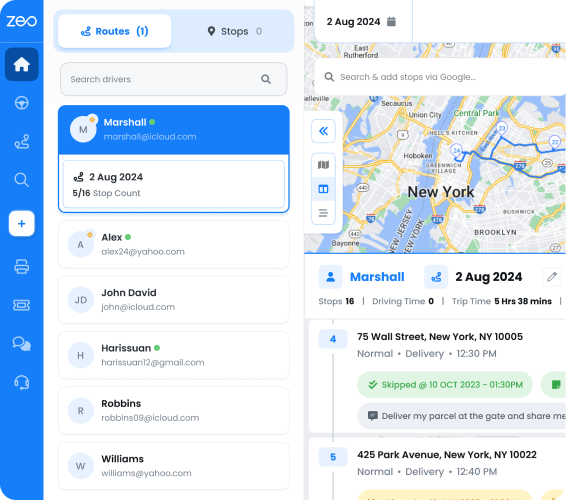
Interface design and usability matter more than feature lists. Drivers use apps while wearing gloves, in bright sunlight, and during time pressure. Look for large buttons, high contrast displays, and simple navigation flows. The app should display essential information like next stop address and customer notes prominently.
Offline functionality prevents disruptions in areas with poor cellular coverage. Your route planner app should download routes to devices and continue providing navigation even when connectivity drops. This reliability is crucial for drivers working in rural areas or urban dead zones.
Integration with preferred navigation apps gives drivers flexibility while maintaining your coordination benefits. Professional route planner apps should export optimized routes to Google Maps, Waze, or Apple Maps for turn-by-turn navigation while still providing real-time updates to fleet managers.
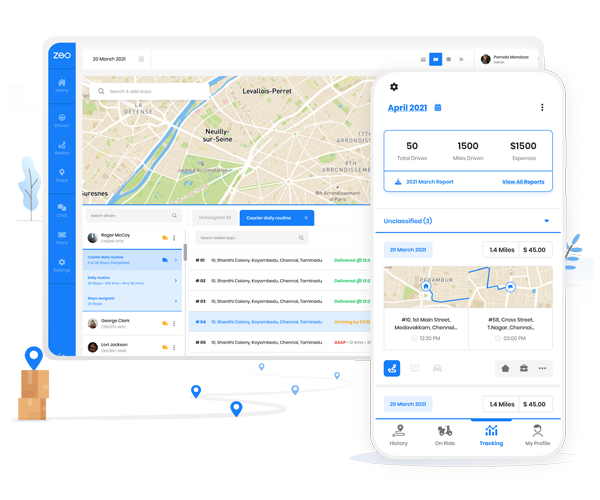
Fleet operations require seamless coordination between manager planning and driver execution. Zeo’s approach illustrates this integration well: fleet managers use the web platform to create and assign optimized routes, while drivers receive these routes automatically in their mobile app with all customer details and service requirements. Real-time updates flow both directions, so managers stay informed of progress while drivers get route adjustments instantly.
Battery optimization and device performance affect daily operations significantly. Route planner apps that drain batteries quickly or slow down older devices create operational problems. Look for apps optimized for all-day use that don’t interfere with other essential business apps on driver devices.
Test mobile app performance during your evaluation period. Have drivers use the app for actual routes and gather feedback on usability, speed, and reliability before making your final decision.
ROI Calculator: When Route Planner Apps Pay for Themselves
Professional route planner apps typically pay for themselves within 30-60 days through time savings and operational improvements. Here’s how to calculate the return on investment for your specific situation.
Time savings provide the most immediate and measurable ROI. The Bureau of Labor Statistics reports that the median wage for delivery drivers is $17.50 per hour, while field service technicians earn $22.50 per hour. If a route planner app saves each driver 2 hours daily, a 5-driver operation saves $525-675 weekly in labor costs alone.
Fuel cost reduction comes from optimized routing that eliminates unnecessary miles. According to the Department of Energy, commercial vehicles average 7-10 miles per gallon. Reducing daily driving by 20 miles per vehicle saves $6-8 daily in fuel costs per driver, assuming current commercial fuel prices.
Customer satisfaction improvements drive revenue growth through repeat business and referrals. Professional route planner apps with real-time tracking and communication typically reduce customer complaints by 40-50% and increase on-time performance to 85-90%.
Consider this real-world example: A pool cleaning service with 8 technicians was spending 3 hours daily on route planning and customer coordination. Their manager was earning $25 per hour, creating $75 daily in administrative costs. After implementing a professional route planner app at $40 per technician monthly, they eliminated 2.5 hours of administrative work and saved 1.5 hours per technician daily through optimized routing.
Their monthly savings totaled $3,100 in administrative time plus $2,400 in technician productivity, while the app cost $320 monthly. The net monthly benefit of $5,180 delivered a 1,620% return on investment.
Calculate your specific ROI by tracking current time spent on route planning, average daily miles driven per vehicle, and customer service issues related to scheduling or delays. Compare these costs to route planner app subscription fees to determine your payback period.
Frequently Asked Questions
Q: How much does a professional route planner app typically cost for small businesses?
Professional route planner apps typically range from $15-50 per driver monthly for small to medium businesses. Zeo Route Planner offers a free tier with 12 routes monthly, with premium plans starting at $15.99/month, making it accessible for growing businesses that need immediate ROI through time savings.
Q: What’s the difference between using Google Maps and a business route planner app?
Google Maps optimizes for shortest routes but lacks business features like multi-driver coordination, real-time tracking, proof of delivery, and customer communication. Business route planner apps consider time windows, driver skills, vehicle capacity, and provide accountability features that consumer apps don’t offer.
Q: How quickly can route optimization software pay for itself?
Most professional route planner apps pay for themselves within 30-60 days through time and fuel savings. A typical 5-driver operation saves $525-675 weekly in labor costs alone when each driver saves 2 hours daily, while app costs range from $80-250 monthly depending on features needed.
Q: Can route planner apps work offline when drivers lose cell coverage?
Yes, quality route planner apps download routes to devices and continue providing navigation during connectivity drops. This offline functionality is essential for drivers working in rural areas or urban dead zones where cellular coverage may be intermittent.
Q: Do route planner apps integrate with existing business software like CRM or e-commerce platforms?
Professional route planner apps typically offer integrations with popular business tools. For example, many integrate with Shopify and WooCommerce for automatic order import, HubSpot for CRM synchronization, and Zapier for connecting to thousands of other business applications.
Professional route planner apps transform business operations by solving the coordination challenges that basic apps ignore. The right solution scales with your business while delivering immediate ROI through time savings and improved customer service.
Start your free trial of Zeo Route Planner to see how professional route optimization can transform your business operations.
Are you a fleet owner?
Want to manage your drivers and deliveries easily?
Grow your business effortlessly with Zeo Routes Planner – optimize routes and manage multiple drivers with ease.

increase fuel savings
Save $200 on fuel, Monthly!
Optimize routes with our algorithm, reducing travel time and costs efficiently.
Get Started for Free