


# Best Route Planner App for Business: Beyond Google Maps
> TL;DR: Modern route planner apps save businesses 15-25% on miles driven and 2+ hours daily in planning time compared to manual methods or basic navigation apps. Professional route optimization tools like Zeo Route Planner address this with AI-powered algorithms and real-time GPS tracking, helping delivery and field service teams achieve measurable cost reductions while improving customer satisfaction.
Your delivery driver just spent 20 minutes finding the optimal order to visit 12 stops. Your field technician is stuck in traffic with no way to update customers about delays. Your operations manager manually assigns routes each morning, burning two hours before the workday even starts.
If your team relies on Google Maps or manual planning, you’re solving yesterday’s problems with yesterday’s tools. Modern route planner apps designed for business transform how mobile teams work, turning chaos into coordination and wasted time into profit.
Let’s explore why basic navigation fails businesses and how the right route planner app can revolutionize your operations.
Why Basic Navigation Apps Fail for Business Route Planning
Google Maps excels at getting you from point A to point B. But running a business with mobile workers requires solving from point A to points B, C, D, E, F, and back to A – efficiently, profitably, and with full visibility.
Single-Stop Thinking vs Multi-Stop Reality
Consumer navigation apps optimize one route at a time. When your driver has 15 deliveries, Google Maps calculates the best path to stop #1, then the best path from #1 to #2, and so on. This creates a locally optimal but globally inefficient route.
A delivery driver following Google Maps suggestions might drive 85 miles to complete stops that a proper route optimization algorithm would organize into a 52-mile circuit. That 33-mile difference compounds across every driver, every day.
No Business Context
Google Maps doesn’t understand that Mrs. Johnson is only home before 2 PM, or that your HVAC technician needs 90 minutes for each service call, or that downtown deliveries take twice as long during lunch rush.
Your business operates within constraints that consumer apps simply can’t process: time windows, service durations, driver skills, vehicle capacities, and customer preferences.
Zero Operational Visibility
When your field team uses personal navigation apps, you’re flying blind. Where is Driver #3? Why is the 2 PM appointment running late? Did the customer sign for the delivery? What’s the ETA for the final stop?
These questions matter for customer service, scheduling, and profitability. Consumer apps provide none of these answers.
Essential Features That Separate Business Route Planners from Consumer Apps
Professional route planner apps solve business problems that Google Maps wasn’t designed to handle. Here’s what separates the tools built for business:
Multi-Stop Route Optimization
True route optimization considers all stops simultaneously, not sequentially. Advanced algorithms evaluate millions of possible route combinations to find the most efficient path for your specific constraints.
The math gets complex quickly. For just 10 stops, there are over 3.6 million possible route combinations. For 20 stops, that number exceeds 2.4 quintillion possibilities. Human intuition and basic navigation apps can’t compete with this computational power.
Time Window Management
Real businesses have real constraints. Your restaurant supply route must hit cafes before lunch prep. Your residential security installation can only happen when homeowners are available. Your pharmaceutical deliveries have strict timing requirements.
Business route planners factor time windows into optimization calculations, ensuring routes respect customer availability while maintaining efficiency.
Proof of Service and Delivery
Documentation matters for business operations. Professional apps include photo capture, digital signatures, delivery notes, and payment collection features. This creates an audit trail while protecting against disputes and chargebacks. Modern proof of delivery systems have become essential for maintaining customer trust and operational transparency.
Real-Time Customer Communication
Customers expect transparency. Business route planners provide automatic notifications with accurate ETAs, live tracking links, and delay updates. This reduces customer service calls while improving satisfaction scores. Advanced driver tracking software enables real-time coordination between field teams and office managers.
Fleet Coordination and Management
When you manage multiple drivers, coordination becomes critical. Business apps provide centralized route planning, real-time tracking, driver-to-manager communication, and performance analytics.
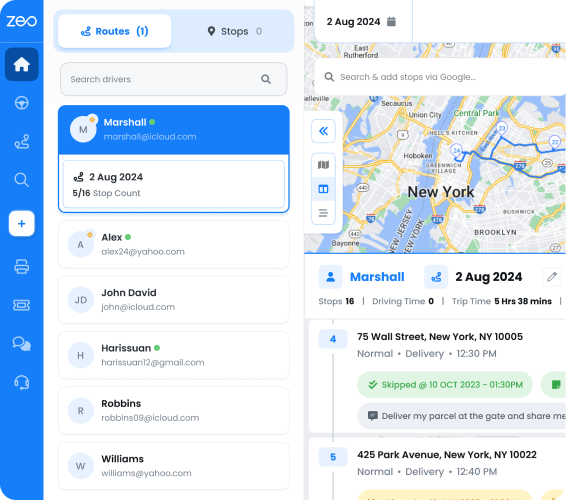
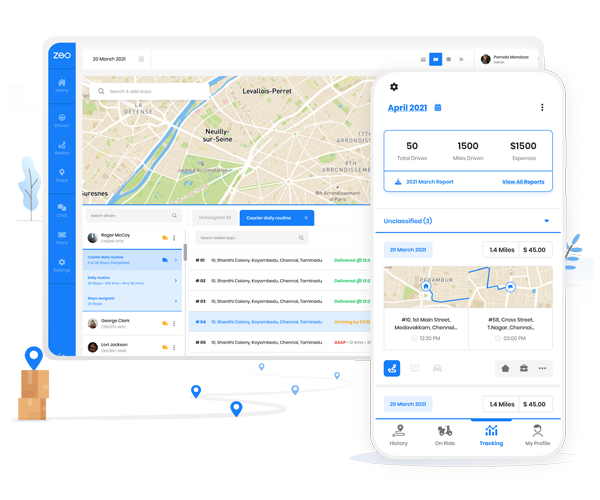
Zeo Route Planner solves this coordination challenge with its dual-platform approach. Fleet managers use the web platform to create optimized routes, while drivers receive assignments directly through the mobile app, complete with navigation and customer details. Professional fleet management software transforms chaos into coordinated efficiency.
How Modern Route Planner Apps Actually Work: Algorithms, AI, and Real-Time Optimization
Understanding how route optimization works helps you evaluate different solutions and set realistic expectations for results.
The Traveling Salesman Problem
Route optimization is a variation of the classic “Traveling Salesman Problem” – finding the shortest path that visits multiple locations exactly once. While mathematically complex, modern algorithms solve this efficiently using several approaches:
Genetic Algorithms simulate evolution, creating multiple route “generations” and selecting the fittest solutions for further refinement. Each iteration produces better routes until optimization converges on the optimal solution.
Machine Learning Models analyze historical data to predict actual travel times, accounting for traffic patterns, road construction, delivery durations, and seasonal variations that static maps miss.
Constraint Programming handles business rules like driver skills, vehicle capacities, time windows, and priority levels while maintaining route efficiency.
AI-Powered Predictive Routing
Advanced route planners don’t just optimize for current conditions – they predict future scenarios. AI-powered optimization analyzes factors like:
- Historical traffic patterns by time and day
- Weather impact on travel times
- Seasonal demand fluctuations
- Customer behavior patterns
- Driver performance variations
Zeo Route Planner’s AI-powered optimization processes these variables automatically, delivering routes that save 2+ hours daily per driver compared to manual planning methods.
Dynamic Re-Optimization
Static routes break down when reality intervenes. Customers reschedule, drivers call in sick, vehicles break down, or emergency jobs appear.
Modern route planners handle these disruptions through dynamic re-optimization, recalculating optimal routes in real-time without requiring manual intervention.
Industry-Specific Route Planning: Delivery vs Field Service vs Sales Requirements
Different industries have unique routing requirements. The best route planner app for your business depends on your specific operational challenges.
Delivery Operations
Delivery businesses prioritize speed, capacity utilization, and proof of delivery. Key requirements include:
High Stop Density: Delivery routes often include 50-150 stops per day. Route optimization can reduce total miles driven by 15-25% compared to manual planning.
Capacity Constraints: Vehicle weight and volume limits must factor into route assignments. Overloading vehicles creates safety risks and potential fines.
Delivery Windows: E-commerce customers expect specific delivery timeframes. According to recent logistics industry studies, 85% of customers prefer scheduled delivery windows over unpredictable arrival times.
Documentation: Signature capture, photos, and delivery notes protect against disputes while enabling customer service teams to answer questions quickly.
Field Service Operations
Field service companies face different challenges than delivery operations:
Service Duration Variability: HVAC repairs might take 45 minutes or 4 hours. Route planners must account for appointment buffer time and scheduling flexibility.
Skill-Based Assignment: Not every technician can handle every job. Advanced route planners match jobs to qualified workers while maintaining geographic efficiency.
Parts and Equipment: Service vehicles carry inventory that affects capacity and capabilities. Route optimization should consider these constraints when assigning jobs.
Emergency Calls: Field service companies must accommodate urgent requests while minimizing disruption to scheduled routes.
Sales Team Routing
Sales representatives have distinct routing needs focused on relationship building and territory management:
Prospect Prioritization: High-value prospects deserve prime appointment slots. Route planners should weight stops by potential revenue, not just geographic convenience.
Relationship Maintenance: Regular customer visits maintain relationships. Sales routing should balance new prospect visits with existing account management.
Flexible Scheduling: Sales calls often run long or short based on opportunity development. Route planners must accommodate schedule variability.
Territory Optimization: Sales teams need tools to identify coverage gaps and optimize territory assignments for maximum market penetration.

increase fuel savings
Hassle Free Deliveries & Pickups!
Optimize routes with our algorithm, reducing travel time and costs efficiently.
Get Started for Free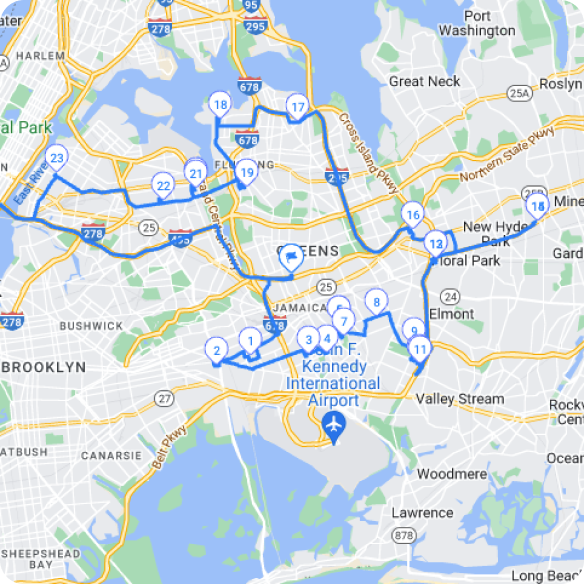
ROI Calculator: How Much Time and Money Route Planner Apps Actually Save
Route planner apps deliver measurable returns through time savings, fuel reduction, and improved customer satisfaction. Here’s how to calculate your potential savings:
Time Savings Calculation
Manual route planning typically requires 20-30 minutes per driver per day. For a 5-driver operation, that’s 2.5 hours of management time daily, or roughly 650 hours annually.
Management Time Savings: 650 hours × $25/hour = $16,250 annual savings
Route optimization reduces actual driving time by 15-25% on average. For drivers covering 100 miles daily, that’s 15-25 fewer miles, saving 30-60 minutes of road time.
Driver Time Savings: 5 drivers × 45 minutes daily × 250 working days × $20/hour = $18,750 annual savings
Fuel Cost Reduction
The Department of Energy reports that commercial vehicles average 10-12 miles per gallon. With current fuel costs around $3.50 per gallon, every mile saved delivers real value.
Using our earlier example of 20 miles saved per driver daily:
- 5 drivers × 20 miles × 250 days = 25,000 annual miles saved
- 25,000 miles ÷ 11 MPG × $3.50 = $7,955 annual fuel savings
Customer Satisfaction Impact
Reliable ETAs and proactive communication reduce customer service calls and improve retention rates. Industry research shows that companies with superior delivery tracking experience 23% higher customer retention than competitors.
For a service business generating $500,000 annual revenue, a 5% improvement in retention delivers $25,000 in preserved revenue.
Total ROI Example
For our hypothetical 5-driver operation:
- Management time savings: $16,250
- Driver productivity gains: $18,750
- Fuel cost reduction: $7,955
- Customer retention value: $25,000
- Total annual benefit: $67,955
Most business route planner apps cost $20-50 per driver monthly, or $1,200-3,000 annually for a 5-driver team. This delivers ROI ratios of 20:1 to 55:1 – among the highest returns of any business software investment.
Choosing the Right Route Planner App: Free vs Paid Features Comparison
Route planner apps range from free consumer tools to enterprise platforms costing hundreds per month. Understanding feature differences helps you choose the right solution for your needs.
Free Route Planning Options
Free tools like Google Maps, MapQuest, and Waze offer basic multi-stop routing with significant limitations:
Stop Limits: Most free tools cap routes at 10-25 stops, insufficient for serious delivery operations.
No Optimization: Free tools create routes in the order you enter stops, missing optimization opportunities.
Limited Business Features: No proof of delivery, customer notifications, or fleet management capabilities.
No Support: Free tools offer minimal customer service when issues arise.
Free options work for very small operations or occasional routing needs, but lack the features required for systematic business improvement.
Entry-Level Paid Solutions
Paid route planners starting at $20-40 monthly typically include:
- Route optimization for 50-200 stops
- Basic proof of delivery (photos, signatures)
- Customer notifications
- Route sharing and basic tracking
- Email support
These solutions work well for single-driver operations or small teams with straightforward routing needs.
Professional Route Planning Platforms
Advanced solutions like Zeo Route Planner provide enterprise-grade features for growing businesses:
Unlimited Route Optimization: Handle routes with 200+ stops using advanced algorithms that consider multiple constraints simultaneously.
Fleet Management: Centralized platform for managing multiple drivers, with route assignment and real-time coordination between office and field teams.
Advanced Tracking: Real-time GPS monitoring, live ETA updates, and comprehensive analytics for performance optimization.
Integration Capabilities: Connect with existing business systems like Shopify, WooCommerce, and CRM platforms for seamless operations.
Dedicated Support: Professional customer service with implementation assistance and ongoing optimization guidance.
Zeo serves over 1.5 million users across 150+ countries, demonstrating the scalability and reliability required for business-critical operations.
Enterprise Solutions
Large operations may require custom enterprise solutions with features like:
- API integration with existing business systems
- Custom reporting and analytics
- Advanced compliance and audit capabilities
- Dedicated account management
- Service level agreements
Enterprise solutions typically start at $200+ monthly but provide the customization and support large organizations require.
Frequently Asked Questions
Q: How much can a route planner app actually save compared to manual planning?
Professional route planner apps typically save 15-25% on total miles driven and 20-30 minutes of planning time per driver daily. Zeo Route Planner’s AI-powered optimization saves users 2+ hours daily compared to manual planning methods, with measurable fuel cost reductions of 20-30% for most fleets.
Q: What’s the difference between Google Maps routing and business route planner apps?
Google Maps optimizes routes sequentially (A to B, then B to C), while business route planners evaluate all stops simultaneously to find the most efficient overall path. Business apps also include features like time windows, proof of delivery, customer notifications, and fleet coordination that Google Maps doesn’t offer.
Q: Can route planner apps handle time-sensitive deliveries and service windows?
Yes, professional route planner apps factor time windows into optimization calculations, ensuring routes respect customer availability while maintaining efficiency. Zeo Route Planner includes time window constraints and priority stops (ASAP vs Normal) to handle urgent deliveries alongside scheduled appointments.
Q: Do route planner apps work for both delivery and field service operations?
Most business route planners support both delivery and field service operations, though feature emphasis varies. Delivery-focused apps prioritize high stop density and capacity constraints, while field service apps emphasize skill-based assignment, variable service durations, and equipment considerations.
Q: What ROI can businesses expect from investing in route planning software?
Route planning software typically delivers ROI ratios of 20:1 to 55:1 through time savings, fuel reduction, and improved customer satisfaction. For a 5-driver operation, annual benefits often exceed $60,000 while software costs range from $1,200-3,000 annually, making it among the highest-return business software investments.
Transform Your Mobile Workforce Today
The difference between basic navigation apps and professional route planners isn’t just features – it’s the difference between managing chaos and orchestrating efficiency.
Your drivers deserve tools that make their jobs easier. Your customers deserve reliable service and accurate communication. Your business deserves the profitability that comes from optimized operations.
The math is clear: professional route planning delivers measurable returns that far exceed the modest monthly investment. The question isn’t whether you can afford to upgrade – it’s whether you can afford to keep wasting time and money on inadequate tools.
Start your free trial of Zeo Route Planner to see how much time and fuel you can save with intelligent route optimization. Experience the difference that purpose-built business tools make for your mobile workforce efficiency.
Are you a fleet owner?
Want to manage your drivers and deliveries easily?
Grow your business effortlessly with Zeo Routes Planner – optimize routes and manage multiple drivers with ease.

increase fuel savings
Save $200 on fuel, Monthly!
Optimize routes with our algorithm, reducing travel time and costs efficiently.
Get Started for Free