


# Legal Document Delivery Optimization: A 2026 Dispatch Playbook
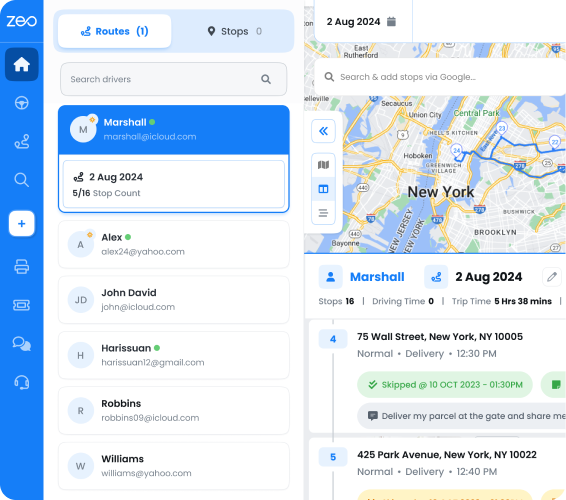
> TL;DR: Legal document delivery optimization combines route planning with process-serving-specific rules, like statutory deadlines, re-attempt patterns, and documentation requirements, to cut failed attempts and protect filing windows. Civil case backlogs have grown in many jurisdictions post-pandemic, making deadline-driven dispatch a competitive advantage rather than a nice-to-have. Route optimization tools like Zeo Route Planner address this with priority stop settings and dynamic mid-shift re-routing, helping process serving teams save 2+ hours daily.
Process serving runs on deadlines. Miss a statutory filing window, and your client’s case can get dismissed. Fail to prove a serve happened, and it can be challenged in court.
Most agencies still assign serves with spreadsheets, group texts, or legacy case management tools that weren’t built for routing. The result: servers waste mileage on bad addresses, urgent serves sit behind routine ones, and proof of service gets reconstructed from memory after the fact.
Legal document delivery optimization fixes this by combining route planning with the specific rules process serving runs on: statutory deadlines, re-attempt patterns, and airtight documentation. This guide walks through the mechanics, the ROI math, and what it looks like in the field.
Why Standard Route Optimization Falls Short for Process Serving
Generic route optimization software is built for delivery trucks dropping off packages. Process serving has different constraints that most routing tools ignore.
A package doesn’t dodge the driver. A defendant might. Standard routing tools don’t account for behavior patterns, like a recipient who’s only home after 7 PM, or an address that needs three attempts before a sub-service option kicks in.
Generic tools also don’t understand legal deadlines. A subpoena due in 48 hours needs to jump the queue, regardless of how far out of the way it is. Most delivery software optimizes purely for distance and time, not statutory urgency.
Jurisdictional rules add another layer. Service requirements vary by county and state. An agency running servers across three states needs routing logic that respects those boundaries, not just the shortest path between stops.
This is why agencies juggling 5 to 30 servers often end up with a patchwork: a spreadsheet for assignments, a group chat for updates, and a filing cabinet (or a shared drive) for proof of service. It works until a serve gets challenged, a deadline gets missed, or a server quits and takes undocumented knowledge of “problem addresses” with them.
Route Optimization Mechanics: How Time-Windows, Priority Rules, and Failed-Attempt Re-Routing Work Together
Legal document delivery optimization isn’t one feature. It’s three mechanics working together: time windows, priority rules, and re-routing logic.
Time windows tell the system when a serve is realistically achievable. If a defendant is only reachable between 6 PM and 9 PM, Zeo’s time window constraints let you lock that in. The route planner then builds the server’s day around that window instead of treating every stop as equally flexible.
Priority stops separate “ASAP” serves from routine ones. Zeo’s priority stop setting lets dispatchers flag a time-sensitive summons so it gets sequenced ahead of lower-urgency drops, even if it means a longer drive for the server.
Failed-attempt re-routing is where dispatch gets dynamic. When a server marks an address as “no answer” or “refused,” that stop needs to re-enter the queue, often on a different day or with a different server. Zeo’s dynamic route adjustments mid-shift let dispatchers rebuild the remaining route in real time instead of waiting until end-of-day to reshuffle tomorrow’s plan.
Here’s how it plays out: a server arrives at an address for attempt two. No answer again. Dispatch gets notified instantly through the live GPS tracking and status updates. Instead of that address sitting untouched until someone remembers to reassign it, it goes back into the pool for a servers whose shift still has capacity, now flagged for an evening attempt based on the pattern from the first two tries.
Deadline-Driven Dispatch: Prioritizing Serves by Statutory and Court Filing Windows
Every serve has a clock attached to it. Some give you weeks. Others give you days. Deadline-driven dispatch means your routing software treats these differently, automatically.
Set up your serving queue so each job carries a due date tied to the statutory deadline, not just a generic “priority” label. A temporary restraining order with a 72-hour window should never be scheduled the same way as a routine civil summons due in three weeks.
With Zeo’s priority stop and time window features combined, you can structure dispatch so:
- Urgent court filings get marked ASAP and routed to the nearest available server first
- Routine serves fill in around time-sensitive ones instead of competing for the same morning slots
- Servers see deadline information directly on their assigned stop, not buried in a separate case file
This matters because courts don’t grant extensions for routing inefficiency. According to the National Center for State Courts’ research on civil case backlogs, civil case backlogs have grown in many jurisdictions post-pandemic, putting more pressure on tight filing windows. An agency that can guarantee same-day or next-day attempts on urgent serves has a real competitive advantage over one that serves everything in the order it was received.
Deadline-driven dispatch also protects your agency’s reputation. Attorneys remember which process servers hit impossible deadlines and which ones made them scramble for a continuance.
The ROI of Optimized Dispatch: A Cost-Per-Failed-Attempt and Mileage Savings Framework
Most agency owners know failed attempts cost money. Few have actually run the math. Here’s a framework you can apply to your own numbers.
Step 1: Calculate your cost per failed attempt.
Take your average server hourly cost (wages plus vehicle expense) and divide by attempts completed per hour. If a server costs $28/hour fully loaded and completes 2.5 attempts per hour, each attempt costs roughly $11.20, successful or not.
Step 2: Calculate your failure rate.
If your agency averages 30% failed first attempts (no answer, wrong address, refused service), and you run 500 serves a month, that’s 150 failed attempts. At $11.20 each, that’s $1,680 a month in attempts that produced nothing.
Step 3: Apply mileage waste.
The IRS standard mileage rate for 2026 sits in the mid-70-cents-per-mile range once updated figures are published, covering fuel, maintenance, and depreciation. If inefficient routing adds even 15 extra miles per server per day across a 15-server team, that’s 225 miles a day, or roughly $160-170 in pure mileage waste daily, before counting wasted labor hours.
Step 4: Model the optimization impact.
Zeo’s AI-powered route optimization is built to save 2+ hours daily per driver by cutting backtracking and sequencing stops efficiently. For a process serving team, that reclaimed time translates directly into more attempts per shift, or the same attempts completed in less paid time.
Run your own numbers: (current monthly failed-attempt cost) + (current monthly mileage waste) = your optimization opportunity. For a 15-server agency, this routinely lands in the $3,000-$6,000/month range in recoverable cost, before counting the revenue from additional completed serves the freed-up time allows.
This isn’t a guarantee of specific savings. It’s a framework to quantify what inefficient dispatch is actually costing your agency today.
Proof of Service That Holds Up in Court: GPS, Photo, Signature, and Timestamp Evidence
An affidavit of service is only as strong as the evidence behind it. When a defendant’s attorney challenges service, “I remember serving him” doesn’t hold up. Documentation does.
Zeo’s proof of delivery tools capture the evidence process servers need, attached directly to the stop record:
- Photo capture at the moment of service, documenting the location and recipient when appropriate
- Digital signature collection when the recipient is willing to sign for acknowledgment
- Delivery notes where the server can log details like physical description, time of day, and circumstances of service
- GPS-stamped location data tied to each completed stop, corroborating that the server was physically at the address
For serves where the recipient refuses to sign or won’t acknowledge identity, the combination of GPS timestamp, photo, and detailed notes gives your agency a documented record instead of a server’s memory months later when the case goes to a contested hearing.
This matters more than most agencies realize. The American Bar Association’s guidance on service of process has repeatedly noted that improper or undocumented service is a leading ground for motions to quash, which can delay cases for months and expose agencies to liability claims. Airtight documentation isn’t just good practice, it protects your agency’s reputation and your client relationships.
Centralizing this proof also solves an operational headache: no more digging through a server’s phone for a photo three weeks after the serve happened. Everything attaches to the route record at the moment of completion.

increase fuel savings
Hassle Free Deliveries & Pickups!
Optimize routes with our algorithm, reducing travel time and costs efficiently.
Get Started for Free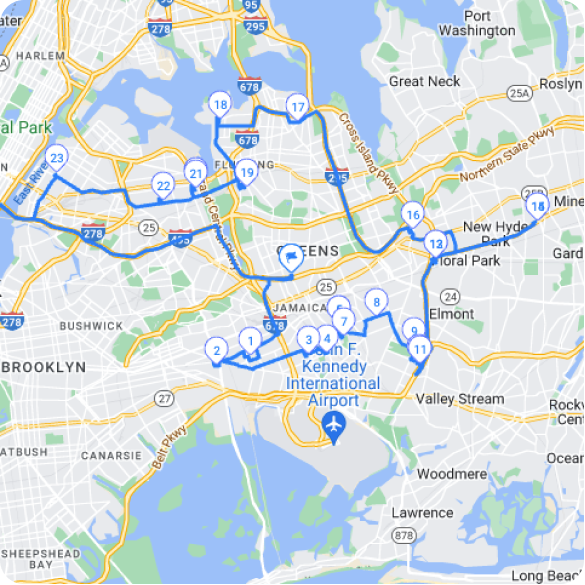
From Solo Server to Multi-State Team: Scaling Dispatch With Territory Balancing
A one-person operation can manage dispatch in their head. A 20-server agency covering multiple counties can’t.
As agencies grow, the challenge shifts from “how do I route my day” to “how do I balance load across a team with different territories, skills, and capacities.” This is where fleet-level dispatch tools matter.
Zeo’s skill-based job assignment lets dispatchers match serves to the right server, not just the nearest one. If certain servers are authorized to serve in specific counties, or have experience with high-conflict addresses, dispatch can route accordingly instead of assigning blind.
Territory balancing also prevents the common growth-stage problem: one server drowning in 40 stops while another has 12. Zeo’s auto-assignment of stops distributes serving load based on capacity, geography, and priority, so no single server becomes a bottleneck.
For agencies expanding into new counties or states, this scalability matters. You’re not rebuilding your dispatch process every time you add territory, you’re extending the same system with new rules layered in.
Zeo’s route analytics and reporting also give operations managers visibility into which servers are consistently over or under capacity, and which territories are generating the most failed attempts, data that’s nearly impossible to pull from a spreadsheet-based system.
Inside the Field Server App: Offline Mode, One-Tap Proof Capture, and Real-Time Status Sync
Here’s what deadline-driven dispatch looks like from the field, start to finish.
The dispatch. A case manager at the office logs into the Zeo web platform and assigns a time-sensitive subpoena, flagged ASAP, with a court filing deadline in 36 hours. The system factors this into the day’s route alongside the server’s other scheduled stops, prioritizing the urgent serve without the dispatcher manually reshuffling anyone’s day.
The receipt. The server opens the Zeo mobile app and sees the updated route, complete with turn-by-turn navigation, the recipient’s address, and any case notes the office attached, like “attempt evening hours only” or “verify identity before serving.”
The field work. The server arrives at an older apartment complex with weak cell signal. No problem. Zeo’s offline mode keeps the app functional even with poor connectivity, so the server can still capture a GPS-stamped photo and log a signature at the moment of service, with that data syncing automatically once the connection returns.
The proof capture. Service is completed and acknowledged. The server takes a timestamped photo, collects a signature, and adds a quick note: “Served to individual matching physical description at front door, 7:42 PM.” All of it attaches to that stop record, no separate paperwork required.
The sync. Within moments of reconnecting, the completed serve status updates back at the office in real time. The case manager sees it immediately, closing the loop without a phone call or a text asking “did you get that one done?”
The exception handling. On the next attempt, the server marks an address as “no answer.” That status update flows straight back to dispatch, where it can be flagged for a re-attempt on a different day or reassigned, based on the behavior pattern logged from prior attempts.
This back-and-forth, dispatcher to field and back again, is what closes the gap between office planning and what actually happens at the door. It’s also what turns “I think it was served” into a documented, time-stamped, court-ready record.
Getting Started: Building Your First Optimized Serving Routes With Zeo
You don’t need to overhaul your entire operation on day one. Start with your highest-stakes problem.
If missed deadlines are your pain point: Start by tagging your current caseload with statutory due dates and setting up priority stops in Zeo so urgent serves route to the top automatically.
If failed attempts are draining your budget: Build time windows around your known behavior patterns for problem addresses, and use dynamic route adjustments to re-route failed attempts same-day instead of letting them sit.
If proof of service challenges are hurting your reputation: Equip your field team with the Zeo mobile app and make photo capture, signature collection, and detailed notes a required step before marking any serve complete.
If you’re scaling across counties or states: Set up skill-based assignment and territory rules so growth doesn’t mean reinventing your dispatch process from scratch. You can also bulk-upload your current caseload from a spreadsheet rather than re-entering addresses by hand.
Most agencies see the clearest first win by tackling deadline-driven dispatch and proof of service together. These two changes directly protect revenue and reputation, the two things a failed serve or a challenged affidavit actually threatens.
Legal document delivery optimization isn’t about adding more software for its own sake. It’s about giving your dispatchers and servers a system that understands deadlines, re-attempt logic, and documentation requirements, built for how process serving actually works.
Frequently Asked Questions
Q: What happens if a process server can’t complete service before a statutory deadline?
Most jurisdictions require a motion for alternative service, extension, or a request for additional time, which varies by court and case type. Agencies that track statutory windows closely and prioritize urgent serves are far less likely to need these workarounds. Flagging time-sensitive serves as a dispatch priority, rather than handling cases in the order received, is one of the most effective ways to avoid missed windows altogether.
Q: How many attempts does a process server typically need before using sub-service or alternative service?
This depends on state and local rules, but many jurisdictions require two to three documented attempts, often at different times of day, before alternative service methods become available. Logging the time, date, and outcome of each attempt is essential, since courts scrutinize this history closely when service is contested. Tools that attach notes and timestamps directly to each attempt make this history easier to reconstruct than relying on a server’s memory weeks later.
Q: What makes proof of service “airtight” if a defendant challenges it in court?
Strong proof of service combines multiple independent data points: a timestamped location, visual documentation, and a detailed written account of the circumstances. Zeo’s proof of delivery tools capture GPS-stamped photos, digital signatures, and delivery notes attached directly to each stop record, giving agencies a documented trail instead of relying on a server’s recollection months later.
Q: How much does route optimization software cost for a small process serving agency?
Pricing varies by platform and team size, but many route optimization tools offer entry-level plans suited to small teams. Zeo Route Planner’s mobile app includes a free tier for up to 12 routes a month, with premium plans starting at $15.99/month, making it accessible for solo servers or small agencies before scaling to fleet-level, per-seat pricing as the team grows.
Q: Can process serving agencies use route optimization across multiple counties or states?
Yes, though agencies need routing logic that respects jurisdictional boundaries rather than just shortest-path calculations, since service rules differ by county and state. Features like skill-based assignment let dispatchers match servers to the territories and case types they’re authorized to handle, which matters more as an agency expands beyond a single jurisdiction.
Start a free Zeo Route Planner trial to build your first deadline-prioritized serving routes, or book a demo to see how fleet dispatch and the driver app work together for process serving teams.
Are you a fleet owner?
Want to manage your drivers and deliveries easily?
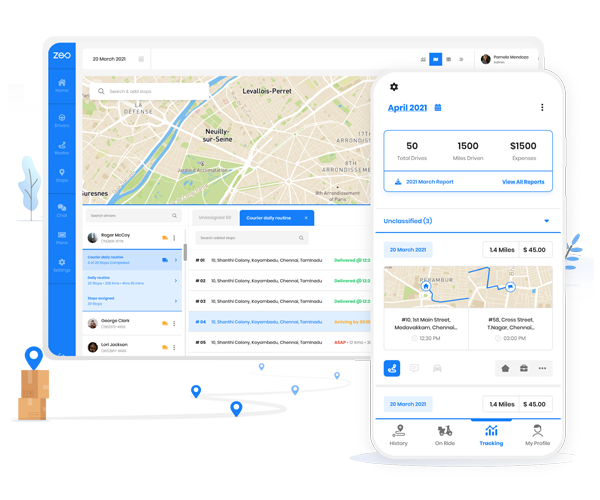
Grow your business effortlessly with Zeo Routes Planner – optimize routes and manage multiple drivers with ease.
increase fuel savings
Save 2 Hours on Deliveries, Everyday!
Optimize routes with our algorithm, reducing travel time and costs efficiently.
Get Started for Free