


# Construction Delivery Management: Project Methods + Logistics Software Guide
> TL;DR: Construction delivery management means two different things — the contractual project delivery method (Design-Build, CMAR, etc.) and the physical logistics of getting materials to job sites on time — and most delays trace back to the second one. The Construction Industry Institute found inefficient material management can account for up to 10-12% of total labor costs on a project, largely from idle crews waiting on late deliveries. Route optimization tools like Zeo Route Planner address this with time window constraints and priority stop flagging, helping materials suppliers and contractors cut missed delivery windows across multi-site projects.
If you searched “construction delivery management,” you probably got two different kinds of results. Some articles explain contract structures like Design-Build and CMAR. Others talk about getting materials to job sites on time.
Both are real. Both matter. And most guides only cover one, leaving you to figure out the other on your own.
This guide covers both. You’ll learn how the major project delivery methods work, then dig into the physical logistics problem that derails projects no matter which method you chose. Because here’s the truth: even a perfectly structured Design-Build contract falls apart if your concrete truck gets turned away at a gate for missing a 7 AM window.
What Does “Construction Delivery Management” Actually Mean? (Clearing Up Two Different Things)
The phrase has two distinct meanings in construction, and mixing them up wastes your time.
Meaning #1: Project Delivery Methods. This is the contractual framework for how a construction project gets designed, bid, and built. It defines who holds risk, how contracts are structured, and who manages the relationship between owner, architect, and contractor.
Meaning #2: Material Delivery Logistics. This is the operational side — getting lumber, concrete, rebar, and equipment to the right job site, at the right time, without blowing through labor costs or site access windows.
Operations managers and logistics coordinators usually care about the second meaning. But the two are more connected than people realize. Your project delivery method sets the schedule. Your logistics execution determines whether that schedule survives contact with reality.
A Design-Build project with an aggressive 10-month timeline doesn’t have room for a lumber delivery showing up four hours late. The contract method sets expectations. The logistics either meet them or miss them.
Construction Project Delivery Methods Explained: Design-Build vs. Design-Bid-Build vs. CM Agency vs. CMAR
Before getting into logistics, it helps to understand the four main project delivery methods you’ll encounter. Each one changes who’s responsible for scheduling and, indirectly, how tight your material delivery windows will be.
| Method | How It Works | Risk Owner | Typical Timeline Pressure |
|—|—|—|—|
| Design-Bid-Build (DBB) | Owner hires architect, then bids construction separately | Split between owner and contractor | Moderate — sequential phases allow planning time |
| Design-Build (DB) | Single entity handles design and construction | Design-build team | High — overlapping phases compress delivery windows |
| CM Agency (CMa) | Owner hires a construction manager as an advisor, contracts stay separate | Owner | Moderate — CM coordinates but doesn’t hold contracts |
| CM at Risk (CMAR) | CM is also the general contractor, guarantees a max price | CM/GC | High — guaranteed price demands tight cost and schedule control |
Here’s what matters for your logistics team: Design-Build and CMAR projects compress timelines because design and construction phases overlap. That means less buffer time for material deliveries. A missed delivery window on a CMAR project doesn’t just delay work — it eats into the contractor’s guaranteed margin.
According to the Associated General Contractors of America industry data, over 40% of nonresidential construction now uses Design-Build or CMAR delivery methods, up from a fraction of that two decades ago. That shift means more projects running on tighter schedules with less room for logistics errors. For broader context on how construction employment and project volume are trending, the Bureau of Labor Statistics construction industry data tracks sector-wide growth that’s pushing more companies toward tighter scheduling.
Whichever method your project uses, the contract tells you when materials need to arrive. It says nothing about how to actually get them there through city traffic, narrow site gates, and competing delivery windows across five active jobs. That’s where most teams get stuck.
The Hidden Logistics Problem: Why Material Deliveries Derail Even the Best-Planned Projects
Here’s what actually happens on a typical Tuesday for a mid-sized materials supplier running deliveries to eight active job sites.
Site access restrictions. Downtown sites often allow deliveries only between 9 AM and 11 AM to avoid rush-hour congestion. Miss that window and your driver waits until the next day — or gets turned away entirely.
Narrow delivery windows stacked across multiple sites. When five job sites all need materials between 7 AM and 9 AM, someone has to lose. Without a system to sequence stops by priority and drive time, dispatchers guess — and guessing means idle crews.
Job-site congestion. Urban construction sites frequently have one access point shared by multiple trades. A plumbing delivery blocking the gate delays your concrete truck by 45 minutes. Multiply that across a week and you’ve lost entire crew-days. This same bottleneck shows up constantly in adjacent trades — see how equipment delivery management and construction site portable toilet logistics deal with identical access-point conflicts on active job sites.
Last-minute schedule changes. A foreman calls at 6:45 AM: the pour got pushed back two hours. Now your driver, already en route, is sitting on a truck full of concrete with nowhere to go.
The cost of this adds up fast. The Construction Industry Institute research on material management has found that inefficient material management can account for up to 10-12% of total labor costs on a project, largely from crews waiting on materials that should have arrived on schedule. Idle crew time is one of the most expensive line items on any job, and most of it traces back to logistics, not design or bidding.
Most companies still handle this with phone calls, spreadsheets, or driver instinct. That worked fine with two trucks and one site. It falls apart fast once you’re coordinating 10+ vehicles across multiple active projects.
How Route Optimization Solves Site Access, Delivery Windows, and Job-Site Congestion
This is where physical logistics and software intersect. Route optimization doesn’t replace your project delivery method — it’s what makes any method actually executable in the field.
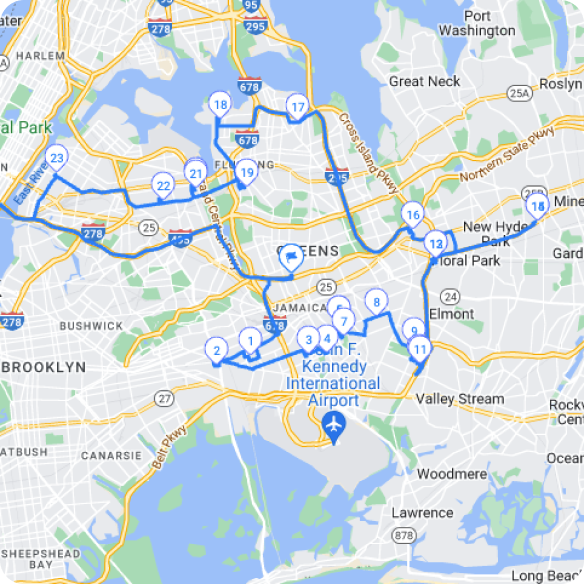
Time window constraints. Zeo Route Planner lets you set hard delivery windows for each job site, so the system automatically builds routes that respect that 9-to-11 AM downtown restriction instead of hoping your driver remembers it.
Priority stops for urgent materials. When a pour can’t wait, you can flag that stop as ASAP instead of Normal priority. Zeo’s AI-powered route optimization resequences the route around it, so urgent materials don’t get stuck behind routine deliveries.
Dynamic rescheduling for last-minute changes. When that foreman calls about the delayed pour, dispatchers can make dynamic route adjustments mid-shift from the web platform. The driver’s app updates in real time, no separate phone call needed.
Capacity-based routing. If you’re running mixed loads — lumber on one truck, steel and hardware on another — capacity-based routing accounts for vehicle weight and volume limits so you’re not overloading trucks or making unnecessary return trips.
Real-time visibility. Instead of calling drivers to ask “where are you,” real-time vehicle tracking and live ETA updates give your team a real-time view of every truck across every site. If a driver is stuck in gate congestion, you’ll see it before the job site calls to complain.

increase fuel savings
Save $200 on fuel, Monthly!
Optimize routes with our algorithm, reducing travel time and costs efficiently.
Get Started for Free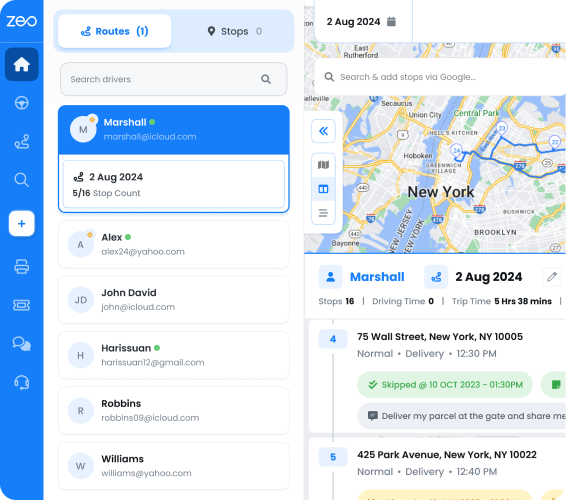
Zeo’s AI-powered route optimization saves drivers 2+ hours daily by cutting out inefficient routing and manual planning. For a company running 15 trucks, that’s not a small efficiency gain — it’s the difference between completing six deliveries a day per truck versus eight.
Choosing Construction Delivery Management Software: A Feature Checklist and Comparison
Not all route planning tools are built for construction logistics. Here’s what to actually check for before you commit to a platform.
Must-have features:
- Time window scheduling — can it enforce strict site access hours, not just suggest them?
- Priority stop flagging — can urgent materials (like concrete) jump the queue?
- Capacity-based routing — does it account for vehicle weight/volume limits for mixed loads?
- Dynamic mid-shift adjustments — can dispatchers reroute drivers in real time when a site delays a pour?
- Proof of delivery — photo and signature capture to confirm materials arrived at the correct site
- Real-time GPS tracking — live location visibility for every truck, not just end-of-day reports
- Customer/site notifications — automatic SMS or email so site supervisors know exactly when a truck is arriving
- Bulk address import — the ability to upload a week’s worth of job site addresses from Excel or Google Sheets instead of entering them one by one
- Driver mobile app — a simple interface drivers actually use, with turn-by-turn navigation built in
- Analytics and reporting — route and driver performance data, plus mileage tracking for expense and tax records
Red flags to watch for:
- Software that requires manual route building for every site, every day
- No mobile app for drivers, or one that requires separate navigation tools
- No ability to adjust routes after they’re dispatched
- No proof-of-delivery capture, leaving you without documentation when a site disputes a delivery
Zeo supports Shopify, WooCommerce, and Zapier integrations, along with API access for custom setups — useful if your order intake already runs through a CRM or e-commerce system and you don’t want to re-enter job site data by hand.
Before & After: What Optimized Multi-Site Delivery Routing Looks Like in Practice
Consider a mid-sized materials supplier running deliveries to 12 active job sites across a metro area, with a fleet of 18 trucks.
Before optimization:
The dispatcher plans routes manually each morning using a whiteboard and driver phone calls. Downtown sites with 9-to-11 AM windows often get missed because the dispatcher doesn’t account for traffic patterns or stacked priorities. When a foreman calls about a schedule change, the dispatcher has to track down the driver by phone, often after the driver is already en route in the wrong direction. Crews report idle time waiting on materials at least twice a week. Fuel costs run high because trucks backtrack across the city instead of following logical routes.
After optimization:
The dispatcher uploads the day’s job site list in bulk from a spreadsheet. Zeo’s AI-powered route optimization builds routes automatically, respecting each site’s time windows and flagging the urgent concrete delivery as a priority stop. Drivers receive their routes on the Zeo mobile app with turn-by-turn navigation already loaded. When the 6:45 AM schedule change comes in, the dispatcher adjusts the route from the web platform, and the driver’s app updates instantly — no phone tag required. Site supervisors get automatic SMS notifications with live tracking links, so they know exactly when to expect the truck and can prep the unloading crew in advance.
The measurable difference: fewer idle crew-hours, fewer missed delivery windows, and drivers completing more stops per shift because routes are sequenced by actual drive time instead of guesswork. Companies using Zeo’s route optimization report saving 2+ hours daily per driver — time that goes back into additional deliveries instead of sitting in traffic or backtracking across town.
Giving Your Drivers the Tools to Succeed On-Site
Route optimization only works if your drivers can actually execute it once they’re on the road. This is where the fleet-plus-app connection matters most.
Dispatchers build and assign multi-stop delivery routes to job sites from the Zeo web platform, setting time windows, priorities, and driver assignments for the day. Drivers then receive those routes directly on their phones through the Zeo mobile app, complete with turn-by-turn navigation, site delivery windows, and customer details.
This matters most when subcontractors or rotating site supervisors are involved. A driver showing up with a load of rebar needs more than a GPS pin — they need to know which supervisor to find, what window they’re working within, and a way to prove the materials arrived on time and at the right site.
That’s where proof of delivery capture earns its keep. Drivers capture a photo of the unloaded materials and collect a digital signature directly in the app. If a site supervisor later disputes whether materials arrived, or billing teams need documentation for invoicing, that record is already attached to the delivery — no chasing down drivers after the fact.
For companies juggling multiple subcontractors across job sites, this kind of documentation reduces disputes and speeds up billing cycles. It also gives drivers confidence that they’re covered if a delivery gets questioned later.
Frequently Asked Questions
Q: What’s the difference between construction delivery management and project delivery methods?
Project delivery methods (like Design-Build or CMAR) are contractual frameworks defining who manages design, risk, and construction. Construction delivery management, in the operational sense, refers to the logistics of getting materials like lumber, concrete, and rebar to job sites on schedule. Both affect project timelines, but one is a legal structure and the other is a daily execution challenge.
Q: How much do delayed material deliveries actually cost a construction project?
Research from the Construction Industry Institute suggests inefficient material management can account for up to 10-12% of total labor costs on a project, mostly from crews sitting idle waiting on materials. On a large project, that idle time often outweighs losses from design changes or bidding issues.
Q: Can route optimization software enforce strict job-site delivery windows?
Yes — platforms like Zeo Route Planner let dispatchers set hard time window constraints for each site, so routes are built to respect restrictions like a 9-to-11 AM downtown access window instead of relying on drivers to remember them. This is one of the verified features fleet managers use to cut missed-window incidents on multi-site projects.
Q: Why do Design-Build and CMAR projects put more pressure on delivery logistics than Design-Bid-Build?
Design-Build and CMAR compress timelines because design and construction phases overlap, leaving less buffer for material delays. According to the Associated General Contractors of America, these methods now account for over 40% of nonresidential construction, meaning more projects are running on tighter schedules with smaller margins for logistics errors.
Q: How do construction suppliers handle last-minute schedule changes, like a delayed concrete pour?
Most rely on phone calls to track down drivers already en route, which wastes time and fuel. With dynamic mid-shift route adjustments, dispatchers can reroute a driver from the web platform and have the change reflect instantly on the driver’s mobile app, without a separate phone call. This is particularly useful for pour delays, gate closures, or sudden site access changes.
Start Managing Construction Deliveries Like a Logistics Operation, Not a Guessing Game
Your project delivery method — whether it’s Design-Build, DBB, CM Agency, or CMAR — sets the schedule your project needs to hit. But hitting that schedule depends on logistics execution that most construction teams still handle manually.
Route optimization software closes that gap. It turns site access restrictions, delivery windows, and last-minute changes from daily fire drills into routes your dispatchers can plan with confidence and your drivers can execute without guesswork.
Start a free trial of Zeo Route Planner to optimize your construction material delivery routes, or book a demo to see how fleet managers coordinate multi-site deliveries with real-time tracking and dynamic rescheduling.
Are you a fleet owner?
Want to manage your drivers and deliveries easily?
Grow your business effortlessly with Zeo Routes Planner – optimize routes and manage multiple drivers with ease.

increase fuel savings
Hassle Free Deliveries & Pickups!
Optimize routes with our algorithm, reducing travel time and costs efficiently.
Get Started for Free