



# Legal Document Delivery Optimization: A Process Server’s Framework for Deadline-Compliant Routing
> TL;DR: Legal document delivery optimization requires routing software that sequences stops around court deadlines and recipient attempt-windows, not just shortest distance. Agencies using manual scheduling commonly see failed-attempt rates above 40% on first tries, while AI-powered route optimization with priority flagging and time window constraints, like Zeo Route Planner’s, helps process serving teams save 2+ hours daily on planning and re-routing.
Legal document delivery optimization is not the same problem as parcel delivery routing. Process serving agencies face court-mandated deadlines, unpredictable recipient availability, and a legal requirement to prove every attempt actually happened. Get it wrong, and you risk a blown statute of limitations, not just an unhappy customer.
If you’re managing 5 to 30 servers across one or more offices, you already know standard route planning tools don’t cut it. This guide gives you a step-by-step framework for building deadline-compliant, multi-attempt routes, backed by real ROI numbers and a workflow you can set up this week. If your agency also handles time-sensitive financial paperwork, our financial document delivery compliance guide covers similar deadline-driven routing challenges.
What Makes Legal Document Delivery Different From Standard Courier Routing (And Why Shortest-Distance Routing Fails)
Most route optimization tools are built for one goal: shortest distance or fastest time. That works fine for food delivery or package drop-offs. It fails for process serving.
Here’s why. Legal document delivery optimization has layers that shortest-distance routing simply ignores:
Court-mandated deadlines. Most states require service within a set number of days after filing, and some documents (like restraining orders) demand same-day or next-day attempts. A route optimizer that only minimizes mileage has no concept of a court deadline.
Multiple attempt windows. Recipients who dodge service are often more reachable at specific times. A nurse working night shifts might only be home at 7 a.m. A small business owner might only be reachable after the shop closes. Standard routing tools don’t let you sequence attempts around behavioral patterns.
Defensibility requirements. In most jurisdictions, you need proof the server was at the right address, at the right time, with the right documents. That means GPS timestamps, photos, and often a signed affidavit. A regular delivery app treats proof of delivery as a nice-to-have. For process servers, it’s a legal necessity.
Skip tracing and re-routing mid-shift. When a server arrives and the recipient has moved, or a new rush job comes in from a client with a filing deadline tomorrow, the route has to adjust in real time. Static routes built the night before don’t account for this.
According to the National Association of Professional Process Servers, a significant share of civil case delays trace back to improper or incomplete service of process. When your routing software only optimizes for distance, you’re optimizing for the wrong variable entirely.
The Real Cost of Unoptimized Process Serving Routes: Missed Attempts, Wasted Mileage, and Dispatcher Burnout (With ROI Benchmarks)
Unoptimized routing doesn’t just cost you gas money. It compounds across four areas: mileage, missed deadlines, dispatcher time, and legal exposure.
Wasted mileage on failed attempts. If servers are driving to addresses at the wrong time of day, based on a dispatcher’s best guess rather than data, failed attempt rates climb. Agencies running manual or spreadsheet-based scheduling commonly report failed-attempt rates above 40% on first tries. Every failed attempt means a repeat trip, more fuel, and more windshield time.
Missed court deadlines. U.S. Courts guidance notes that improper service is among the most common grounds for case delay or dismissal in civil litigation. A missed deadline isn’t just an internal miss. It can trigger a malpractice claim against the attorney, and against your agency.
Dispatcher overload. When one person is manually juggling 15-30 servers’ schedules, cross-referencing deadlines, attempt windows, and addresses in a spreadsheet, errors creep in. Agencies that scale past 10 servers without route optimization software typically need to add a second or third dispatcher just to keep up with manual scheduling. That’s a direct labor cost tied to inefficiency, not growth. Current Bureau of Labor Statistics data on process server employment trends shows this is a growing occupation, which makes scalable dispatch systems more relevant, not less.
Liability exposure from incomplete proof. If a recipient disputes service in court and your only proof is a server’s handwritten note, you have a weak case. Disputed service of process can delay a case for months, and in some situations, result in sanctions against the serving party.
Here’s the ROI math that matters to owners: AI-powered route optimization, like what Zeo Route Planner provides, saves 2+ hours daily per driver by cutting out manual planning and reducing backtracking between stops. Across a 15-server agency, that’s 30+ hours a day in recovered capacity, enough to take on more volume without hiring more staff.
Step-by-Step: Building Multi-Attempt, Deadline-Compliant Routes With Priority Sequencing and Time Windows
Here’s a practical framework for building routes that respect court deadlines and attempt-window strategy, not just geography.
Step 1: Tag every job with its court deadline. Before anything else, flag jobs by urgency. A restraining order due tomorrow is not the same priority as a subpoena due in two weeks. Zeo’s priority stops feature lets you mark jobs as ASAP versus Normal, so deadline-sensitive serves always surface to the top of a server’s route.
Step 2: Set time windows based on attempt strategy, not convenience. If a recipient is known to be home only in early morning or late evening, set a time window constraint for that stop. Time window constraints in route optimization software force the route to hit that address inside the right hours, instead of whenever is geographically convenient.
Step 3: Sequence multiple attempts across the day, not just across days. A strong multi-attempt strategy often means hitting a home address at 7 a.m., a work address at noon, and back to the home at 7 p.m., all in a single day for a high-priority serve. Build this into the route plan up front instead of leaving it to the server’s judgment.
Step 4: Assign by skill and jurisdiction, not just proximity. Some servers have specific county certifications, bilingual skills, or experience with difficult serves. Skill-based driver assignment lets dispatchers match the right server to the right job, not just the closest one.
Step 5: Build in capacity for same-day rush jobs. Litigation doesn’t wait for your route plan. Dynamic route adjustments mid-shift let dispatchers insert a new urgent serve into an active server’s route without rebuilding the whole day.
Step 6: Re-optimize, don’t just re-route. When an attempt fails, don’t just tack the address onto tomorrow’s list. Feed it back into the next optimization run so it gets the best possible time slot based on the new deadline countdown.
A process serving agency handling landlord-tenant evictions, for example, might have 20 same-day notices due by end of day, each needing a morning and evening attempt. Running that manually across 10 servers means a dispatcher cross-checking 40 time slots by hand. Running it through an optimization engine with time windows and priority flags turns that into a few minutes of setup.
Defensible Proof of Service: Automating GPS Timestamps, Photos, and E-Signatures in the Field
Proof of service is the single most important deliverable in your entire operation. If it’s incomplete, disputed, or inconsistent, everything else you did right doesn’t matter.
Here’s what a defensible proof of delivery record should include:
- GPS-verified location at time of attempt
- Timestamp down to the minute
- Photo of the location or recipient (where legally permitted)
- Digital signature, when accepted
- Server notes describing the attempt (who answered, what was said, refusal details)
Manual proof of service, handwritten notes and a signed paper affidavit, creates gaps. A server might forget to note the exact time. A photo might get lost. If a recipient challenges service in court weeks later, your agency needs a record that holds up, not a memory.
Zeo’s proof of delivery tools capture photo, signature, and notes directly in the field, timestamped and GPS-tagged automatically. That data syncs back to the dispatcher in real time, so you have a defensible record the moment the attempt happens, not days later when someone finally submits paperwork.
This matters most in disputed cases. If opposing counsel challenges whether service occurred, a GPS-timestamped photo with a logged note of “no answer, dog barking, lights on” is a materially stronger record than a server’s recollection from two weeks prior.
Route Optimization Software Checklist for Process Serving Agencies (Feature Comparison Table)
Not all route optimization software is built for the demands of process serving. Use this checklist when evaluating a platform.
| Requirement | Why It Matters for Process Serving | Zeo Route Planner |
|—|—|—|
| Priority stop flagging (ASAP vs. Normal) | Court deadlines require urgent jobs to surface first | Yes |
| Time window constraints | Attempt windows tied to recipient behavior patterns | Yes |
| Skill-based assignment | Match servers to jurisdiction or language needs | Yes |
| Dynamic mid-shift re-routing | Insert rush serves without rebuilding the day | Yes |
| Photo + signature capture | Build defensible proof of service records | Yes |

increase fuel savings
Save 2 Hours on Deliveries, Everyday!
Optimize routes with our algorithm, reducing travel time and costs efficiently.
Get Started for Free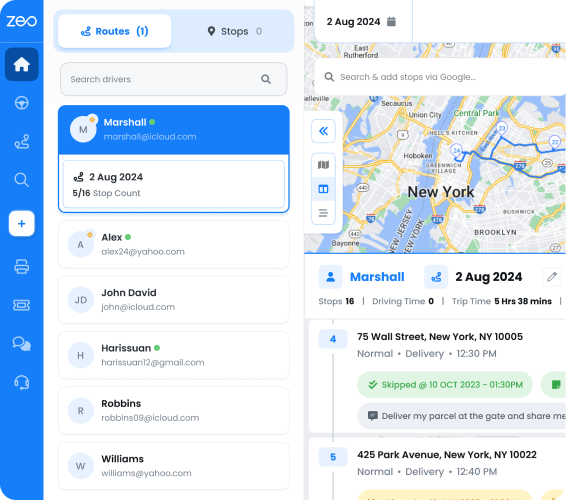
| GPS timestamp logging | Prove location and time of each attempt | Yes |
| Real-time GPS tracking | Dispatcher visibility into server location and progress | Yes |
| Driver performance analytics | Track attempt success rates by server | Yes |
| Bulk address import | Load large case batches from Excel, CSV, or Google Sheets | Yes |
| Scheduled/recurring routes | Plan repeat attempts across multiple days | Yes |
| Blackout dates | Pause a scheduled route without deleting it (holidays, court closures) | Yes |
| Day Plan / Date Override | Assign different servers to specific days of a multi-day serve attempt | Yes |
| Mobile app for field servers | Servers navigate and log proof on their phones | Yes |
When comparing platforms, don’t just ask “does it optimize routes.” Ask whether it optimizes for deadlines, attempt windows, and defensibility, the three things that actually determine whether your agency gets paid and stays out of court itself.
Scaling a Multi-Server Operation: Centralized Dispatch, Live Tracking, and Performance Analytics
Growing from 5 servers to 30 isn’t just “more of the same.” It’s a different operational problem.
Centralized dispatch across offices. If you run multiple office locations, your dispatcher needs one dashboard showing every server’s route, status, and deadline risk, not separate spreadsheets per office. A centralized web platform lets one dispatcher manage servers across locations without duplicating work.
Live tracking for accountability and client updates. Attorneys and clients increasingly expect status updates, not just a final affidavit. Real-time GPS tracking and live ETA updates let you share a tracking link so clients can see attempt status without calling your office every hour.
Performance analytics to catch problems early. Driver performance analytics show you which servers have high first-attempt success rates and which are missing deadlines. This data lets you reassign difficult serves to your strongest performers instead of distributing jobs evenly and hoping for the best.
In-app chat for field coordination. When a server hits a locked gate or a hostile recipient, they need to reach the dispatcher fast. In-app chat between manager and drivers keeps that communication inside the same system as the route, instead of a separate text thread that’s easy to lose track of.
A 25-server agency with two offices, for example, benefits significantly from consolidating dispatch into one system. Instead of two dispatchers each managing a spreadsheet and texting servers individually, one dispatcher can see every active route, flag at-risk deadlines, and reassign jobs from a single screen.
How It Works in Practice: Dispatcher Builds the Route, Servers Execute It in the Field
Here’s what this looks like day to day with Zeo Route Planner.
The dispatcher opens the Zeo web platform each morning and imports the day’s case batch, pulled from a spreadsheet or added manually. They tag each job by priority (ASAP for anything with a looming deadline), set time windows based on known attempt-window strategy, and let the AI-powered optimization engine sequence stops by deadline urgency, time constraints, and server location.
Multi-attempt jobs get built directly into the schedule, morning and evening passes for the same address, assigned to the server best suited by skill or jurisdiction. The dispatcher assigns the finished routes to each server with a few taps.
On the ground, each process server receives their sequenced stops, priority flags, and attempt-window alerts directly on the Zeo mobile app. They navigate turn-by-turn using their preferred maps app, whether that’s Google Maps, Waze, or Apple Maps. At each address, they capture a GPS-timestamped photo, collect an e-signature if service is accepted, and log notes describing the attempt, refusal, no-answer, or successful service.
All of that data syncs back to the dispatcher in real time. If an attempt fails, the dispatcher sees it immediately and can re-sequence that address into the next available window instead of waiting for an end-of-day report. If a rush job comes in at 2 p.m. with a same-day deadline, the dispatcher inserts it into the nearest available server’s route without disrupting the rest of their schedule.
By end of day, the agency has a complete, timestamped, photo-backed proof of service record for every attempt, successful or not, ready to support an affidavit if the case goes to a hearing.
Frequently Asked Questions
Q: How many days do you typically have to serve legal documents after filing?
Timelines vary significantly by state and document type, but most civil summons and complaints require service within 30 to 120 days of filing, while documents like temporary restraining orders often demand same-day or next-day attempts. Always confirm the specific deadline in your jurisdiction’s rules of civil procedure, since missing it can affect the case’s validity.
Q: What’s considered a “reasonable” number of attempts before pursuing alternative service?
Most jurisdictions expect at least three good-faith attempts at different times of day before a court will consider alternative methods like substitute service or publication. Courts generally want to see varied attempt times, such as early morning, midday, and evening, documented with specifics on each visit.
Q: Can process servers use GPS and photo evidence as legal proof in court?
Yes, GPS timestamps and photos are increasingly accepted as supporting evidence alongside a signed affidavit, though requirements vary by state. Zeo’s proof of delivery tools capture photo, signature, and GPS-tagged timestamps automatically in the field, giving agencies a documented record that’s stronger than handwritten notes alone.
Q: How do process serving agencies handle a recipient who’s actively avoiding service?
Agencies typically build a multi-attempt strategy around known behavioral patterns, like hitting a home address early morning and a workplace at midday, then returning in the evening. If avoidance continues, servers document each failed attempt in detail since that record often supports a later motion for alternative service.
Q: What should I look for when comparing route optimization software for process serving specifically?
Look for priority stop flagging, time window constraints, and skill-based assignment, since generic shortest-distance routing tools don’t account for court deadlines or attempt-window strategy. Zeo Route Planner’s AI-powered optimization engine builds routes around these constraints and has helped field service teams save 2+ hours daily compared to manual scheduling.
—
Legal document delivery optimization isn’t about shaving a few miles off a route. It’s about meeting court deadlines, documenting every attempt defensibly, and scaling your agency without drowning your dispatcher in spreadsheets. The frameworks in this guide, priority sequencing, time windows, GPS-backed proof of service, give you a path to do that.
Start a free Zeo Route Planner trial to build your first court-deadline-compliant multi-attempt route in minutes, or book a demo to see the dispatch dashboard and proof-of-service workflow in action.
Are you a fleet owner?
Want to manage your drivers and deliveries easily?
Grow your business effortlessly with Zeo Routes Planner – optimize routes and manage multiple drivers with ease.
increase fuel savings
Save 2 Hours on Deliveries, Everyday!
Optimize routes with our algorithm, reducing travel time and costs efficiently.
Get Started for Free