



# Financial Document Delivery: A Compliance-First Routing Guide for Banks, Title Companies, and Law Firms
> TL;DR: Financial document delivery requires routing software built for SLA deadlines and chain-of-custody documentation, not generic courier apps optimized for speed alone. Missed closing windows and undocumented handoffs are a recurring source of real estate transaction disputes, according to industry data. Zeo Route Planner addresses this with time-window routing, skill-based driver assignment, and photo/signature proof-of-delivery, helping operations teams build a documented audit trail from pickup to final drop-off.
Financial document delivery isn’t just courier work. It’s a compliance function with legal and financial consequences.
Banks, title companies, law firms, and credit unions move checks, loan packages, and signed legal paperwork every day. Every stop carries risk: a missed signature, a late drop-off, or a lost document can trigger compliance violations or legal disputes.
Most operations teams still manage this with spreadsheets, phone calls, and generic courier apps. These tools weren’t built for chain-of-custody requirements or SLA deadlines. This guide breaks down what financial document delivery really requires, where it goes wrong, and how route optimization software fixes it.
What Is Financial Document Delivery?
Financial document delivery means physically transporting sensitive paperwork between branches, clients, title companies, law offices, or partner institutions. Think loan closing packages, signed mortgage documents, checks, wire authorization forms, and legal statements.
Courier-Based vs. Digital Delivery
Digital document transfer works for many routine transactions. But physical delivery still matters for:
- Documents requiring wet signatures or notarization
- Original checks or negotiable instruments
- Legal paperwork with jurisdiction-specific delivery rules
- Closing packages for mortgages and real estate transactions
- Sensitive files that institutions won’t risk sending electronically
Many state and federal regulations still require physical originals for certain financial and legal transactions. Title companies, for example, often need wet-ink signatures on closing documents before a transaction can record with the county. The Consumer Financial Protection Bureau’s mortgage closing guidelines outline why document timing and accuracy carry real weight in these transactions.
Why Physical Still Matters
E-signatures and encrypted file transfers have replaced plenty of paper processes. But courier delivery remains essential when documents need a verifiable, physical chain of custody. That’s why operations managers still run courier fleets or coordinate with dedicated financial delivery services, even in a digital-first industry.
The High Stakes of Getting It Wrong
Financial document delivery carries real operational and legal risk. Here’s what’s at stake when routes aren’t managed well.
SLA breaches. Many institutions operate under strict service-level agreements with partner banks, title companies, or law firms. A late delivery can breach contract terms, damage the relationship, or trigger financial penalties.
Compliance exposure. Mortgage closings, loan disbursements, and legal filings often have hard deadlines tied to state law or regulatory windows. Missing a window isn’t just inconvenient. It can delay a closing, void a transaction, or create liability for the institution.
Chain-of-custody gaps. Without documented proof of pickup and delivery, there’s no way to verify who handled a document and when. If a dispute arises, “the driver says it was delivered” isn’t evidence.
Lost or misdelivered documents. A single lost loan package or misrouted check can cost thousands in reissuance, legal exposure, or regulatory scrutiny. According to the American Land Title Association, delayed or mishandled closing documents are a recurring source of transaction disputes in real estate closings.
Wasted driver hours. Manual route planning doesn’t account for traffic, time windows, or driver capacity. That means drivers spend hours on inefficient routes instead of making more stops per shift.
The common thread: these aren’t staffing problems. They’re logistics and documentation problems. And they require software built for both speed and accountability.
How Route Optimization Software Improves Financial Document Delivery
Generic courier apps handle basic routing. Financial document delivery needs more: real-time visibility, verifiable proof-of-delivery, and routes built around deadlines, not just distance.
Real-Time Tracking for Full Visibility
Operations managers need to know where every document is, at every moment. Real-time GPS tracking shows live driver location and updated ETAs, so you can confirm a courier is on pace to make a 2 p.m. closing deadline instead of finding out after the fact.
Live tracking links also let receiving branches or law offices see exactly when a courier will arrive, reducing phone calls and manual status checks.
Proof-of-Delivery for Chain-of-Custody
Digital proof-of-delivery replaces the “trust me” model with documented evidence. Photo capture, digital signatures, and delivery notes create a timestamped record for every handoff.
For financial document delivery, this means a loan package drop-off at a title company isn’t just completed. It’s documented with a signature, a photo, and a time log that can be referenced if a dispute comes up later.
Optimized Scheduling for Faster SLAs
Route optimization software builds routes around time windows and priority stops, not just the shortest distance. A courier picking up documents at three branches before a 3 p.m. title company deadline needs a route that accounts for that window, not a generic map route.
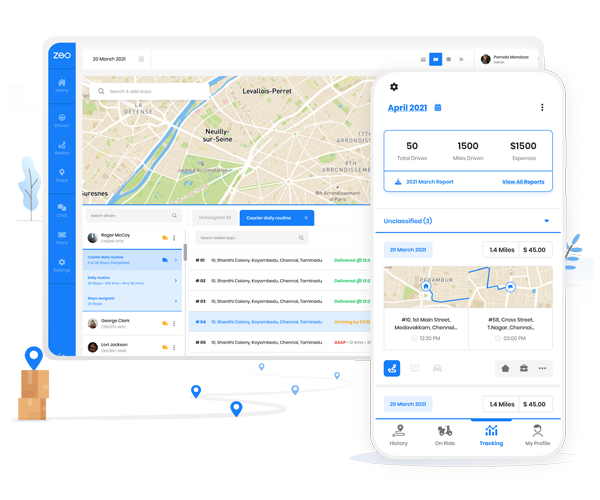
This is also where the fleet-plus-app model matters. Operations managers plan and assign routes from the web dashboard, setting time windows, priority stops, and driver assignments based on who’s qualified to handle sensitive documents. Drivers then receive those routes on the Zeo mobile app, complete with turn-by-turn navigation, stop details, and customer contact information.
At each stop, the driver captures a signature or photo ID verification, logs a timestamped delivery photo, and marks the stop complete. Dispatchers see this happen live from the web platform. The result is a full audit trail, from route planning to final proof-of-delivery, without manual check-ins or phone tag.
Best Practices for Secure, Compliant, and Efficient Delivery Routes
Operations managers running financial courier routes should build these practices into daily operations:
Set time windows for every stop. Closings, bank deposits, and legal filings often have hard deadlines. Build routes around those windows instead of hoping drivers arrive in time.
Require proof-of-delivery on every stop. Signature and photo capture should be standard, not optional, for any document involving financial or legal liability.
Assign stops based on driver qualifications. Some deliveries require bonded couriers, background-checked drivers, or specific certifications. Skill-based driver assignment ensures sensitive documents only go to qualified drivers.
Use priority flags for time-sensitive documents. Not every stop is equal. Mark closing packages or same-day legal filings as priority so dispatchers and drivers know what can’t wait.
Monitor routes in real time, not after the fact. Waiting for a driver to call in creates blind spots. Live GPS tracking lets dispatchers catch delays early and adjust routes mid-shift if needed.

increase fuel savings
Save 2 Hours on Deliveries, Everyday!
Optimize routes with our algorithm, reducing travel time and costs efficiently.
Get Started for Free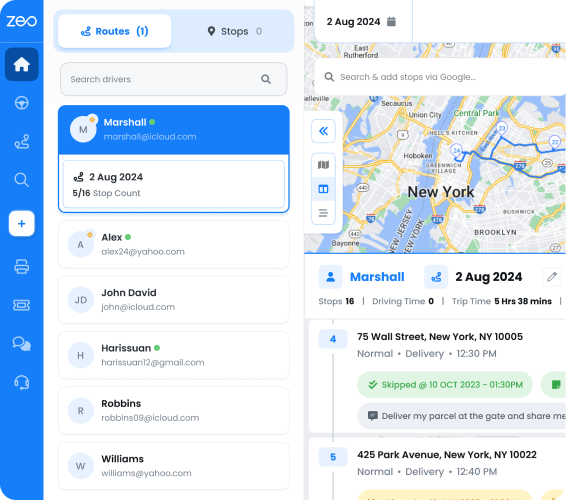
Keep a digital paper trail. Paper logs get lost. Delivery notes, timestamped photos, and digital signature records stored digitally create a defensible record if a dispute or audit happens.
Review performance data regularly. Route analytics and reporting help identify recurring delays, problem routes, or drivers who need additional support.
In-House Courier Fleet vs. Outsourced Delivery: Which Model Fits Your Institution?
Operations managers typically choose between three models: a fully in-house courier fleet, an outsourced courier service, or a hybrid approach. This decision mirrors similar tradeoffs seen in other compliance-sensitive courier fields, including medical courier routes, where chain-of-custody and timing matter just as much as speed.
In-house fleets give you full control over driver training, document handling protocols, and chain-of-custody procedures. This matters for institutions handling highly sensitive legal or financial documents. The tradeoff is overhead: vehicles, driver management, and route planning all fall on your team.
Outsourced delivery services reduce staffing overhead and offer flexibility for institutions with lower delivery volume. The risk is less direct oversight of chain-of-custody and documentation standards, especially if the courier service uses its own tracking tools.
Hybrid models are increasingly common among banks and title companies. In-house drivers handle high-value or time-sensitive documents, while outsourced couriers cover overflow or lower-risk routes.
Whichever model you choose, the software layer matters more than the staffing model. A route planning platform that supports multiple drivers, whether employed or contracted, gives operations managers consistent visibility and documentation standards across the entire delivery operation. This matters because, per the U.S. Bureau of Labor Statistics, courier and messenger services continue to see steady demand growth, meaning more institutions are managing larger, more complex delivery networks than in past years.
How Zeo Route Planner Helps Banks, Law Firms, and Financial Couriers Streamline Document Delivery
Zeo Route Planner is built for operations managers coordinating 5 to 50 drivers across time-sensitive, compliance-heavy delivery routes.
Plan routes around deadlines, not guesswork. Zeo’s AI-powered route optimization builds stop sequences around time windows and priority flags, helping drivers hit closing deadlines and SLA windows consistently. Fleet coordinators report saving 2+ hours daily on route planning compared to manual scheduling.
Assign the right driver to the right document. Skill-based assignment lets you match bonded or specially trained couriers to sensitive stops, like mortgage closing packages or legal filings, while routing routine deliveries to other drivers.
Build a documented chain-of-custody. Zeo’s proof-of-delivery tools, photo capture, digital signatures, and delivery notes, create a timestamped record at every stop. If a title company questions whether a package arrived on time, you have documented evidence, not a verbal account.
Give dispatchers full visibility. Operations managers plan and assign secure routes from the Zeo web dashboard, setting time windows and priority stops for each branch or client location. Drivers then receive these routes on the Zeo mobile app, with turn-by-turn navigation and stop details. At drop-off, they log signatures, capture timestamped photos, and mark deliveries complete. Dispatchers watch this unfold in real time through live GPS tracking, creating a complete audit trail from planning to final delivery.
Keep clients informed without extra calls. Branded tracking pages and live ETA notifications let receiving branches or law offices know exactly when a courier will arrive, cutting down on status-check phone calls.
Track mileage for reporting. Built-in mileage tracking supports expense reporting and audit documentation across your driver fleet.
Zeo Route Planner serves 1.5M+ users across 150+ countries, including delivery and field service operations that depend on documented, time-sensitive routing.
Frequently Asked Questions
Q: How long do banks and title companies have to keep proof of delivery for financial documents?
Retention requirements vary by document type and jurisdiction, but many mortgage and loan-related records must be kept for several years under state and federal regulations. Institutions typically build retention policies around their compliance department’s guidance rather than a single universal rule. Digital proof-of-delivery records, like timestamped photos and signatures, are easier to retain and retrieve than paper logs when audits or disputes arise years later.
Q: Can financial document couriers use the same route planning software as regular delivery drivers?
Yes, but the requirements differ. Standard delivery routing focuses on speed and stop volume, while financial document delivery needs time-window accuracy, skill-based driver assignment, and verifiable proof-of-delivery for every stop. Zeo Route Planner supports both models, letting operations managers set priority flags and time windows for compliance-sensitive stops while still optimizing the full route for efficiency.
Q: What happens if a courier misses a mortgage closing deadline?
A missed closing deadline can delay the recording of a transaction with the county, which may push back fund disbursement or void time-sensitive contract terms. This can trigger SLA penalties between institutions and, in some cases, legal liability if the delay causes financial harm to a buyer or seller. Real-time GPS tracking and live ETA updates help dispatchers catch potential delays early enough to reroute or notify the receiving office before the deadline passes.
Q: Do financial couriers need to be bonded or background-checked?
Many institutions require bonded or background-checked couriers for high-value or legally sensitive deliveries, such as loan packages, checks, and signed closing documents, though specific requirements vary by state and company policy. This is typically an internal compliance decision rather than a universal legal mandate. Route planning software with skill-based assignment lets dispatchers restrict sensitive stops to qualified drivers only, reducing the risk of an unverified courier handling a high-liability document.
Q: How is financial document delivery different from standard courier services?
Financial document delivery involves legal and regulatory stakes that standard parcel courier work doesn’t carry, such as SLA deadlines tied to closings, chain-of-custody documentation, and jurisdiction-specific delivery rules. A late pizza delivery is an inconvenience; a late loan package can delay a real estate closing or breach a contract. This is why operations managers often need dedicated routing tools with documented proof-of-delivery rather than generic courier apps.
—
Start a free Zeo Route Planner trial to build secure, optimized financial document delivery routes with real-time tracking and digital proof-of-delivery. Or book a demo to see how Zeo fits your institution’s compliance and SLA requirements.
Are you a fleet owner?
Want to manage your drivers and deliveries easily?
Grow your business effortlessly with Zeo Routes Planner – optimize routes and manage multiple drivers with ease.
increase fuel savings
Save 2 Hours on Deliveries, Everyday!
Optimize routes with our algorithm, reducing travel time and costs efficiently.
Get Started for Free