
# Route Planner: What It Is, How It Works, and How to Pick the Right One
> TL;DR: A route planner automatically sequences multiple stops into the most efficient order — something Google Maps and basic GPS apps can’t do on their own. With 20 stops, there are over 60 quintillion possible route combinations, which is why optimization algorithms (not manual guesswork) are needed to find the fastest one. Route planners like Zeo Route Planner solve this with AI-powered route optimization, helping delivery and field service teams save 2+ hours daily.
If you’re still sequencing stops by eye in Google Maps, you’re not alone. Most small teams start there. But a real route planner does far more than draw lines between addresses — and understanding that difference can save you hours every week.
This guide breaks down what route optimization actually means, how it works under the hood, and how to pick the right tool whether you’re a solo driver or managing 50 technicians.
What Is a Route Planner (And How Is It Different From Google Maps)?
Google Maps is a navigation tool. A route planner is a decision-making tool.
Google Maps shows you turn-by-turn directions between points you’ve already put in order. It doesn’t decide which stop should come first, second, or last. If you have 15 deliveries, you still have to figure out the best sequence yourself — then type each stop in manually.
A route planner does that sequencing for you. It takes a list of addresses, runs them through an optimization algorithm, and spits out the most efficient order based on distance, time, traffic, and constraints like delivery windows.
Here’s the practical difference:
- Google Maps: You decide the order. It gives directions.
- Route planner: It decides the order. You just drive.
For a single trip with 3-4 stops, this gap barely matters. But once you’re juggling 10, 20, or 50 stops across multiple drivers, manual sequencing becomes guesswork. You end up backtracking across town, missing delivery windows, or burning fuel on inefficient loops — without ever knowing there was a better route available. Documenting completed stops matters too; features like proof of delivery give teams a record of what actually happened on the route, not just where it was supposed to go.
This is the core problem a route planner solves. It’s not about making maps prettier. It’s about solving a math problem that’s too complex for a human to do quickly by hand.
How Route Optimization Algorithms Actually Work: From Stop List to Optimized Route
Route optimization is built on a well-known math challenge called the Traveling Salesman Problem (TSP) — finding the shortest possible route that visits a set of locations and returns to the start. Researchers have studied TSP for decades because it gets exponentially harder as you add stops. With 10 stops, there are over 3 million possible route combinations. With 20 stops, that number balloons past 60 quintillion.
No human — and no basic mapping app — can test every combination. That’s where optimization algorithms come in.
Here’s what happens when you load a stop list into a real route planner:
- Data collection: The system pulls in addresses, delivery time windows, vehicle capacity, driver skills, and priority levels (like ASAP vs. normal stops).
- Constraint mapping: It factors in real-world limits — a driver can’t be in two places at once, a refrigerated van has a weight cap, a customer only accepts deliveries between 2-4 PM.
- Algorithmic calculation: The engine runs heuristic and AI-based models to test thousands of route combinations in seconds, searching for the one with the lowest total drive time and distance.
- Dynamic adjustment: Good systems also account for live traffic and road conditions, recalculating if something changes mid-route.
This is why Zeo’s AI-powered route optimization can save drivers 2+ hours daily — it’s not guessing at a good order, it’s calculating the mathematically efficient one, then adjusting for real-world constraints like time windows and vehicle capacity.
The output isn’t just a shorter route. It’s fewer miles driven, less fuel burned, and more stops completed per shift.
Step-by-Step: Plan an Optimized Multi-Stop Route in Under 5 Minutes
Here’s what the process looks like with a modern route planner like Zeo:
Step 1: Add your stops.
Upload a spreadsheet (Excel, CSV, Google Sheets), paste addresses, or pull them from a saved Favorites list. You can also add stops individually using Google Search or by importing them from an image.
Step 2: Set your constraints.
Mark any time-sensitive stops, assign priority levels (ASAP vs. normal), and set vehicle capacity limits if you’re hauling goods with weight or volume restrictions.
Step 3: Let the algorithm optimize.
Hit optimize. The system calculates the most efficient stop order in seconds — factoring in distance, time windows, and traffic.
Step 4: Review and adjust.
Want to lock a stop order manually? Use Navigate as Added to preserve your manual sequence without auto re-optimization. Need to avoid highways or tolls? Set Avoid Params to exclude highways, tunnels, bridges, or ferries.
Step 5: Send it to the driver’s phone.
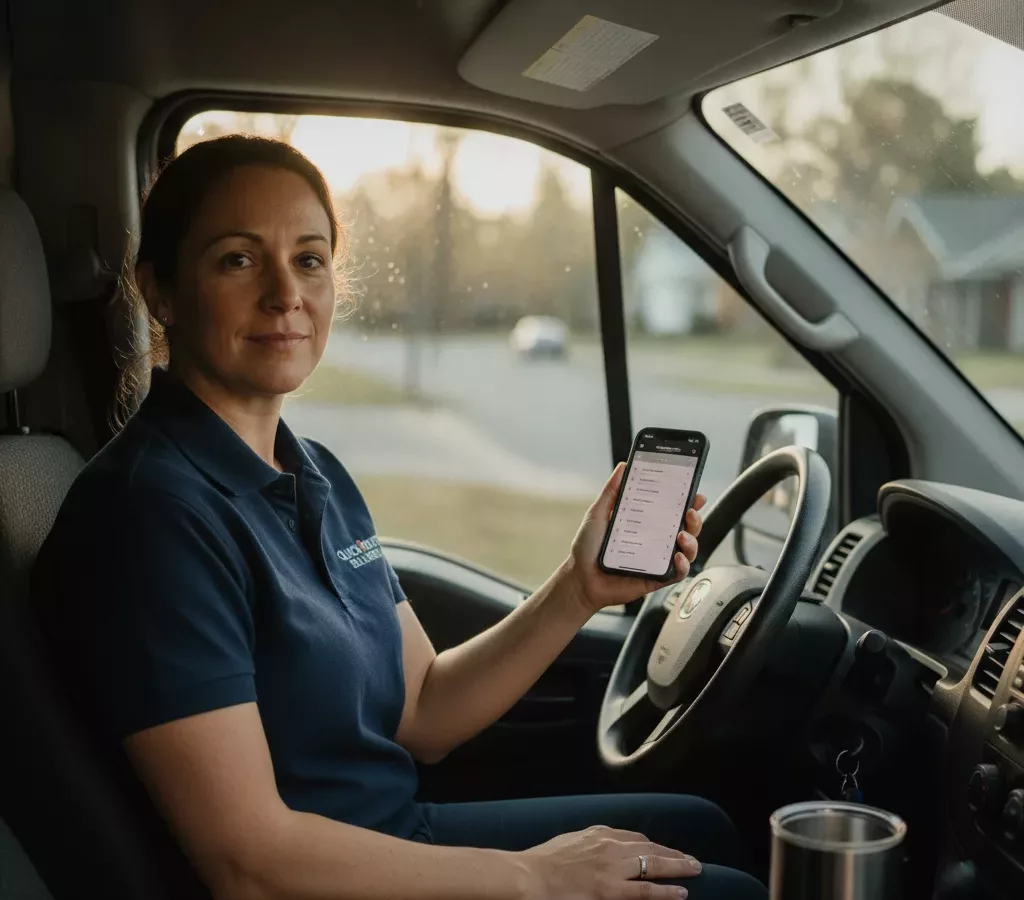
The optimized route pushes directly to the Zeo mobile app, where the driver gets turn-by-turn navigation, customer details, and the ability to capture proof of delivery.
Step 6: Track and notify.
Customers get live ETA updates via SMS, email, or a branded tracking link. You get real-time GPS visibility into where every driver is through driver tracking software built into the platform.
What used to take 30-45 minutes of manual mapping now takes under 5. For recurring routes — say, a weekly pest control schedule — you can save the sequence and reuse it, only adjusting for new or canceled stops.
Solo Driver vs. Fleet: Choosing the Right Route Planner for Your Team Size
Not every route planner is built the same way, and your team size should drive your decision.
If you’re a solo driver or owner-operator:
You need something fast and simple — upload stops, get an optimized route, drive. Features like Favorites (for repeat customers) and Quick Route Creation turn a saved list into a ready-to-go route instantly. You likely don’t need driver management tools or fleet-wide analytics yet.
If you manage a team of 5-50 drivers or technicians:
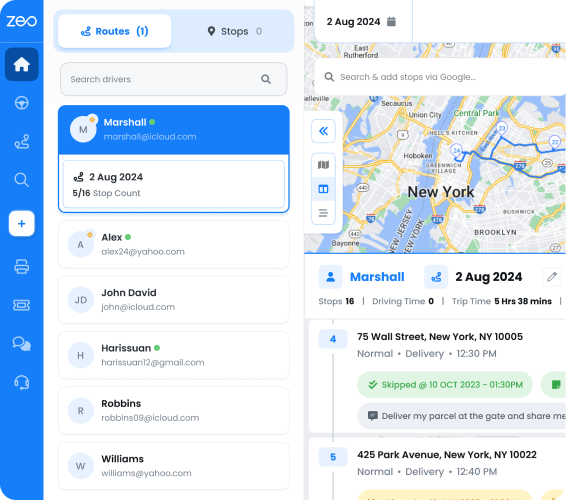
You need a web-based dispatch dashboard, not just a mobile app. This is where the fleet + app relationship matters. As a fleet manager, you build and assign routes on Zeo’s web platform — setting skill-based assignments, work hours, and capacity limits for each vehicle. Once you hit assign, those routes push instantly to each driver’s phone through the Zeo mobile app. For teams juggling multiple vehicles and overlapping constraints, understanding the underlying vehicle routing problem helps clarify why a dispatch dashboard matters more as fleets scale.
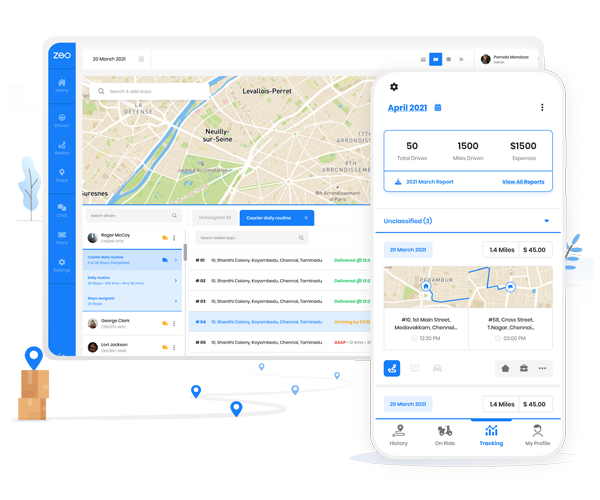
Your technicians receive optimized routes directly on their phones, complete with turn-by-turn navigation, customer details, and proof of delivery tools. Meanwhile, you see live location tracking and route progress back on your dashboard, with no phone calls needed to check status.
This matters for scheduling flexibility too. If a driver calls in sick, Date Override lets you swap the assigned agent for a single day without disrupting the full recurring route. If you need to pause service for a holiday, Blackout Dates let you pause scheduled routes temporarily instead of deleting them.
The key takeaway: the same core optimization engine works for one driver or fifty. What changes is the management layer on top — and that’s what you should be evaluating when comparing tools.
Route Planning by Industry: Delivery, Field Service, Sales, and Courier Use Cases
Route planners solve slightly different problems depending on your industry.
Last-mile delivery and e-commerce:
High stop density, tight time windows, and customer communication are the priorities. A Shopify store doing local deliveries can auto-import orders into Zeo, optimize the day’s route, and automatically send customers a live tracking link — cutting down on “where’s my order” support tickets.
Field service (HVAC, pest control, plumbing, pool cleaning):
Optimize routes with our algorithm, reducing travel time and costs efficiently.
increase fuel savings
Save 2 Hours on Deliveries, Everyday!
These businesses need skill-based assignment — sending the technician certified for a specific job to the right address — plus recurring scheduled routes for weekly or monthly service visits. A pest control route planning setup servicing 40 homes a week can configure a recurring route once and only adjust for new sign-ups or cancellations.
Sales reps and field teams:
Reps often have loose daily schedules with flexible stop order. Priority stops (marking must-see accounts as ASAP) combined with miles tracking for expense and tax records are the most useful features here.
Courier and B2B delivery:
Speed and proof of delivery matter most. Pickup-Delivery Linking automatically pairs a pickup with its matching drop-off and sequences them correctly, which is critical for couriers juggling dozens of paired stops in one shift.
According to the U.S. Bureau of Labor Statistics occupational outlook for delivery drivers, employment for delivery drivers is projected to grow faster than average through the decade, meaning more businesses will be managing larger driver pools with tighter margins — making route optimization less of a luxury and more of a baseline requirement.
Route Planner Comparison: Zeo vs. MapQuest vs. RouteXL vs. MyRouteOnline vs. Circuit
Here’s how the major players stack up on the features that matter most for evaluating a route planner:
| Feature | Zeo | MapQuest | RouteXL | MyRouteOnline | Circuit |
|—|—|—|—|—|—|
| AI route optimization | Yes | Limited | Yes | Yes | Yes |
| Fleet dashboard (web) | Yes | No | No | Yes | Yes |
| Driver mobile app | Yes | No | No | Limited | Yes |
| Proof of delivery | Yes | No | No | No | Yes |
| Live customer tracking | Yes | No | No | No | Yes |
| Skill-based assignment | Yes | No | No | No | Limited |
| Free plan | Yes (12 routes/mo) | Limited | Yes (20 stops) | No | Limited |
| Integrations | Shopify, WooCommerce, Zapier, HubSpot | None | None | Limited | Limited |
The honest takeaway: MapQuest and RouteXL are fine for very basic, occasional route sequencing with no team management needs. MyRouteOnline and Circuit add more optimization power but lack the combined fleet dashboard, skill-based routing, and integration depth that growing teams need.
Zeo Route Planner is built to serve both ends of that spectrum — a free tier for solo drivers planning up to 12 routes a month, and a fleet platform with driver management, analytics, and proof of delivery for teams scaling past a handful of drivers.
Real ROI: Time, Fuel, and Cost Savings From Route Optimization
The numbers behind route optimization are worth putting in front of any decision-maker.
Time savings: Zeo’s AI-powered optimization saves drivers 2+ hours daily compared to manual route planning. For a 10-driver team, that’s 20 hours a day — nearly 2.5 full-time employees’ worth of time — freed up for more stops or faster service.
Fuel savings: The U.S. Department of Energy’s research on fuel waste estimates that inefficient routing and excessive idling can waste significant fuel across a fleet’s annual mileage. Optimized routes reduce total miles driven by eliminating backtracking and unnecessary detours, which directly cuts fuel spend.
Cost of late or missed deliveries: McKinsey’s research on last-mile delivery economics has noted that last-mile delivery can account for more than 50% of total supply chain costs, much of it driven by inefficient routing and failed first-attempt deliveries. Accurate ETAs and live tracking reduce missed appointments and the re-delivery costs that come with them.
Example scenario: A regional HVAC route planning company with 12 technicians switches from manual Google Maps planning to Zeo. Each technician completes 1-2 more service calls per day because routes are sequenced efficiently instead of guessed. Over a month, that’s 300-600 additional completed jobs — without hiring a single new technician.
These aren’t guaranteed outcomes for every business, but they reflect the kind of results companies using route optimization consistently report.
Frequently Asked Questions
Q: What’s the difference between a route planner and a GPS app?
A GPS app like Google Maps gives turn-by-turn directions between points you’ve already put in order. A route planner decides the most efficient stop sequence first — factoring in distance, time windows, and traffic — then hands off to navigation.
Q: Do I need a route planner if I only have 2-3 stops a day?
Probably not. Route optimization shows its value once you’re managing 5 or more stops, where manual sequencing starts costing real time, fuel, and missed delivery windows.
Q: How many stops can a route planner optimize at once?
Most modern route planners can handle anywhere from a handful of stops to several hundred per route, depending on the plan and vehicle constraints involved. Zeo’s AI-powered optimization engine calculates efficient sequences for both small daily routes and larger multi-driver fleet schedules, factoring in time windows and vehicle capacity along the way.
Q: Can a route planner adjust routes mid-day if plans change?
Yes — this is called dynamic re-optimization. Zeo supports dynamic route adjustments mid-shift, so if a stop gets added, canceled, or a driver falls behind schedule, the route can recalculate without starting from scratch.
Q: Does route optimization actually save fuel, or just time?
Both. Shorter, smarter routes mean less idling, less backtracking, and fewer unnecessary miles, which directly reduces fuel consumption in addition to saving drive time — a point supported by the U.S. Department of Energy’s research on fuel waste from inefficient routing and idling.
—
If you’re still planning routes by hand, the fastest way to see the difference is to try it. Start a free trial of Zeo Route Planner and plan your first optimized route in under 5 minutes — free for up to 12 routes a month, no credit card required. If you’re managing a team, book a live demo to see fleet-wide optimization and driver tracking in action.
Are you a fleet owner?
Want to manage your drivers and deliveries easily?
Grow your business effortlessly with Zeo Routes Planner – optimize routes and manage multiple drivers with ease.
increase fuel savings
Save 2 Hours on Deliveries, Everyday!
Optimize routes with our algorithm, reducing travel time and costs efficiently.
Get Started for Free