

Updated on: May 4, 2026
Reading Time: 4 minutes
TL;DR: Multiple stops with the same address create inefficient routing that wastes time through repetitive navigation and disorganized delivery sequences. Studies show that last-mile delivery inefficiencies can increase operational costs by up to 28%. Route optimization tools like Zeo Route Planner address this with auto-assignment of stops to drivers and AI-powered route optimization, helping delivery teams save 2+ hours daily.
You’re halfway through your shift, and your next stop? It’s a big apartment complex. You pull in, park, and grab the first package for 304B. You climb up and deliver it. Back to the van.
Next one: 306A. Same building. Then 302C. Still the same address. Now you’re walking circles around the same complex, juggling packages and trying not to lose time. Sound familiar?
This is what multiple stops with the same address actually look like in last-mile logistics. It’s a silent time-killer hiding in your route. It clutters your navigation, eats into delivery windows, and adds stress to a job that already runs on tight schedules. And here’s the kicker: most route planners don’t do a thing about it.
The Core Problem of Multiple Stops with the Same Address
At first glance, multiple stops with the same address might seem like a minor glitch. Here’s what’s really going wrong when your routing app doesn’t group them right.
- Same Address, Different Units, Endless Guesswork.
Assume that you’ve got five stops all reading “100 Elm Street,” but they’re for different units: 3A, 3B, 3C, and so on. But your routing app treats them like five different stops. So now, you’re forced to double-check each one manually. “Did I already hit this address or not?” This constant second-guessing slows you down, drains your mental battery, and adds unnecessary stress to what should be a quick building sweep. - Repetitive Navigation = Repetitive Frustration
Without grouping stops with the same addresses, the route planner app keeps sending you back to the same spot. So instead of making one smooth visit to the building, you’re pulling over three separate times, launching navigation again and again, and doing three sets of entry instructions. You’re basically replaying the same actions that could be completed in one go. - Manual Sorting Becomes Mental Gymnastics
Let’s say you’ve got 12 packages going to different units of the same apartment complex. If your app can’t group them, you’re left scrolling manually through your stop list. Was that package for 2A or 2B? Did you already deliver 4C? You’re juggling all that in your head, trying not to mess up while the clock’s ticking and your other deliveries are still waiting. - No Logical Drop-Off Flow
Even if you’ve made it inside the building, now you’re bouncing between floors like it’s leg day. You drop one at the third floor, one at the sixth, then go back to the second, because your route app gave you stops in random order. Without smart grouping and logical sequencing, you’re wasting elevator rides, stair climbs, and valuable time.
How It Impacts Delivery Efficiency and Performance
Now that we have explored the challenge of multiple stops with the same address, let’s understand how it can affect your operational efficiency.
- Slower Deliveries and Unreliable ETAs
If your route planner doesn’t recognize multiple stops at the same address as a single visit, your delivery timeline balloons. You end up overestimating how far apart stops are and underestimating how long you’ll spend at one location. This confuses both dispatchers and customers with unreliable ETAs. That’s a perfect recipe for missed time windows and poor customer experience. According to U.S. Bureau of Labor Statistics data on courier services, delivery timing accuracy directly impacts customer satisfaction and operational costs. - Increased Risk of Errors
When drivers can’t clearly see what belongs to which unit at the same address, mix-ups are bound to happen. One missed door number and suddenly you’ve delivered John’s microwave to Sarah’s doorstep. Without clear visual cues and consolidated grouping, error rates rise. And that’s bad for both the driver’s efficiency and performance, and the company’s reputation. - Inefficient Use of Time and Fuel
Here’s a hidden cost: treating the same building as five separate stops means starting the engine more, circling back to the same location, and adding unnecessary mileage. In last-mile logistics, every detour counts. Multiply this over a week of deliveries and you’re staring at serious fuel, cost, and time wastage. Department of Transportation studies show that optimized routing can reduce fuel consumption by up to 20% for commercial delivery fleets. - Poor Route Optimization Outcomes
Most routing software just can’t handle multiple stops with the same address smartly. They don’t group based on geolocation; they sort alphabetically. That means your route isn’t truly optimized, it’s just rearranged. This results in poor route optimization and inefficient deliveries.
The Hidden Costs of Disorganized Multi-Stop Deliveries
Beyond the immediate frustrations, multiple stops with the same address create cascading financial impacts that many delivery operations overlook. Driver overtime costs spike when simple deliveries take longer than expected. Vehicle wear increases from excessive stopping and starting. Customer complaints rise when packages get mixed up between units, leading to costly redelivery attempts.
The staffing implications are equally problematic. Experienced drivers burn out faster when they’re constantly fighting their route planner instead of focusing on customer service. New drivers take longer to train because they’re learning to work around system limitations rather than following logical delivery patterns. This creates a cycle where operational efficiency decreases just when delivery volumes are increasing.
For companies managing large delivery fleets, these inefficiencies compound across hundreds of routes daily. A single apartment complex handled incorrectly might only waste 15 minutes per driver, but multiply that across a metropolitan delivery network and you’re looking at significant productivity losses. Advanced route planner apps for business address these challenges by treating logistics as a comprehensive optimization problem rather than simple point-to-point navigation.
Why Most Route Planners Fail Here
Most route planners look smart on the surface, until you throw multiple stops with the same address into the mix. That’s where the cracks start to show.
The problem? Most routing tools treat “101 Main St Apt 3B” and “101 Main Street Apt 5C” as two entirely different stops, even though they’re going to the same building. So instead of last-mile logistics getting smarter, they become more tangled.
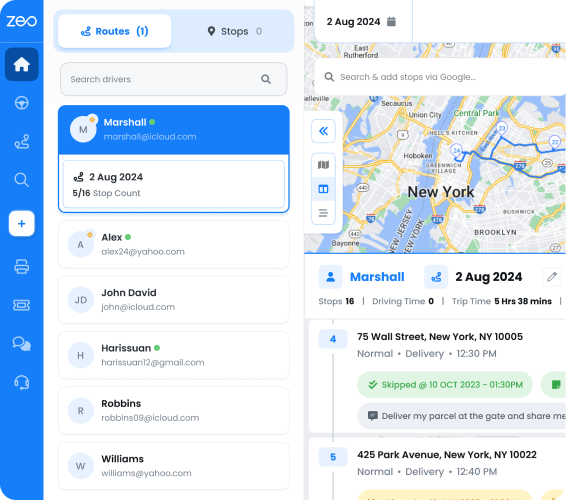
What’s missing is routing intelligence. A truly efficient route planner should recognize that these stops share identical latitude and longitude coordinates and group them smartly. This is exactly where the need for Zeo’s Multiple SKUs feature becomes non-negotiable. Drivers need a system that groups deliveries by location, but still lets them mark each item individually.

increase fuel savings
Hassle Free Deliveries & Pickups!
Optimize routes with our algorithm, reducing travel time and costs efficiently.
Get Started for Free
Technology Solutions That Actually Work
The answer isn’t just better mapping—it’s smarter grouping logic built into the routing algorithm. Modern delivery management systems need to recognize when multiple delivery points share the same physical location and automatically cluster them for efficient handling.
Effective solutions include geolocation-based grouping that identifies shared coordinates regardless of how addresses are formatted. They also provide clear visual organization so drivers can see all deliveries for a single location at once, plus flexible marking systems that let drivers complete individual deliveries while staying organized within the larger stop.
The best systems also integrate real-time adjustments, so when new deliveries get added to the same address during the day, they’re automatically grouped with existing stops rather than creating separate route points. This prevents the common scenario where morning route optimization gets undone by afternoon dispatch decisions.
Conclusion
Messy routing costs time, fuel, patience, and trust. And in the high-stakes world of last-mile logistics, you can’t afford to let something as simple as multiple stops with the same address drag your performance down.
The Multiple SKUs feature inside Zeo Route Planner is built exactly for this challenge. It declutters your routes, keeps your deliveries precisely tracked, and gives drivers a smoother, smarter way to handle deliveries for multiple stops with the same address, without losing visibility.
Want to see how it works in action? Schedule a demo and let our experts show you how the right tools make last-mile logistics effortless.
Frequently Asked Questions
How do you handle deliveries to apartment complexes efficiently?
Group all deliveries for the same building before entering, organize packages by floor number, and plan your route through the building from bottom to top or in a logical sequence. Use the building directory to identify the most efficient path between units and carry all packages for that trip to avoid multiple vehicle visits.
What causes delivery routes to become inefficient?
Poor stop sequencing, lack of geographic clustering, and failure to account for delivery time windows are the primary causes. When routing systems treat each address as an isolated point without considering proximity or logical grouping, drivers waste time backtracking and making unnecessary trips to the same locations.
Can route optimization software reduce delivery time for multi-unit buildings?
Yes, advanced route optimization tools automatically group deliveries by location and sequence them logically. Zeo Route Planner’s AI-powered route optimization and auto-assignment features help delivery teams save 2+ hours daily by eliminating redundant trips and organizing stops efficiently.
Why do some route planners show the same address multiple times?
Most basic routing tools process each delivery as a separate waypoint without recognizing shared coordinates or building locations. They rely on text-based address matching rather than geographic intelligence, so “123 Main St Apt A” and “123 Main St Apt B” appear as different destinations even though they’re the same building.
How do delivery errors increase with poor route organization?
When packages for the same building aren’t grouped together, drivers lose track of which items belong to which units, leading to wrong-door deliveries and package mix-ups. Disorganized stop sequences also create confusion about which deliveries have been completed, especially in large apartment or office complexes with similar unit numbers.
Are you a fleet owner?
Want to manage your drivers and deliveries easily?
Grow your business effortlessly with Zeo Routes Planner – optimize routes and manage multiple drivers with ease.
increase fuel savings
Save 2 Hours on Deliveries, Everyday!
Optimize routes with our algorithm, reducing travel time and costs efficiently.
Get Started for Free