



# How to Track Uniform Delivery Inventory: Complete Guide 2026
> TL;DR: Effective uniform delivery inventory tracking requires real-time scanning, digital documentation, and integrated systems that follow every item from warehouse to customer doorstep. The average uniform rental company loses 3-5% of inventory annually due to tracking failures. Route optimization tools like Zeo Route Planner address this with mobile scanning capabilities and real-time GPS tracking, helping uniform delivery teams save 2+ hours daily.
Managing uniform delivery inventory across multiple vehicles and drivers creates constant headaches for operations managers. You’re dealing with thousands of items flowing between your warehouse, delivery trucks, and customer locations daily. Without proper tracking systems, uniforms disappear into a black hole of lost inventory and billing disputes.
This guide shows you how to track uniform delivery inventory effectively using end-to-end systems that follow every item from your warehouse to the customer’s doorstep while maintaining real-time visibility and driver accountability.
The Hidden Costs of Poor Uniform Inventory Tracking
Poor inventory tracking hits your bottom line harder than most operations managers realize. The average uniform rental company loses 3-5% of inventory annually due to tracking failures, according to the Textile Rental Services Association. For a company managing 50,000 uniform pieces, that’s $75,000-$125,000 in lost revenue.
The costs compound quickly. When drivers can’t locate specific uniforms during delivery, they waste time searching through trucks or making return trips. Customer complaints spike when deliveries arrive incomplete or with wrong sizes. Your billing department spends hours reconciling discrepancies between what was shipped and what customers received.
Inventory shrinkage creates a cascading effect throughout your operation. You order more uniforms to compensate for missing items, increasing your working capital requirements. Customer trust erodes when billing doesn’t match actual deliveries. Your drivers become frustrated dealing with constant inventory questions they can’t answer.
The most expensive consequence is losing customers over billing disputes. When you can’t prove what was delivered, customers refuse to pay for items they claim never arrived. Building trust requires transparency that starts with accurate inventory tracking at every step.
Complete Uniform Delivery Lifecycle: From Warehouse to Customer Doorstep
Effective uniform inventory tracking requires visibility at five critical control points throughout the delivery route planning lifecycle.
Warehouse Staging forms your foundation. Every uniform leaving your facility needs scanning with specific customer, size, and style details. Create staging areas organized by route to prevent mixing orders. Use batch scanning to process multiple items quickly while maintaining accuracy.
Vehicle Loading creates your first accountability checkpoint. Drivers must verify they’re receiving the correct items for their assigned customers. Digital manifests replace paper lists that get lost or damaged. Photo documentation of loaded vehicles provides visual proof of what left your warehouse.
Customer Delivery requires real-time confirmation of what actually reaches each location. Drivers scan items during delivery and capture customer signatures confirming receipt. Exception handling documents damaged items or customer refusals that affect your billing.
Pickup Documentation tracks returned uniforms with the same precision as deliveries. Drivers scan each returned item, noting condition and any damage. This data feeds directly into your cleaning and redistribution workflow.
Return to Warehouse completes the cycle with final inventory reconciliation. Compare what returns against what was picked up to identify any losses during transport. This creates a complete audit trail for every uniform in your system.
Mobile Technology: Real-Time Inventory Updates from Every Delivery Vehicle
Modern mobile technology transforms how drivers interact with inventory throughout their routes. Instead of relying on paper manifests and manual counts, drivers use smartphones to scan, photograph, and update inventory in real-time.
Barcode scanning eliminates manual data entry errors that plague paper-based systems. Drivers scan each uniform during loading, delivery, and pickup. The system automatically updates inventory counts and customer records instantly. This creates real-time visibility for dispatchers and customer service teams.
Digital signature capture replaces paper delivery receipts that fade or get lost. Customers sign directly on the driver’s phone, with signatures automatically attached to the correct customer record. Photo documentation shows exactly what was delivered, providing visual proof for billing disputes.
Proof of delivery systems enable drivers to scan and photograph uniform deliveries, capture digital signatures, and update inventory counts in real-time. This ensures managers have instant visibility into what’s happening on every route without waiting for drivers to return and submit paperwork.
Exception reporting lets drivers document problems immediately when they occur. If a customer refuses certain items or uniforms are damaged, drivers photograph the issue and add notes. This information flows directly to customer service teams who can address problems before they become billing disputes.
Offline capability ensures tracking continues even when drivers enter areas with poor cellular coverage. The app stores scanned data locally and uploads everything once connectivity returns. This prevents data loss that would create gaps in your inventory trail.
Optimizing Delivery Routes While Maintaining Inventory Accuracy
Route optimization and inventory tracking work together to maximize efficiency while maintaining accountability. The challenge lies in creating routes that minimize drive time while ensuring drivers can manage inventory accurately at each stop.
Time windows become crucial when customers expect specific pickup and delivery schedules. Your routing system must account for the extra time required for inventory scanning and signature capture at each location. Build buffer time into routes to prevent drivers from skipping tracking steps to stay on schedule.
Vehicle capacity planning requires precise inventory data to maximize each truck’s efficiency. Fleet management software with capacity-based routing considers both weight and volume limits when assigning uniform deliveries to vehicles. This prevents overloading while ensuring every customer gets served efficiently.
Dynamic route adjustments accommodate real-world complications without losing inventory control. When customers add last-minute pickups or refuse deliveries, your routing system must adapt while maintaining accurate inventory records. Real-time communication between drivers and dispatchers ensures changes get documented properly.
Stop sequencing affects inventory management throughout the route. Organize vehicle loading to match delivery sequence, placing first-stop items near the truck doors. This reduces handling time and prevents uniforms from getting disorganized as drivers access later deliveries.
Driver breaks and meal periods require secure vehicle protocols. Establish procedures for securing inventory when drivers leave their vehicles unattended. GPS tracking provides additional security by monitoring vehicle locations throughout the day, as detailed by EPA SmartWay transport efficiency guidelines.
Integration Strategies: Connecting Inventory Systems with Route Planning
Your inventory tracking system only works effectively when it integrates seamlessly with existing business systems. Disconnected systems create data silos that defeat the purpose of real-time tracking.

increase fuel savings
Save 2 Hours on Deliveries, Everyday!
Optimize routes with our algorithm, reducing travel time and costs efficiently.
Get Started for Free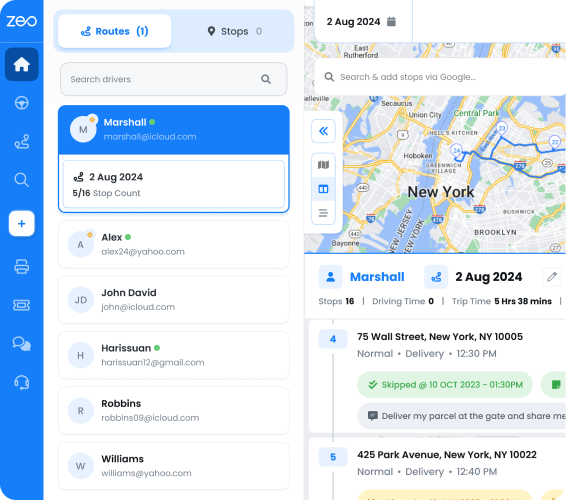
Customer relationship management integration ensures inventory data flows directly into customer records. When drivers scan delivered uniforms, the information automatically updates customer accounts for accurate billing. Service teams access complete delivery histories when handling customer inquiries.
Accounting system connections eliminate double data entry between inventory tracking and billing systems. Delivered quantities automatically generate invoice line items with supporting delivery documentation. This reduces billing errors while speeding up your collection cycle.
Warehouse management system integration provides end-to-end visibility from inventory staging through customer delivery. When items ship from your warehouse, route optimization software automatically receives manifests with precise quantities and customer details. Returns update warehouse inventory levels immediately upon scanning.
API connections enable custom integrations with specialized uniform industry software. Standard integrations handle common business systems, while APIs accommodate unique requirements specific to your operation. This flexibility ensures your tracking system works within your existing technology infrastructure.
Real-time data synchronization prevents conflicts when multiple systems update the same customer records simultaneously. Establish clear data ownership rules and update sequences to maintain consistency across all connected systems.
Building Accountability: Proof of Delivery and Inventory Reconciliation
Accountability starts with clear expectations and systems that make it easy for drivers to follow proper procedures. Complex tracking requirements that slow down drivers lead to shortcuts that compromise accuracy.
Driver training focuses on the business impact of accurate tracking rather than just the technical procedures. Explain how inventory accuracy affects customer satisfaction, billing disputes, and company profitability. When drivers understand the bigger picture, they’re more likely to follow tracking procedures consistently.
Performance metrics track both efficiency and accuracy to prevent drivers from sacrificing quality for speed. Monitor scanning compliance rates alongside delivery times. Driver tracking software analytics show individual performance trends that help identify training opportunities before problems escalate.
Daily reconciliation procedures catch discrepancies while they’re still fresh in drivers’ memories. Compare driver-reported deliveries against customer signatures and photo documentation. Address any inconsistencies immediately rather than discovering problems weeks later during billing.
Exception handling protocols define exactly what drivers should do when situations don’t match standard procedures. Whether customers aren’t available, items are damaged, or addresses are incorrect, drivers need clear steps that maintain inventory accuracy while serving customers professionally.
Regular audits verify that tracking procedures work as designed in real-world conditions. Ride with drivers periodically to observe actual practices versus documented procedures. Use audit results to refine training and update procedures based on field experience.
Incentive programs reward accurate tracking alongside traditional productivity metrics. Recognize drivers who consistently maintain high scanning compliance rates and accurate inventory documentation. This reinforces the importance of tracking while encouraging continued excellence.
Frequently Asked Questions
Q: What percentage of uniform inventory is typically lost due to poor tracking systems?
The average uniform rental company loses 3-5% of inventory annually due to tracking failures, according to industry data. For a company managing 50,000 uniform pieces, this translates to $75,000-$125,000 in lost revenue. Digital tracking systems with barcode scanning and real-time updates can reduce these losses significantly.
Q: How can mobile technology improve uniform delivery accuracy?
Mobile technology eliminates manual data entry errors through barcode scanning and digital signature capture. Zeo Route Planner’s mobile app allows drivers to scan uniforms, photograph deliveries, and capture signatures in real-time, providing instant visibility to managers without waiting for paperwork returns.
Q: What documentation is required for uniform delivery accountability?
Essential documentation includes delivery manifests with item counts, customer signatures confirming receipt, photo evidence of delivered items, and exception reports for any issues. This creates a complete audit trail that supports accurate billing and resolves disputes quickly.
Q: How do you integrate uniform inventory tracking with existing business systems?
Integration connects inventory data directly to customer records, accounting systems, and warehouse management platforms. Real-time data synchronization ensures delivered quantities automatically generate invoice line items while maintaining consistency across all connected systems.
Q: What are the most common causes of uniform delivery billing disputes?
Billing disputes typically arise from incomplete delivery documentation, missing customer signatures, damaged items without proper notation, and discrepancies between shipped quantities and customer receipts. Clear tracking procedures and digital documentation prevent most disputes before they occur.
Ready to eliminate inventory tracking headaches while optimizing your uniform delivery routes? Start your free trial of Zeo Route Planner to optimize your uniform delivery routes while maintaining complete inventory visibility. Join over 1.5 million users across 150+ countries who trust Zeo for efficient routing and comprehensive delivery management.
Are you a fleet owner?
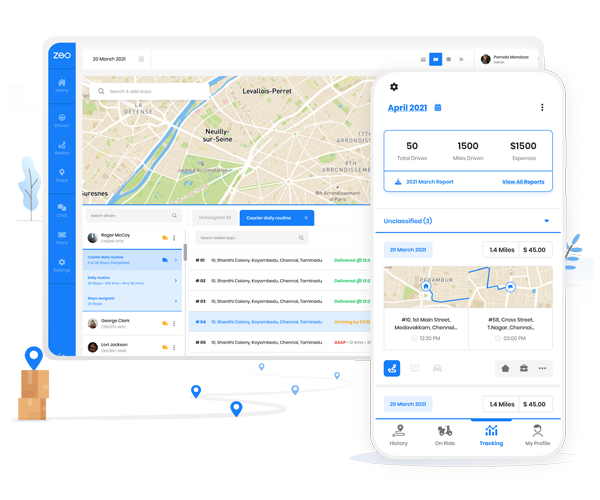
Want to manage your drivers and deliveries easily?
Grow your business effortlessly with Zeo Routes Planner – optimize routes and manage multiple drivers with ease.

increase fuel savings
Save $200 on fuel, Monthly!
Optimize routes with our algorithm, reducing travel time and costs efficiently.
Get Started for Free