


# Financial Document Delivery: How to Build a Compliant, In-House Workflow
> TL;DR: Financial document delivery requires chain-of-custody proof, not just a fast drop-off — missing documentation on a single loan package or title document can trigger compliance exposure or a blown closing date. Route optimization platforms like Zeo Route Planner address this with timestamped photo and signature capture at every stop, helping title companies and financial back-offices save 2+ hours daily while building an auditable delivery record.
Financial document delivery isn’t like dropping off a package. One late loan package can blow a closing date. One missing signature can trigger a compliance audit. One lost title document can cost thousands of dollars and your client’s trust.
Yet many title companies, law firms, and bank back-offices still run this process the old way. Manual dispatch sheets. Outsourced couriers with no live tracking. Phone calls to confirm a delivery actually happened.
This guide shows you how to build or upgrade an in-house financial document delivery operation. You’ll get more control, better compliance, and lower costs than outsourcing — using route optimization and fleet management software designed for exactly this kind of high-stakes delivery work.
What Is Financial Document Delivery (and Why It’s Not Like Regular Courier Work)
Financial document delivery means transporting time-sensitive, confidential paperwork between branches, offices, and clients. Think loan packages, title documents, signed contracts, checks, and regulatory filings. This process shares some operational challenges with legal document delivery, where chain-of-custody and timing are equally critical.
This is not the same as delivering a pizza or a package from an online store. Three things set it apart.
First, timing is non-negotiable. A title document that misses a closing window can delay a real estate transaction by days. A loan package that arrives late can cost a bank a deal.
Second, chain-of-custody matters. You need to know who handled a document, when, and where — every step of the way. Regular courier apps rarely capture this level of detail.
Third, the stakes are higher. A lost or exposed document isn’t just a customer complaint. It can mean regulatory exposure, legal liability, or a breach of client confidentiality.
According to the Consumer Financial Protection Bureau’s guidance on handling nonpublic personal information, mortgage and loan documents often contain personally identifiable information that falls under federal privacy rules. Financial institutions delivering this type of paperwork may also fall under the FTC’s Safeguards Rule for financial institutions, which sets expectations for protecting customer data throughout its handling. That means your delivery process isn’t just an operations problem — it’s a compliance one.
This is why financial document delivery needs its own workflow. Generic courier dispatching wasn’t built for proof, speed, and accountability at this level.
In-House Fleet vs. Outsourced Courier Services: Cost, Control, and Compliance Compared
Many companies default to outsourcing document delivery to third-party courier services. It feels easier upfront. But it often creates more problems than it solves.
Cost. Outsourced couriers charge per delivery, and rates climb fast for rush or same-day service. According to Bureau of Labor Statistics data on couriers and messengers, demand for courier services continues to grow, which often means rising third-party rates too. An in-house fleet has fixed costs — drivers, vehicles, fuel — that scale better as your delivery volume grows.
Control. When you outsource, you lose visibility the moment the courier picks up the document. You’re relying on their tracking, their drivers, and their reporting. If something goes wrong, you find out after the fact.
Compliance. Third-party couriers rarely offer the audit trail regulated industries need. You can’t easily prove who signed for a document or when it changed hands. That’s a real liability if you’re ever audited or sued.
An in-house fleet flips this. You control hiring, training, and vetting of drivers who handle confidential paperwork. You set the technology stack, so every delivery is tracked and documented the way your compliance team requires. And you keep the full cost savings instead of paying a courier’s margin on every stop.
The tradeoff is that running an in-house fleet takes the right tools. Without route optimization and real-time tracking, you’ll just recreate the same visibility gaps you had with outsourcing — just with more overhead.
Chain-of-Custody and Compliance: What Regulated Document Delivery Requires
Chain-of-custody isn’t a nice-to-have for financial document delivery. It’s the core requirement.
At minimum, you need to answer four questions for every document, every time:
- Who picked it up, and when?
- Where did it travel, and in what order?
- Who signed for it at delivery?
- What proof exists that it arrived intact and on time?
Manual logs and phone confirmations can’t reliably answer these questions. A driver might forget to log a timestamp. A dispatcher might lose a sticky note with delivery details. And if a client disputes a delivery, you’re left with no paper trail.
Zeo Route Planner’s proof of delivery tools address this directly. Drivers capture a photo, collect a digital signature, and add delivery notes at every stop. Each proof of delivery is timestamped and synced to your dashboard automatically, creating a digital record you can pull up during an audit or client dispute.
Real-time GPS tracking adds another layer. You can see exactly where a document is at any point in its journey, not just where it started and ended. If a client calls asking about a loan package, you don’t need to call the driver — you check the live tracking link.
This kind of documentation doesn’t just protect you legally. It builds trust with clients who are handing over sensitive financial paperwork and need to know it’s being handled professionally.
How Route Optimization Software Powers Faster, Safer, More Accountable Deliveries
Here’s where the operational upgrade happens. Route optimization software turns a reactive, manual dispatch process into a structured, trackable system.
Faster deliveries through AI-powered routing. Zeo’s route optimization saves drivers 2+ hours daily by calculating the most efficient multi-stop sequence, factoring in time windows and priority stops. For financial document delivery, this means your 10 AM closing deadline gets scheduled ahead of your 4 PM routine drop-off, automatically.
Priority stops for time-sensitive documents. Not every delivery carries the same urgency. Zeo lets you flag stops as ASAP versus normal priority, so a rush loan package doesn’t get stuck behind a routine filing delivery.
Capacity and skill-based assignment. If certain drivers are bonded, background-checked, or trained specifically for handling confidential documents, you can use skill-based job assignment to route work based on those qualifications rather than just proximity.
Dynamic adjustments mid-shift. When a title company calls with an urgent same-day document, dispatchers can adjust routes on the fly from the web platform, without disrupting the rest of the day’s schedule.
This is where the fleet-and-app connection matters most. Your dispatcher plans and assigns multi-stop document routes from the Zeo web platform, optimizing for deadlines and priority. Each courier then receives their route on the Zeo mobile app — complete with turn-by-turn navigation and stop details.
At every delivery, the driver captures a signature or photo as proof, directly in the app. That proof, along with exact timestamps, syncs back to the manager’s dashboard in real time. If a bank’s compliance officer later asks for proof that a loan package was delivered and signed for at 2:47 PM on a specific date, you have it — no phone calls, no guessing.
Example scenario: A title company operations manager runs eight drivers delivering signed closing documents across three counties. Before route optimization, dispatch relied on a whiteboard and a group text. Deliveries were sequenced by whoever called in first, not by deadline.
After switching to Zeo, the manager builds routes each morning based on closing times, flags same-day rush documents as priority, and assigns drivers by territory. Drivers get their stops on the mobile app, navigate with built-in GPS, and capture a signature at each closing office. The manager watches live ETAs from the web dashboard and can tell a nervous title agent exactly when their documents will arrive — because the system shows it in real time.
Building Your Financial Document Delivery Workflow: A Step-by-Step Checklist
Use this checklist to build or upgrade your in-house delivery operation.
1. Map your delivery volume and deadlines.

increase fuel savings
Save 2 Hours on Deliveries, Everyday!
Optimize routes with our algorithm, reducing travel time and costs efficiently.
Get Started for Free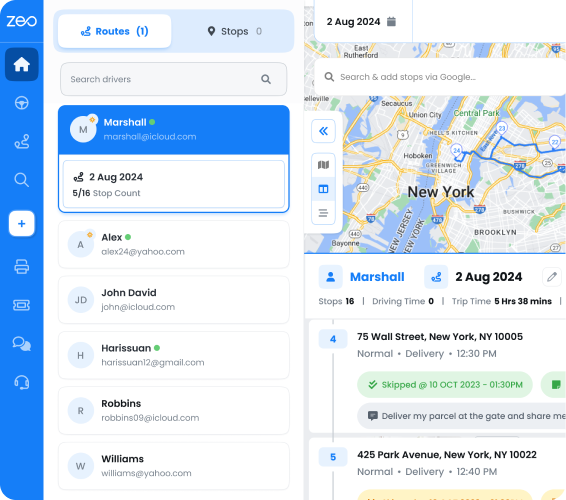
List out your typical daily and weekly delivery types — loan packages, title documents, checks, filings — and their time-sensitivity. This tells you how many drivers and vehicles you actually need.
2. Vet and assign drivers by role.
Some documents require bonded or background-checked couriers. Use skill-based assignment so sensitive deliveries only go to qualified drivers.
3. Set up your route optimization platform.
Import your regular delivery addresses using bulk address import (Excel, CSV, or Google Sheets) or save repeat stops like branch offices and law firms as Favorites for quick route creation.
4. Build in time windows and priority flags.
Set hard deadlines for time-sensitive deliveries like closing documents, and flag rush orders as ASAP so they’re sequenced first.
5. Configure proof of delivery requirements.
Decide which deliveries require a signature, a photo, or both. Digital signature collection paired with delivery notes lets drivers log any unusual circumstances (e.g., “left with office manager, not direct recipient”).
6. Turn on customer notifications.
Use live tracking links and SMS/email alerts so recipients know exactly when their documents will arrive, reducing the “where is it” phone calls to your office.
7. Review analytics weekly.
Check route analytics and driver performance reports to spot recurring delays, identify your most efficient routes, and catch patterns before they become compliance issues.
8. Set recurring routes for regular runs.
If you deliver to the same branches or firms daily, set up scheduled recurring routes so dispatchers aren’t rebuilding the same route every morning. Use blackout dates to pause a route for holidays without deleting the full schedule.
9. Audit your proof-of-delivery records monthly.
Pull signature, photo, and timestamp records regularly to confirm your chain-of-custody documentation is complete and ready for any compliance review.
Following this checklist turns a reactive courier operation into a structured, auditable workflow — one that holds up under scrutiny from clients, auditors, or regulators.
Frequently Asked Questions
Q: How long should a title company keep proof-of-delivery records for closing documents?
Retention requirements vary by state and by the underwriting or lending partner involved, but many title companies keep delivery records for at least as long as their title insurance liability period, often several years. Digital proof of delivery — timestamped signatures, photos, and notes — is easier to store and retrieve than paper logs when a dispute or audit happens years later.
Q: What’s the difference between a courier app and a chain-of-custody delivery system?
A standard courier app typically tracks pickup and drop-off times, while a chain-of-custody system documents who handled a document at every point in its journey, with signatures, photos, and timestamps synced automatically. Zeo Route Planner’s proof of delivery tools capture signature, photo, and notes at each stop, creating a digital record that syncs to the dispatcher’s dashboard in real time.
Q: Do banks and title companies need to notify clients when documents are in transit?
There’s no universal legal requirement to send transit notifications, but many financial and legal firms do it as a service standard to reduce client anxiety and status-check calls. Live tracking links and SMS/email alerts let recipients see exactly when a loan package or title document will arrive without calling the office.
Q: How many drivers does a small title company or law firm need for an in-house delivery fleet?
This depends on delivery volume, geographic spread, and how many same-day rush deliveries you handle weekly. A good starting point is mapping your daily and weekly delivery types and deadlines first, then sizing your fleet around peak volume rather than average volume, so rush closings don’t get delayed.
Q: What happens if a financial document is lost or delivered to the wrong recipient?
Without documentation, a lost or misdelivered document can mean reprinting, re-signing, delayed closings, or in serious cases, a reportable data exposure under privacy regulations. Capturing a signature and photo at every stop, with GPS-verified timestamps, gives operations teams a record to investigate quickly and demonstrate due diligence if questioned.
—
Financial document delivery carries more risk than standard courier work, but it doesn’t require more complexity to manage well. The right combination of route optimization, real-time tracking, and proof of delivery turns a compliance liability into a controlled, auditable process.
Start a free Zeo Route Planner trial to build a compliant, trackable financial document delivery workflow — optimize multi-stop routes, capture proof of delivery, and get real-time visibility across your entire fleet.
Are you a fleet owner?
Want to manage your drivers and deliveries easily?
Grow your business effortlessly with Zeo Routes Planner – optimize routes and manage multiple drivers with ease.

increase fuel savings
Save $200 on fuel, Monthly!
Optimize routes with our algorithm, reducing travel time and costs efficiently.
Get Started for Free