



# Financial Document Delivery: How Route Optimization Closes the Compliance Gap
> TL;DR: Financial document delivery demands hard deadline enforcement and a documented chain of custody, not just a driver with a GPS app. Delayed closings are a leading cause of real estate transaction disputes, and lending disclosure delays can trigger regulatory penalties. Route optimization platforms like Zeo Route Planner address this with time-window constraints, priority stop sequencing, and digital proof-of-delivery (signature, photo, and timestamped notes) at every stop — giving courier operations an audit-ready record without extra manual work.
Financial document delivery is one of the highest-stakes jobs in the courier industry. A closing package delivered 20 minutes late can delay a home sale. A bank interoffice transfer that gets lost can trigger a compliance investigation.
If you run a courier or logistics company serving banks, title companies, or law firms, you already know the margin for error is thin. This guide breaks down why financial document delivery demands different tools than regular courier work, and how route optimization software closes the gap between “we think it arrived on time” and “here’s proof it did.”
What Is Financial Document Delivery (And Why It’s Not Like Regular Courier Work)
Financial document delivery means transporting time-sensitive, legally binding paperwork. Think closing documents, loan packages, title transfers, and bank interoffice transfers. It shares some operational DNA with legal document delivery, where chain-of-custody and deadline enforcement are equally critical, but financial deliveries carry their own regulatory weight.
Unlike a food delivery or retail package, these documents often have:
- Hard legal deadlines. Closings are scheduled to the minute. Miss it, and the whole transaction can fall apart.
- Chain-of-custody requirements. Banks and title companies need proof of who handled the document, when, and where.
- Zero tolerance for “close enough.” A loan package delivered an hour late can violate state lending regulations or trigger penalty fees.
- Multiple stakeholders tracking the same delivery. Loan officers, title agents, attorneys, and bank compliance teams all want visibility.
Regular courier work tolerates some flexibility. A late pizza is an inconvenience. A late closing package can mean a lawsuit, a lost deal, or a compliance citation.
This is why operations managers in this niche need more than a driver with a GPS app. You need a system that documents every stop, every signature, and every timestamp — automatically.
The Real Cost of a Missed Delivery Window: Legal, Financial, and Compliance Risks
A missed SLA window in financial document delivery rarely stays a “minor delay.” It cascades.
Legal risk. Missed closings can breach purchase agreements. According to the American Land Title Association, delayed closings are among the top causes of real estate transaction disputes, often resulting in renegotiated terms or canceled deals.
Financial risk. Mortgage lenders face regulatory penalties for late disclosure delivery under TILA-RESPA Integrated Disclosure (TRID) rules enforced by the Consumer Financial Protection Bureau. A courier’s delay becomes the lender’s liability — and often the courier’s lost contract.
Reputational risk. Title companies and law firms don’t tolerate repeated delays. In an industry built on referrals and long-term contracts, one missed closing can end a courier relationship permanently.
Compliance risk. When a bank or regulator asks “where was this document at 2:15 PM,” “the driver said it was fine” is not an acceptable answer. You need a timestamped, auditable trail.
The common thread: most of these risks stem from a lack of visibility, not a lack of effort. Drivers are trying their best. But manual routing and paper logs can’t produce the proof you need when something goes wrong. This dynamic plays out across the courier industry broadly — Bureau of Labor Statistics data on couriers and messengers shows how fragmented and time-pressured last-mile delivery work has become, which only raises the stakes for document-specific couriers.
In-House Fleet vs. Outsourced Courier vs. Software-Powered Delivery: Comparing Cost, Control, and Compliance
Operations managers typically choose between three models. Here’s how they compare on the factors that matter most.
| Factor | In-House Fleet (Manual) | Outsourced Courier | Software-Powered Delivery (Zeo) |
|—|—|—|—|
| Cost control | High fixed cost (vehicles, drivers, fuel) | Variable, but markup per delivery adds up | Fixed low-cost subscription, scales with volume |
| SLA reliability | Depends on manual dispatch and driver judgment | Limited visibility into third-party performance | Time-window scheduling with live ETA tracking |
| Proof of custody | Paper logs or verbal confirmation | Often minimal, hard to request on demand | Digital signature, photo, and notes at every stop |
| Route efficiency | Manual planning, prone to error | Not optimized for your specific SLA needs | AI-powered optimization saves 2+ hours daily |
| Scalability | Hard to scale without hiring | Easy to scale, but control drops | Easy to scale drivers and routes without losing control |
| Audit readiness | Weak — relies on memory and paperwork | Weak — data sits with a third party | Strong — timestamped digital record for every stop |
In-house fleets give you control but often lack the tools to enforce SLA windows consistently. Outsourced couriers reduce overhead but hand over visibility — a dangerous trade when compliance is on the line.
Software-powered delivery, where you keep your own drivers but run them through a route optimization platform like Zeo, gives you the control of in-house operations with the accountability of enterprise logistics. This approach mirrors what’s happening in adjacent sectors like banking logistics, where operators increasingly need both control and auditability. That’s the model more financial courier operators are shifting toward, especially as SLA penalties and compliance scrutiny increase.
How Route Optimization Software Eliminates Missed SLA Windows
Most missed deadlines in financial document delivery aren’t caused by traffic. They’re caused by bad planning. A driver gets assigned eight stops in the wrong order, hits a time-window conflict, and the 2 PM closing document arrives at 2:40 PM.
Zeo Route Planner’s AI-powered route optimization solves this at the planning stage. Here’s how:
Time window constraints. You set hard deadlines for each stop — a bank’s 1 PM interoffice transfer, a title company’s 3 PM closing. Zeo builds the route around these windows instead of forcing drivers to guess.
Priority stops. Mark a loan package as ASAP and a routine document as Normal. Zeo’s routing logic sequences stops so the time-critical ones never get buried behind lower-priority deliveries.
Dynamic route adjustments. If a driver gets stuck or a new urgent pickup comes in mid-shift, dispatchers can adjust the route in real time from the web dashboard, without starting from scratch.
Skill-based assignment. Some deliveries require a driver familiar with a specific bank’s security protocol or a law firm’s intake process. Zeo lets you assign stops based on driver skills, not just proximity.
Live ETA updates. Title companies and law firms waiting on documents get real-time tracking links, so they’re not calling your dispatcher every 15 minutes asking “where is it?” This same driver tracking infrastructure gives dispatchers full visibility into every vehicle’s location throughout the day.
Together, these features mean fewer missed windows — not because drivers work harder, but because the system removes the guesswork.
Building an Audit-Ready Chain of Custody with Digital Proof-of-Delivery
When a bank compliance officer or title company audit asks for proof of custody, “the driver remembers dropping it off” doesn’t hold up. You need documentation.
Zeo’s proof-of-delivery tools create that documentation automatically, at every stop:

increase fuel savings
Save 2 Hours on Deliveries, Everyday!
Optimize routes with our algorithm, reducing travel time and costs efficiently.
Get Started for Free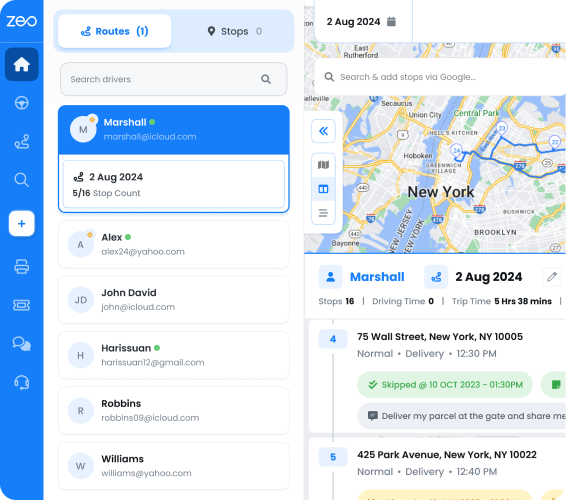
- Digital signature capture confirms who received the document and when.
- Photo capture documents the handoff location and condition of the package.
- Delivery notes let drivers record specifics — like “left with front desk, confirmed by Jane at 2:14 PM.”
- Timestamped GPS tracking ties every delivery to an exact location and time.
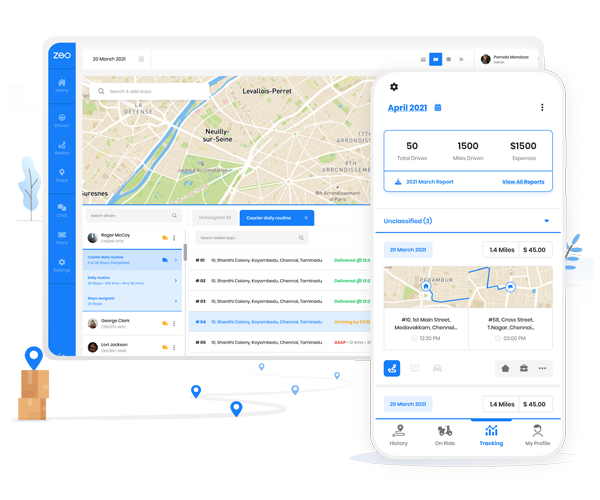
Here’s where the fleet-and-app structure matters. Operations managers build and assign time-sensitive routes from the Zeo web dashboard, setting the time windows, priority levels, and stop-specific instructions for each bank branch, title office, or law firm on the route.
Drivers then receive those stops directly in the Zeo mobile app, complete with time windows and document-specific notes. At each stop, they capture a signature, snap a photo, and log delivery notes right from their phone. That creates a real-time, timestamped proof-of-delivery trail — one that managers and auditors can pull up instantly, without digging through paper logs or calling drivers for details.
This is the difference between “we’re pretty sure it was delivered on time” and a defensible, auditable record you can hand a compliance team without hesitation.
Step-by-Step: Setting Up Multi-Stop Financial Delivery Routes for Banks, Title Companies & Law Firms
Here’s how to build your first audit-ready route in Zeo:
1. Import your stops. Upload addresses in bulk using Excel, CSV, or Google Sheets. If you deliver to the same bank branches or title offices regularly, save them as Favorites for faster route building next time.
2. Set time windows for each stop. Enter the exact SLA deadline for each delivery — a 1 PM bank transfer, a 3:30 PM closing deadline. This is the core of SLA compliance.
3. Mark priority stops. Flag time-critical documents, like loan packages tied to a closing, as ASAP so they’re sequenced first.
4. Assign drivers by skill or zone. If a specific driver handles a law firm’s intake process or a bank’s security check-in, assign them directly using skill-based assignment.
5. Let Zeo optimize the route. The AI sequences stops to meet every time window while minimizing drive time, saving drivers 2+ hours daily compared to manual planning.
6. Dispatch to the mobile app. Drivers receive their optimized route, stop order, and delivery instructions directly on the Zeo mobile app, with turn-by-turn navigation built in.
7. Monitor in real time. Use the web dashboard to track live GPS location and ETA for every driver, and get alerted if a stop is at risk of missing its window.
8. Collect proof at every stop. Drivers capture signatures, photos, and notes as they complete each delivery, building your audit trail automatically.
9. Review delivery analytics. After the route closes, check driver performance analytics and delivery reports to spot patterns — like which routes consistently run tight on time.
This entire setup takes under 10 minutes once your stops and drivers are loaded into the system.
Real-World Scenario: How Route Planning Prevents a Missed Closing
Picture a mid-sized courier company serving title companies across a metro area. On a Tuesday afternoon, they have 14 stops: seven closing packages, four bank interoffice transfers, and three routine legal document drops. It’s a similar volume and time-pressure profile to what operators see when they optimize medical courier routes, where every stop also carries its own hard deadline.
Without route optimization, a dispatcher manually assigns stops by rough geography. One driver ends up with a 2 PM closing scheduled after a 2:15 PM bank drop across town — a scheduling conflict nobody caught until the driver was already stuck in traffic.
With Zeo, the operations manager sets time windows for all 14 stops and marks the seven closing packages as priority. Zeo’s routing engine automatically sequences the day so no driver is physically unable to make a deadline. The dispatcher sees the full route on the web dashboard before drivers even leave the office.
Mid-afternoon, one title company calls in an urgent same-day document. The dispatcher adds it to a nearby driver’s route using dynamic route adjustment, without disrupting the rest of the day’s schedule.
Every closing package gets delivered within its window. Every stop is signed for and photographed in the mobile app. At the end of the day, the manager has a complete digital record — no missed deadlines, no compliance gaps, and no end-of-day scramble to reconstruct what happened.
That’s the practical difference between hoping a route works out and knowing it will, before the first driver leaves the lot.
Frequently Asked Questions
Q: How long do couriers need to keep proof-of-delivery records for financial documents?
Retention requirements vary by document type and state, but many title companies and lenders request records be kept for several years to align with real estate and lending audit cycles. Digital proof-of-delivery records — like those captured in Zeo’s mobile app with timestamps, photos, and signatures — are easier to store and retrieve than paper logs when a records request comes years later.
Q: What’s the difference between a courier SLA and a standard delivery deadline?
A courier SLA (service level agreement) ties a delivery window to contractual or regulatory consequences, like a closing deadline or a TRID disclosure requirement, whereas a standard delivery deadline is more of a customer expectation. Missing a financial document SLA can trigger penalty fees, legal disputes, or lost contracts, which is why these routes need hard time-window enforcement rather than best-effort scheduling.
Q: Can a single driver handle both routine documents and time-critical closing packages in one route?
Yes, as long as the routing system can distinguish priority levels. Zeo’s priority stop feature lets dispatchers mark closing packages or loan documents as ASAP so they’re sequenced ahead of routine drops, rather than relying on the driver to guess which stop matters more.
Q: What should a courier do if a financial document delivery is going to be late?
Best practice is to notify the receiving party as early as possible with an updated ETA, rather than waiting until the deadline passes. Live ETA tracking and automated customer notifications give title companies and banks real-time visibility, so they can adjust on their end instead of being surprised at the scheduled time.
Q: Do banks and title companies require electronic signatures for document handoffs?
Requirements differ by institution, but most banks and title companies now accept digital signature capture as valid proof of receipt, especially when paired with a timestamp and photo of the handoff. It’s worth confirming specific requirements with each client, since some may still require wet-ink signatures for certain legal documents.
—
Manual routing and loose tracking aren’t sustainable in an industry where every delivery window carries legal and financial weight. Start a free Zeo Route Planner trial to build your first audit-ready, time-window-compliant delivery route in under 10 minutes — or book a demo to see how fleet teams manage financial courier operations at scale.
Are you a fleet owner?
Want to manage your drivers and deliveries easily?
Grow your business effortlessly with Zeo Routes Planner – optimize routes and manage multiple drivers with ease.
increase fuel savings
Save 2 Hours on Deliveries, Everyday!
Optimize routes with our algorithm, reducing travel time and costs efficiently.
Get Started for Free