

# Route Planning for Heavy Beverage Loads: A Weight-Based Framework
> TL;DR: Route planning for heavy beverage loads has to start with weight and axle limits, not distance or stop count, because kegs and bottled water max out a truck’s GVWR long before the cargo space is full. Overloaded axles increase rollover risk and trigger DOT fines, which is why capacity-based routing matters more than mileage optimization for this industry. Zeo Route Planner addresses this with capacity-based routing that sets vehicle weight and volume limits per truck, helping beverage fleets build compliant routes instead of discovering overweight axles at a weigh station.
Route planning for heavy beverage loads is not the same game as planning for boxes or parcels. A truck full of kegs, bottled water, or cases of soda hits its weight limit long before it runs out of room. If your route planner only thinks about stop count and mileage, it’s setting you up for overloaded axles, DOT fines, and trucks that tip toward one side on every turn.
This guide gives you a practical framework for planning routes around weight, not just distance. You’ll get a step-by-step sequencing method, a feature checklist for choosing software, and a look at how Zeo Route Planner helps beverage fleets stay compliant and efficient.
Why Heavy Beverage Loads Need a Different Route Planning Approach
Beverage delivery has a physics problem most other industries don’t. A pallet of bottled water or a stack of full kegs can max out a truck’s weight capacity while leaving half the cargo space empty.
Standard route optimization tools optimize for the shortest path between stops. They don’t know that stop #3 needs 40 cases of beer pulled from the back, or that your truck is already close to its gross vehicle weight rating (GVWR) before you’ve even left the warehouse.
The Federal Motor Carrier Safety Administration’s commercial vehicle weight regulations enforce strict weight and axle limits for a reason. Overloaded axles increase stopping distance, wear out brakes faster, and raise rollover risk — especially on trucks carrying liquid loads that shift during turns and hard stops.
For beverage distributors, this means route planning apps built for food and beverage logistics have to account for:
- Total vehicle weight against GVWR limits
- Axle weight distribution, not just total load
- Load balance so heavy pallets don’t sit unevenly on one side
- Unloading sequence, so weight shifts predictably as stops are completed
Ignore these factors and you’re not just risking fines. You’re risking a truck that handles poorly on wet roads or tight turns, loaded with product that can spill, break, or shift.
The Hidden Costs of Poor Heavy-Load Routing: Fines, Fuel, and Failed Deliveries
Bad routing for heavy loads doesn’t just cost you once. It compounds across fuel, fines, labor, and lost trust.
DOT fines and roadside inspections. Overweight violations can cost thousands of dollars per incident, and repeat violations can trigger closer scrutiny of your entire fleet. According to FMCSA roadside inspection data, vehicle-related violations remain among the top reasons trucks get placed out of service during roadside inspections.
Fuel waste from bad sequencing. A truck loaded and routed without weight in mind often burns more fuel than necessary. Heavier trucks consume more fuel per mile, and inefficient routes compound that waste — the U.S. Department of Energy’s fuel economy data notes that fuel economy drops noticeably as vehicle weight and stop-and-go driving increase.
Failed and delayed deliveries. When kegs or bulk cases are loaded in the wrong order, drivers waste time digging through the truck to reach the right product. That means idling at the loading dock, late arrivals at bars and restaurants during their busiest prep hours, and overtime pay for drivers stuck finishing routes after dark.
Safety incidents and insurance costs. An unbalanced load raises the risk of accidents, and accidents raise your insurance premiums. For a fleet of 10-50 trucks, even one preventable incident can affect rates fleet-wide.
Here’s a real scenario: a regional beer distributor sends a truck out with 30 stops, sequenced purely by distance. The truck’s rear axle is overloaded because kegs got stacked toward the back for “easy access.” Halfway through the route, the truck gets flagged at a weigh station. The driver loses two hours, the remaining 15 stops run late, and three bars call in complaints about missed happy-hour deliveries. That’s what happens when routing ignores weight.
Step-by-Step Framework: Sequencing Routes by Weight, Windows, and Load Balance
Here’s a practical framework for building weight-aware beverage routes, whether you’re doing it manually or setting up software rules.
Step 1: Calculate total load weight before building the route.
Know your truck’s GVWR and current load weight before you assign a single stop. Don’t build a 25-stop route and hope it fits — start from the weight limit and work backward.
Step 2: Map axle weight, not just total weight.
Total weight can be within limits while one axle is still overloaded. Distribute heavier items (kegs, water pallets) evenly across the truck length, not just by total pounds.
Step 3: Sequence stops by unloading order, heaviest first when possible.
Plan routes so the heaviest items get delivered earliest. This reduces axle strain gradually instead of leaving a truck back-heavy for the entire shift.
Step 4: Layer in time windows.
Bars and restaurants often have narrow delivery windows — before opening or between meal rushes. Weight sequencing needs to work with these windows, not against them. A route that’s perfectly weight-balanced but arrives during a restaurant’s lunch rush still fails.
Step 5: Assign based on driver and vehicle capability.
Not every truck in your fleet has the same axle configuration or GVWR. Match heavier routes to trucks built for the load, and lighter, high-stop-count routes to smaller vehicles.
Step 6: Build in real-time adjustment capability.
Weight isn’t static — a partial delivery or last-minute add-on order changes the load mid-route. Your framework needs a way to recalculate sequencing without starting over.
This is exactly where manual planning breaks down. Doing this math for 20-30 stops per truck, across 10-50 trucks, isn’t realistic with spreadsheets. It’s a job for truck routing software built to handle capacity constraints as a core input, not an afterthought.
Software Feature Checklist: What a Route Planner Must Handle for Beverage Fleets
If you’re evaluating route planning software for a beverage fleet, here’s what to check for before you commit:
Capacity-based routing. The system should let you set vehicle weight and volume limits, and build routes that respect them automatically. Zeo Route Planner supports capacity-based routing so stops are assigned based on what a truck can actually carry, not just how many addresses fit on a map.
Time window support. Bars, restaurants, and retailers often require deliveries within specific windows. Look for software that lets you set hard time windows per stop, not just suggested arrival times.
Priority stop handling. Some deliveries — a bar that’s out of stock before a weekend rush — need ASAP handling over normal-priority stops. Your planner should support priority flags that adjust sequencing accordingly.
Skill-based driver assignment. Delivering kegs safely requires different handling than delivering cases of canned soda. Assigning drivers based on skill sets and vehicle type helps match the right person to the right load.
Bulk import for large stop lists. During peak season, you may be entering 200+ stops across your fleet. Look for bulk address import from Excel, CSV, or Google Sheets, so you’re not manually entering each account.
Real-time GPS tracking. Once trucks are on the road, managers need visibility into where they are and whether they’re on schedule.
Proof of delivery. For high-value drops like keg deliveries or bulk retail orders, photo capture, digital signatures, and delivery notes protect you against disputes.
Dynamic route adjustments. When a load changes mid-shift — a rejected delivery, an added stop — the system should let you adjust the route without rebuilding it from scratch.
Zeo Route Planner covers each of these, combining capacity-based routing with real-time tracking and proof of service in one platform, used across 150+ countries by more than 1.5 million users.
Planning for Seasonal Surges Without Blowing Past Capacity Limits
Beverage demand spikes hard around holidays, summer weekends, and major sporting events. This is exactly when weight-blind routing causes the most damage.
Plan capacity before you plan stops. Before adding surge-season accounts to a route, check whether existing trucks can absorb the extra weight. Adding 10 more cases to an already near-capacity truck isn’t a routing decision — it’s a compliance risk.
Split high-weight days across more vehicles. If your average load per truck spikes 30% during a holiday week, consider running more trucks with lighter loads rather than fewer trucks packed to the axle limit.
Use scheduled and recurring routes for predictable surges. If certain accounts always order more before major holidays, set up recurring routes ahead of time instead of reacting last minute. Zeo supports scheduled and recurring routes, so predictable seasonal patterns don’t require rebuilding logistics from scratch each time.
Reassign drivers based on skill and vehicle fit during peak weeks. Surge periods often mean pulling in backup drivers or reassigning vehicles. Skill-based and capacity-based assignment features matter most exactly when you’re under the most pressure.
Monitor analytics from the previous season. Route analytics and reporting help you see which routes ran over capacity or behind schedule last year, so you can adjust before the same surge hits again.
The goal isn’t to avoid growth during peak season. It’s to grow volume without letting a single truck exceed what it’s rated to carry.

increase fuel savings
Save 2 Hours on Deliveries, Everyday!
Optimize routes with our algorithm, reducing travel time and costs efficiently.
Get Started for Free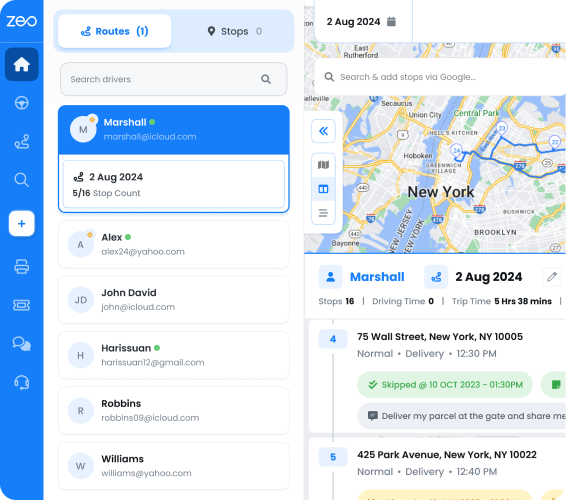
Common Heavy-Load Routing Mistakes (and How to Fix Them)
Mistake: Routing by distance alone.
Fix: Build routes starting from weight and axle constraints first, then optimize for distance within that constraint.
Mistake: Loading heaviest items last “for convenience.”
Fix: Sequence stops so heavy items unload earlier, reducing sustained axle strain across the shift.
Mistake: Treating all trucks in the fleet as identical.
Fix: Match routes to each vehicle’s actual GVWR and axle rating, not a fleet-wide average.
Mistake: Ignoring time windows in favor of weight optimization.
Fix: Combine both. A route that’s weight-balanced but misses every bar’s delivery window still fails operationally.
Mistake: Manual spreadsheet planning for 20+ stops per truck.
Fix: Use software built for capacity-based routing. AI-powered optimization can save 2+ hours daily per driver by removing manual sequencing work.
Mistake: No real-time visibility once trucks leave the depot.
Fix: Use driver tracking software with live GPS so dispatchers can catch problems — like a driver flagging an overloaded compartment — before they become violations.
Mistake: No proof of delivery for high-value drops.
Fix: Require photo capture and signature collection for keg deliveries and bulk orders, protecting against disputes over quantity or condition.
From Dispatcher to Driver: How Zeo Keeps Managers and Drivers in Sync
Weight-aware routing only works if the plan built in the office actually matches what happens on the truck. This is where the connection between dispatch and driver matters most.
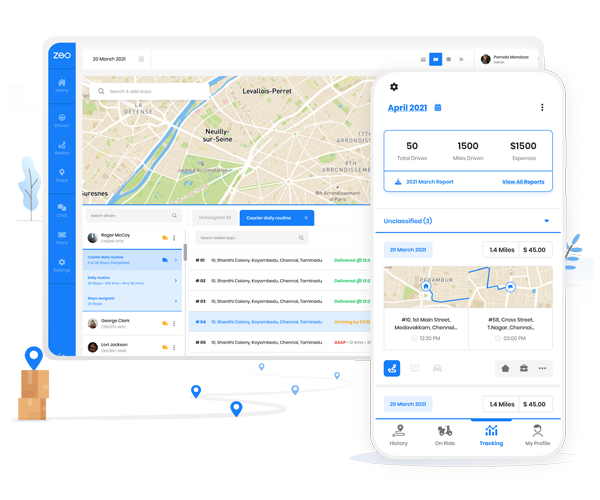
Fleet managers use the Zeo web platform to build routes based on vehicle capacity, axle limits, time windows, and stop priority. Once the route is finalized, it gets pushed directly to each driver’s phone through the Zeo mobile app.
From there, drivers get turn-by-turn navigation using their preferred app — Google Maps, Waze, or Apple Maps — along with customer details and delivery instructions for each stop. If a driver notices a load or weight issue mid-route, they can flag it in real time through the in-app chat, so dispatchers can adjust the plan instead of finding out about a problem after the fact.
For heavy or high-value drops — a keg delivery to a busy bar, a bulk retail order to a grocery chain — drivers capture proof of delivery directly in the app: photo, signature, and delivery notes. That record protects both the driver and the business if there’s ever a dispute over quantity, condition, or delivery time.
This loop — plan on the web platform, execute on the app, report back in real time — keeps weight-based planning from breaking down between the office and the road.
FAQ: Weight Limits, Compliance, and Route Planning for Bulk Beverage Delivery
What’s the difference between GVWR and axle weight limits?
GVWR is the maximum total weight a vehicle can safely carry, including cargo and passengers. Axle weight limits govern how much weight can rest on each individual axle. A truck can be under its GVWR and still violate axle limits if the load isn’t distributed evenly — a common issue with keg and bottled water deliveries.
How do I know if my beverage routes are violating axle weight limits?
Check load distribution against your vehicle’s axle rating, not just total cargo weight. Route planning software that supports capacity-based routing helps you set these limits upfront, so routes are built around what the vehicle can safely carry.
Does route planning software actually help with DOT compliance?
Software can’t file paperwork or guarantee compliance on its own. But capacity-based routing helps you stay within weight limits by design, and proof of delivery features create a documented record of each drop, which supports your compliance efforts.
How should I sequence stops when trucks carry mixed products (kegs, bottles, cans)?
Generally, sequence heavier items for earlier delivery to reduce sustained axle strain, while balancing that against each stop’s required time window. Priority stop settings help you flag urgent deliveries without abandoning weight-based sequencing.
Can route planning help during seasonal demand spikes like holidays or summer weekends?
Yes. Scheduled and recurring routes let you prepare for predictable surges in advance, while route analytics help you review whether last year’s peak season routes stayed within capacity limits.
What should I look for in a route planner if I run a mixed fleet of trucks with different weight ratings?
Look for software that lets you set individual vehicle capacity limits per truck, along with skill-based driver assignment, so routes are matched to each vehicle’s actual rating rather than a fleet-wide assumption.
Frequently Asked Questions
Q: How much weight can a beverage delivery truck legally carry?
It depends on the vehicle’s gross vehicle weight rating (GVWR) and axle configuration, both of which are set by the manufacturer and regulated under federal weight limits. A standard box truck might have a GVWR between 16,000 and 26,000 lbs, but the real limit for beverage loads is often axle weight distribution, not total capacity, since kegs and bottled water are dense enough to overload a single axle before the truck hits its overall weight limit.
Q: Why do beverage trucks hit weight limits before running out of space?
Beverages are dense cargo — a pallet of bottled water or a stack of full kegs weighs far more per cubic foot than most dry goods or parcels. This means a beverage truck can look half-empty and still be at or near its GVWR, which is why route planning built for box count or mileage alone doesn’t work for this industry.
Q: What’s the best way to sequence stops when every truck carries a different load weight?
Sequence heaviest items for earlier delivery when possible, since this reduces sustained axle strain across the shift, and match trucks to routes based on their individual axle rating rather than a fleet-wide average. Zeo Route Planner’s capacity-based routing lets managers set weight and volume limits per vehicle, so stops are assigned based on what each specific truck can safely carry.
Q: Can route planning software help reduce overweight violations for beverage fleets?
Software can’t file compliance paperwork or guarantee a violation-free fleet, but capacity-based routing helps build routes around weight limits from the start rather than checking compliance after the truck is loaded. Zeo Route Planner’s capacity-based routing and proof of delivery features, used by fleets across 150+ countries, help create a documented, weight-aware planning process that supports compliance efforts.
Q: How do seasonal demand spikes affect weight-based routing for beverage distributors?
Surge periods like holidays and summer weekends push more volume onto existing trucks, which increases the risk of exceeding axle or GVWR limits if routes aren’t rebuilt around capacity first. Splitting high-weight days across more vehicles and reviewing the previous season’s route analytics are two of the most reliable ways to catch capacity problems before they become roadside violations.
Weight-aware route planning isn’t optional for beverage distribution fleets — it’s the difference between a compliant, efficient operation and one that’s one weigh-station stop away from a costly fine.
Start a free Zeo Route Planner trial to build weight-smart, DOT-compliant delivery routes for your beverage fleet, or book a demo to see capacity-based routing in action.
Are you a fleet owner?
Want to manage your drivers and deliveries easily?
Grow your business effortlessly with Zeo Routes Planner – optimize routes and manage multiple drivers with ease.
increase fuel savings
Save 2 Hours on Deliveries, Everyday!
Optimize routes with our algorithm, reducing travel time and costs efficiently.
Get Started for Free