


# Complete Guide to Delivery Route Planner Software: Cut Costs 30% in 2026
> TL;DR: Delivery route planner software reduces fuel costs by 20-30% and saves 2+ hours daily in planning time by automatically optimizing routes for multiple stops, time windows, and vehicle constraints. According to transportation industry research, manual route planning costs delivery companies $300,000+ annually in unnecessary fuel and overtime expenses. Route optimization tools like Zeo Route Planner address this with AI-powered optimization that processes 100+ stops across multiple drivers in under 30 seconds, helping delivery teams serve 1.5M+ users across 150+ countries.
Manual route planning is costing your delivery business thousands of dollars every month. While you’re spending hours each morning plotting routes on paper or basic maps, your competitors are using delivery route planners to slash fuel costs and delight customers with on-time deliveries.
The delivery landscape has transformed dramatically. Rising fuel prices, driver shortages, and customer expectations for real-time tracking mean that manual planning isn’t just inefficient—it’s business suicide.
This guide shows you exactly how to choose and implement a delivery route planner that transforms your operations from chaotic to streamlined.
Why Manual Delivery Route Planning Is Killing Your Profit Margins
Every morning, operations managers across America waste 2-3 hours creating routes manually. They spread out maps, estimate drive times, and try to balance driver workloads—all while fielding calls from impatient customers.
This manual process creates a cascade of expensive problems. Routes planned by hand are typically 20-30% longer than optimized alternatives, according to transportation industry research. That translates directly to higher fuel costs, overtime pay, and vehicle wear.
The Hidden Costs Add Up Fast
Consider a delivery company with 20 drivers making 150 stops daily. Manual planning means each driver travels an extra 15-20 miles per day. At current fuel prices, that’s $50-75 in unnecessary fuel costs per driver daily—over $300,000 annually for just fuel.
But fuel is only the beginning. Manual planning leads to missed delivery windows, requiring expensive return trips. Industry data shows that failed first-delivery attempts cost companies $15-25 per package in additional handling and transportation.
Customer complaints spike when deliveries arrive outside promised windows. Modern consumers expect Amazon-level service—real-time tracking, accurate ETAs, and reliable delivery windows. Manual planning makes these expectations nearly impossible to meet consistently.
Driver Frustration Drives Turnover
Poorly planned routes frustrate drivers who spend extra hours in traffic and deal with angry customers. The American Trucking Association reports that driver turnover costs delivery companies $5,000-15,000 per departing driver in recruitment and training expenses.
Complete Guide to Delivery Route Planning: 7-Step Process for Maximum Efficiency
Effective delivery route planning follows a systematic approach that considers multiple variables simultaneously. Here’s how modern delivery companies optimize their daily operations using route optimization best practices.
Step 1: Consolidate All Delivery Data
Start by gathering complete information for each stop: addresses, time windows, special instructions, and delivery requirements. Import customer data from your order management system, CRM, or spreadsheet into your route planning platform.
Include vehicle capacities, driver skills, and any equipment requirements. A plumbing supply company, for example, needs to match heavy deliveries with drivers who have lift gates and proper lifting equipment.
Step 2: Set Time Windows and Priorities
Define delivery windows for each stop. Residential customers often prefer evening deliveries, while businesses need morning arrivals. Mark urgent or high-value deliveries as priority stops that must be completed first.
Time windows prevent drivers from arriving at closed businesses or bothering residential customers at inappropriate hours. They also help manage customer expectations and reduce complaints.
Step 3: Configure Vehicle and Driver Constraints
Input vehicle capacities (weight and volume), driver work hours, and break requirements per Federal Motor Carrier Safety Administration regulations. Factor in different vehicle types—smaller vans for dense urban areas, larger trucks for bulk deliveries.
Consider driver specializations. HVAC technicians can’t deliver pool chemicals, and some drivers lack commercial driving licenses for larger vehicles.
Step 4: Apply Route Optimization Algorithm
Modern route planners use AI algorithms to calculate optimal routes considering distance, traffic patterns, time windows, and constraints simultaneously. These algorithms solve complex mathematical problems that would take humans hours to figure out.
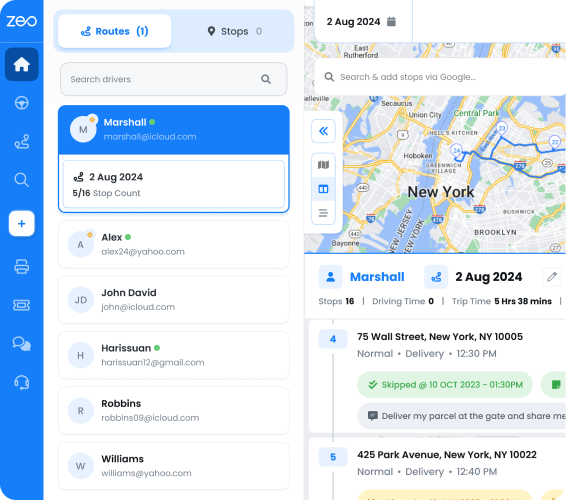
The system assigns stops to drivers and sequences them for minimum drive time while respecting all constraints. Advanced planners like Zeo Route Planner can optimize routes for 100+ stops across multiple drivers in under 30 seconds.
Step 5: Review and Adjust Routes
Check the generated routes for obvious issues. While algorithms excel at mathematical optimization, human judgment spots problems like construction zones, difficult parking situations, or customer preferences.
Make manual adjustments as needed. Good route planners allow drag-and-drop editing while maintaining overall optimization.
Step 6: Distribute Routes to Drivers
Send optimized routes directly to driver mobile devices with all necessary information: customer details, special instructions, contact numbers, and navigation support.
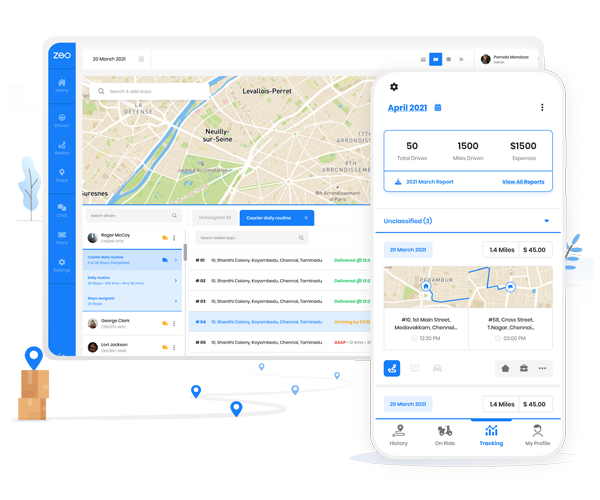
Your drivers receive routes on their smartphones through the route planner’s mobile app, complete with turn-by-turn navigation and the ability to update delivery status in real-time.
Step 7: Monitor and Optimize
Track route performance throughout the day. Monitor driver progress, customer feedback, and delivery success rates. Use this data to refine future route planning and identify improvement opportunities.
Modern route planners provide real-time visibility into your entire fleet, allowing managers to make adjustments and communicate with drivers as conditions change.
Essential Features Every Delivery Route Planner Must Have (Free vs Paid Comparison)
Not all route planning solutions are created equal. Understanding which features matter most helps you choose the right platform for your business needs and budget.
Core Optimization Features
Every delivery route planner should handle basic multi-stop optimization. Free tools like Google Maps can plan routes for up to 10 stops, but they lack the sophistication for complex delivery operations.
Paid platforms offer advanced optimization considering vehicle capacities, time windows, driver skills, and priority stops. They also handle much larger route sizes—professional delivery companies often need to plan 50-150 stops per driver.
Time Window Management
Free tools rarely handle time windows effectively. They might show you the shortest route, but not one that respects when customers are available for deliveries.
Professional route planners like Zeo Route Planner let you set specific delivery windows for each stop and optimize routes to meet these constraints while minimizing drive time.
Real-Time Tracking and Communication
Basic route planners provide static directions. Advanced platforms offer live GPS tracking, automatic customer notifications, and real-time ETA updates.
This capability transforms customer service. Instead of fielding “where’s my delivery” calls all day, your customers receive proactive updates with accurate arrival times and live tracking links.
Proof of Delivery
Free solutions don’t capture delivery confirmation. Professional platforms include photo capture, digital signatures, and delivery notes that protect your business from disputes and provide accountability.
These features prove deliveries were completed successfully and provide documentation for insurance claims or customer service issues.
Driver Mobile Applications
Consumer-grade tools work fine for occasional users but lack features professional drivers need. Business route planners provide dedicated mobile apps with offline navigation, delivery workflows, and communication tools.
Integration Capabilities
Growing delivery businesses need route planners that connect with existing systems. Look for platforms that integrate with your e-commerce platform, CRM, or order management system to eliminate manual data entry.
Key Feature Comparison
Free tools work for very small operations (under 5 drivers with simple routes). They’re good for testing route planning concepts but quickly become limiting.
Paid platforms justify their cost through time savings, fuel reduction, and improved customer satisfaction. The best solutions pay for themselves within weeks through operational improvements.
ROI Calculator: How Much Money Route Optimization Actually Saves Delivery Companies
Let’s quantify the financial impact of implementing a professional delivery route planner. These calculations use conservative estimates based on U.S. Bureau of Labor Statistics transportation industry averages.
Time Savings Analysis
Manual route planning takes 2-3 hours daily for a 20-driver operation. Route optimization software reduces this to 10-15 minutes—saving 2.5+ hours of management time daily.
At $25/hour for operations manager time, that’s $62.50 daily or $16,250 annually just in planning time savings. Larger operations see proportionally bigger savings.
Fuel Cost Reduction
Optimized routes typically reduce driving distances by 20-30%. For a driver covering 100 miles daily, optimization saves 20-30 miles of unnecessary driving.
At current fuel prices and average vehicle efficiency, route optimization saves $15-25 per driver daily in fuel costs. A 20-driver fleet saves $300-500 daily or $78,000-130,000 annually.
Overtime and Labor Savings
Shorter, more efficient routes reduce driver hours. Saving just 30 minutes per driver daily eliminates significant overtime costs.

increase fuel savings
Hassle Free Deliveries & Pickups!
Optimize routes with our algorithm, reducing travel time and costs efficiently.
Get Started for Free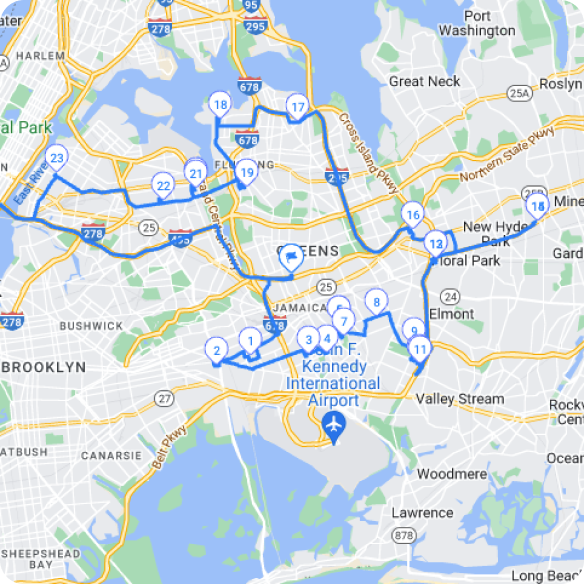
For drivers earning $20/hour, 30 minutes daily savings per driver equals $10 daily or $2,600 annually per driver. A 20-driver operation saves $52,000 yearly in reduced labor costs.
Customer Satisfaction Improvements
On-time deliveries reduce customer complaints and return trips. Failed delivery attempts cost $15-25 in additional handling and transportation.
If route optimization prevents just 2 failed deliveries per driver weekly, that saves $30-50 per driver weekly or $1,560-2,600 annually per driver.
Total ROI Calculation
For a typical 20-driver delivery operation, professional route planning saves:
- Planning time: $16,250
- Fuel costs: $104,000
- Labor reduction: $52,000
- Failed delivery prevention: $41,600
Total annual savings: $213,850
Professional route planning software costs $30-100 per driver monthly, or $7,200-24,000 annually for 20 drivers. The ROI ranges from 890% to 2,970%—exceptional returns that justify immediate implementation.
Industry-Specific Route Planning Strategies: Food Delivery vs E-commerce vs B2B
Different delivery industries have unique requirements that affect route planning strategies. Understanding these differences helps you configure your route planner for maximum effectiveness.
Food Delivery Optimization
Food delivery demands speed and freshness. Routes must minimize delivery times to maintain food quality and customer satisfaction.
Time windows are typically tight—30-45 minutes from kitchen to customer. Route planners must prioritize delivery sequence based on food temperature sensitivity and preparation times.
Consider a pizza delivery operation during dinner rush. Hot pizzas need immediate delivery, while cold items like salads can wait slightly longer. Route optimization algorithms account for these priorities while maintaining efficient driver routes.
Zeo Route Planner handles priority stops perfectly for food delivery, marking urgent orders as “ASAP” while optimizing the overall route for minimum drive time.
E-commerce Delivery Requirements
E-commerce deliveries typically involve larger package volumes with flexible time windows. The challenge shifts from speed to capacity optimization and delivery density.
Package sizes and weights vary dramatically. Route planners must consider vehicle capacity constraints and loading efficiency. Delivering 200 small packages requires different planning than 50 large items.
Customer availability varies widely for e-commerce deliveries. Some customers accept packages anytime, while others require specific delivery windows. Effective route planning balances these constraints with delivery efficiency.
B2B Delivery Considerations
Business-to-business deliveries often involve larger shipments, specific delivery appointments, and special handling requirements.
B2B customers typically prefer morning deliveries and have loading dock constraints. A medical supply company might deliver to hospitals that only accept deliveries during specific hours with particular entrance requirements.
Route planning must account for longer stop times, special equipment needs, and delivery documentation requirements. B2B deliveries often require signatures, proof of delivery photos, and detailed delivery notes.
Specialized Requirements
Some industries need additional considerations. Pharmaceutical deliveries require temperature control and chain of custody documentation. Same-day delivery operations need age verification procedures for items like alcohol.
While route planners can’t handle every specialized requirement automatically, they provide frameworks for documenting compliance. Zeo’s photo capture and delivery notes help drivers document ID checks, temperature readings, and other compliance requirements.
Implementation Guide: Getting Your Drivers On Board with New Route Planning Technology
Successfully implementing route planning technology requires careful change management. Drivers who’ve worked the same routes for years might resist new systems that alter their familiar routines. Delivery management software implementation requires a strategic approach.
Start with Clear Communication
Explain why you’re implementing route planning technology. Focus on benefits drivers care about: shorter days, less traffic stress, and better customer interactions.
Avoid framing it as fixing driver problems. Instead, position it as providing better tools to help them succeed. Emphasize that optimized routes reduce their daily stress and help them finish work earlier.
Provide Comprehensive Training
Schedule hands-on training sessions with your route planning platform. Show drivers how to use the mobile app, update delivery status, and communicate with dispatch.
Practice with sample routes before going live. Let drivers experiment with the system during low-pressure situations so they’re comfortable when it matters.
Address Common Concerns
Drivers often worry that route optimization will eliminate their jobs or reduce their hours. Explain that route planning helps the business grow, creating more opportunities rather than fewer.
Some drivers prefer their existing routes and worry about losing familiar customers. Emphasize that route optimization considers customer preferences and driver expertise while improving overall efficiency.
Implement Gradually
Start with a small pilot group of enthusiastic drivers. Work out system bugs and refine processes before rolling out company-wide.
Use pilot group success stories to build enthusiasm among remaining drivers. Let early adopters share their positive experiences and practical tips.
Provide Ongoing Support
Designate a point person for technical questions and system issues. Drivers need to know they can get help quickly when problems arise.
Monitor driver adoption and address resistance quickly. Some drivers might need additional training or one-on-one support to become comfortable with new technology.
Measure and Share Results
Track key metrics like route efficiency, customer satisfaction, and driver feedback. Share positive results with your team to reinforce the benefits of the new system.
Celebrate improvements and acknowledge drivers who embrace the new technology. Recognition helps build momentum for continued adoption and optimization.
Technical Implementation
Your drivers receive optimized routes directly on their smartphones through the route planner’s mobile app, complete with turn-by-turn navigation and customer details. This seamless integration eliminates the need for separate GPS devices or printed directions.
The mobile app works with popular navigation platforms like Google Maps, Waze, and Apple Maps, so drivers can use their preferred navigation tool while maintaining route optimization and delivery tracking.
Frequently Asked Questions
Q: How much can route optimization software reduce daily fuel costs for delivery fleets?
Route optimization typically reduces driving distances by 20-30%, translating to significant fuel savings. For a 20-driver fleet, this can mean $300-500 daily savings or $78,000-130,000 annually. Zeo Route Planner’s AI-powered optimization helps delivery companies achieve these savings by calculating the most efficient routes in under 30 seconds.
Q: What’s the difference between free route planners and professional delivery route planning software?
Free tools like Google Maps handle basic routing for up to 10 stops but lack advanced features like time windows, capacity constraints, and real-time tracking. Professional platforms manage 50-150+ stops per driver, handle complex delivery requirements, and provide customer notifications and proof of delivery capabilities.
Q: How long does it typically take to implement route planning software for a delivery team?
Implementation usually takes 1-2 weeks with proper change management. Start with a pilot group of 3-5 drivers, provide hands-on training, and gradually roll out company-wide. Zeo Route Planner’s mobile app integrates seamlessly with existing navigation tools, making the transition smoother for drivers already familiar with GPS systems.
Q: What features should delivery companies prioritize when choosing route planning software?
Essential features include multi-stop optimization, time window management, real-time GPS tracking, customer notifications, and proof of delivery. For growing businesses, integration capabilities with existing e-commerce platforms or CRMs are crucial to eliminate manual data entry and streamline operations.
Q: Can route optimization software handle different vehicle types and driver specializations?
Yes, advanced route planners accommodate vehicle capacity constraints (weight/volume), driver skills, and equipment requirements. The software can match heavy deliveries with drivers who have lift gates, assign specialized routes to certified technicians, and optimize based on vehicle size restrictions for urban versus rural areas.
Route planning technology transforms delivery operations from reactive to proactive. Instead of dealing with problems after they occur, you prevent issues through better planning and real-time visibility.
The investment in professional route planning pays for itself quickly through reduced fuel costs, improved customer satisfaction, and operational efficiency. Companies that implement route optimization typically see positive ROI within the first month.
Ready to transform your delivery operations? Start your free trial of Zeo Route Planner to see how much time and money you can save on your delivery routes.
Are you a fleet owner?
Want to manage your drivers and deliveries easily?
Grow your business effortlessly with Zeo Routes Planner – optimize routes and manage multiple drivers with ease.
increase fuel savings
Save 2 Hours on Deliveries, Everyday!
Optimize routes with our algorithm, reducing travel time and costs efficiently.
Get Started for Free