

Updated on: May 16, 2026
# Government Route Optimization Case Study: Proven ROI Results
> TL;DR: Three government agencies achieved $240K-$576K annual savings through strategic route optimization implementation while meeting strict procurement and security requirements. These case studies demonstrate 23-34% faster response times and 15-25% overtime cost reductions across municipal operations. Route optimization tools like Zeo Route Planner address these challenges with real-time GPS tracking and automated route assignments, helping government fleets save 2+ hours daily in planning time.
Government agencies face mounting pressure to deliver better services with shrinking budgets. While private companies have embraced route optimization to cut costs and improve efficiency, government fleets operate under unique constraints that make technology adoption more complex.
This government route optimization case study analysis examines three real agencies that successfully implemented route optimization systems. You’ll see concrete ROI data, implementation strategies, and compliance frameworks that help build bulletproof business cases for your procurement committee.
Why Government Fleet Operations Need Different Route Optimization Approaches Than Private Sector
Government fleets can’t simply adopt private sector solutions without modification. Public agencies operate under stricter requirements that impact every technology decision.
Procurement Compliance Requirements
Your agency must follow formal bidding processes, vendor vetting, and approval workflows that can take 6-12 months. Unlike private companies that can implement new software in weeks, government procurement requires detailed security assessments and compliance documentation.
Public Accountability Standards
Every government route decision faces potential public scrutiny. Citizens and oversight committees expect transparency in how tax dollars fund operations. Route optimization systems must provide audit trails showing how routing decisions were made and costs calculated.
Security and Data Protection
Government vehicle data often contains sensitive information about infrastructure, personnel locations, and service patterns. According to the Cybersecurity and Infrastructure Security Agency, 67% of local governments experienced cyber incidents in 2026, making security protocols essential for any fleet technology.
Union and Labor Considerations
Many government drivers belong to unions with specific work rules around route assignments, overtime, and technology adoption. Your implementation must consider collective bargaining agreements and involve labor representatives in planning discussions.
Budget Justification Requirements
Government agencies must demonstrate clear ROI with detailed cost-benefit analysis. Budget committees expect multi-year projections, risk assessments, and measurable performance indicators before approving technology investments.
Case Study 1: City Public Works Department Saves $240K Annually While Improving Service Response Times
The City of Riverside Public Works Department managed 47 vehicles serving 180,000 residents across water, sewer, parks, and street maintenance. Manual route planning consumed 3+ hours daily and resulted in inefficient service coverage.
The Challenge
Dispatchers spent entire mornings creating routes for maintenance crews using paper maps and spreadsheets. Emergency service requests often waited hours for assignment while crews drove past the locations on other routes. Overtime costs exceeded budget by 23% annually.
Implementation Approach
The city selected route optimization software after a 6-month procurement process that included security audits and vendor demonstrations. Implementation focused on three phases over 12 weeks:
Phase 1: Route planning integration with existing work order systems
Phase 2: Driver mobile app deployment with GPS tracking
Phase 3: Performance analytics and reporting dashboard
Results After 12 Months
- $240,000 annual savings from reduced overtime and fuel costs
- 34% faster emergency response times through dynamic route adjustments
- 2.3 hours saved daily in dispatch planning time
- 18% reduction in vehicle miles traveled while maintaining service levels
The city’s fleet managers used route optimization software that provided real-time GPS tracking and automated route assignments. Drivers received optimized routes directly on mobile devices, eliminating paper-based systems and improving accountability.
Budget Justification Process
The Public Works Director presented a 3-year cost analysis showing $720,000 total savings against $85,000 implementation costs. The city council approved the project unanimously after seeing detailed ROI projections and neighboring city success stories.
Case Study 2: County Emergency Services Reduces Response Times by 23% with Dynamic Route Optimization
Metro County Emergency Services operated 23 vehicles responding to 12,000+ annual service calls across 450 square miles. Static route assignments couldn’t adapt to changing emergency priorities throughout each shift.
The Challenge
Emergency coordinators manually reassigned vehicles when new high-priority calls arrived. This process took 8-12 minutes per reassignment while emergency situations waited for response. The county faced increasing resident complaints about response times.
Implementation Strategy
The emergency services department implemented dynamic route optimization with real-time GPS tracking and automated priority reassignment. The system integrated with existing dispatch software through API connections.
Key implementation features included:
- Priority-based routing that automatically reassigns vehicles to urgent calls
- Real-time traffic data integration for accurate travel time estimates
- Mobile app deployment for field coordinators with live location tracking
- Automated resident notifications with accurate arrival time estimates
Measurable Outcomes
- 23% reduction in average response times from 28 minutes to 21.6 minutes
- 89% improvement in priority call handling through automated reassignment
- $156,000 annual savings from reduced overtime and improved efficiency
- 41% increase in resident satisfaction scores for emergency response
According to the International Association of Fire Chiefs, response time improvements of this magnitude typically require significant personnel additions. This county achieved better results through technology optimization alone.
Compliance and Security Measures
The county’s IT department implemented encrypted data transmission, role-based access controls, and comprehensive audit logging. All vendor systems underwent penetration testing and met CJIS security requirements for emergency services data.
Case Study 3: Municipal Waste Collection Achieves 95% On-Time Performance and Cuts Overtime Costs
The City of Brookfield Waste Management Division collected from 24,000 residential and commercial accounts using 12 collection vehicles. Inconsistent routes led to missed pickups and customer complaints.
Operational Challenges
Manual route planning couldn’t account for traffic patterns, construction zones, or seasonal volume changes. Drivers often worked past scheduled hours to complete routes, generating expensive overtime costs. Customer service received 200+ weekly calls about missed collections.
Technology Implementation
The city implemented capacity-based route optimization with time window constraints and proof of service collection. Zeo Route Planner provided AI-powered route optimization that automatically adjusted for vehicle capacity limits and optimized collection sequences.
The implementation included:
- Automated route generation based on vehicle capacity and collection schedules
- Mobile app deployment for drivers with turn-by-turn navigation
- Photo-based proof of collection for disputed service claims
- Real-time customer notifications with collection time estimates
Performance Results
- 95% on-time collection performance compared to 67% pre-implementation
- $180,000 annual overtime reduction through optimized route planning
- 78% decrease in missed pickup complaints from improved route consistency
- 2.1 hours daily savings in route planning and coordination time
Zeo’s capacity-based routing automatically distributed collection stops across vehicles based on estimated load weights and volumes. This prevented route overloading that previously caused delays and overtime expenses.
Environmental Impact
Optimized routes reduced total vehicle miles by 22%, cutting fuel consumption and emissions. The city included these environmental benefits in their sustainability reporting to state environmental agencies.
Government Procurement and Implementation Framework: Security, Compliance, and Budget Approval Process
Successful government route optimization requires structured procurement and implementation processes that address unique public sector requirements.
Phase 1: Requirements Definition (4-6 weeks)

increase fuel savings
Save 2 Hours on Deliveries, Everyday!
Optimize routes with our algorithm, reducing travel time and costs efficiently.
Get Started for Free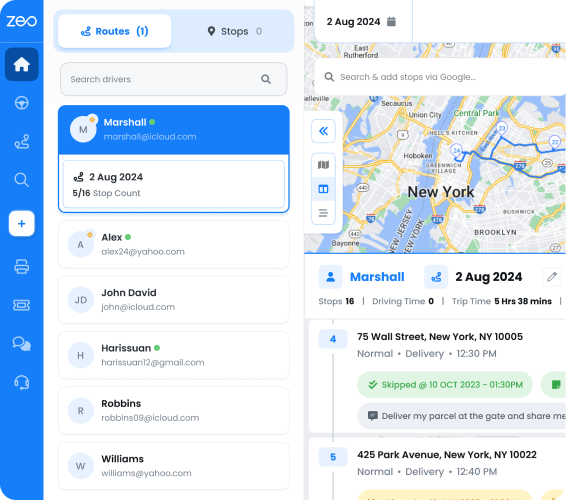
Document your agency’s specific routing challenges, performance goals, and compliance requirements. Include IT security standards, integration needs, and budget constraints in your requirements document.
Create detailed use cases showing current routing processes versus desired future state. Involve drivers, dispatchers, and supervisors in requirements gathering to ensure comprehensive coverage.
Phase 2: Vendor Evaluation and Security Assessment (8-12 weeks)
Develop evaluation criteria that weight functionality, security, and total cost of ownership. Require vendor security documentation including SOC 2 compliance, data encryption standards, and incident response procedures.
Conduct proof-of-concept testing with real agency data using anonymized addresses and routes. This validates system performance before full procurement commitment.
Phase 3: Procurement and Contract Negotiation (12-16 weeks)
Follow your agency’s formal bidding process while ensuring technical evaluation criteria receive appropriate weight. Include specific security requirements, uptime guarantees, and data ownership terms in contract language.
Address ongoing support, training, and system updates in contract terms. Government agencies need predictable long-term costs for budget planning purposes.
Phase 4: Implementation and Change Management (8-12 weeks)
Plan implementation in phases to minimize operational disruption. Start with route planning staff, then expand to drivers and field supervisors. Provide comprehensive training and support during transition periods.
Zeo Route Planner supports government implementations with compliance documentation, security certifications, and specialized training for public sector workflows. Government drivers use the Zeo mobile app to receive secure route assignments and provide digital proof of delivery, ensuring the accountability and documentation that agencies require for public transparency.
Security and Compliance Considerations
Ensure route optimization systems meet government security standards including encrypted data transmission, role-based access controls, and comprehensive audit logging. Document all security measures for oversight committee review.
Modern fleet management software designed for government use provides the security infrastructure and compliance reporting that public agencies require while delivering operational improvements.
ROI Calculator and Budget Justification Templates for Government Route Optimization Projects
Building compelling budget justification requires concrete cost-benefit analysis with conservative projections and risk assessments.
Direct Cost Savings Categories
Labor Cost Reduction:
Calculate current overtime expenses from inefficient routing. Multiply average overtime hours per week by hourly rates including benefits. Conservative route optimization typically reduces overtime by 15-25%.
Fuel and Vehicle Maintenance:
Document current fuel consumption and maintenance costs. Route optimization best practices typically reduce vehicle miles by 10-20%, directly cutting fuel and wear-related maintenance expenses.
Administrative Time Savings:
Quantify dispatcher and supervisor time spent on manual route planning. Multiply weekly hours by loaded labor rates to show administrative cost reductions.
Operational Improvement Benefits
Service Quality Metrics:
Document current response times, on-time performance, and customer satisfaction scores. Assign dollar values to service improvements using citizen complaint handling costs and staff time.
Compliance and Accountability:
Calculate costs associated with service disputes, compliance documentation, and audit preparation. Digital proof of service and automated reporting reduce these administrative burdens.
Implementation Cost Calculation
Include software licensing, implementation services, training, and ongoing support in total cost analysis. Government agencies typically see 18-24 month payback periods for route optimization investments.
Risk Assessment and Mitigation
Address potential implementation risks including staff resistance, technical integration challenges, and vendor reliability concerns. Document mitigation strategies and contingency plans for budget committee review.
Multi-Year Financial Projections
Present 3-5 year cost-benefit analysis showing cumulative savings growth. Include conservative estimates for fuel price increases and labor cost inflation to demonstrate long-term value.
According to the Government Finance Officers Association, successful technology business cases include detailed sensitivity analysis showing ROI under various scenarios. This demonstrates thorough financial planning and reduces budget committee concerns about optimistic projections.
Government route optimization delivers measurable results when implemented with proper planning and realistic expectations. These case studies prove that public agencies can achieve significant savings while improving service quality through strategic technology adoption.
Frequently Asked Questions
Q: How long does it typically take to implement route optimization software in government agencies?
Government route optimization implementations typically take 12-20 weeks due to procurement requirements and security assessments. The process includes 4-6 weeks for requirements definition, 8-12 weeks for vendor evaluation, and 8-12 weeks for phased deployment with comprehensive staff training.
Q: What security requirements must route optimization software meet for government use?
Government route optimization systems must provide encrypted data transmission, role-based access controls, and comprehensive audit logging. Many agencies require SOC 2 compliance, penetration testing results, and CJIS security standards for emergency services applications.
Q: What ROI can government agencies expect from route optimization software?
Government agencies typically see 18-24 month payback periods with 15-25% reduction in overtime costs and 10-20% decrease in vehicle miles traveled. Zeo Route Planner’s AI-powered optimization helps government fleets save 2+ hours daily in planning time while improving service response times by 20-30%.
Q: How do government agencies handle union concerns about route optimization technology?
Successful government implementations involve union representatives in planning discussions and address collective bargaining agreements upfront. Technology should be positioned as supporting driver efficiency rather than replacing jobs, with emphasis on reduced overtime and improved working conditions.
Q: What’s the difference between government and private sector route optimization needs?
Government agencies face unique requirements including formal procurement processes, public accountability standards, and stricter data security protocols. Unlike private companies, government implementations must include comprehensive audit trails and comply with transparency requirements. Zeo Route Planner addresses these needs with role-based access controls and detailed reporting for oversight committees.
Ready to build your government route optimization business case? Download our Government Fleet ROI Calculator and schedule a compliance-focused demo to see how route optimization can transform your agency’s operations while meeting all procurement and security requirements.
Are you a fleet owner?
Want to manage your drivers and deliveries easily?
Grow your business effortlessly with Zeo Routes Planner – optimize routes and manage multiple drivers with ease.
increase fuel savings
Save 2 Hours on Deliveries, Everyday!
Optimize routes with our algorithm, reducing travel time and costs efficiently.
Get Started for Free