

# The Complete Guide to Choosing the Right Route Planner App (2026)
> TL;DR: The right route planner app depends on your stop volume and team size — solo users need fast mobile optimization, while fleets need web-based dispatch and tracking. Businesses managing more than 5-6 stops per day typically waste 20-30 minutes daily on manual sequencing alone. Route planner apps like Zeo Route Planner address this with AI-powered route optimization and skill-based driver assignment, helping delivery and field service teams save 2+ hours daily.
If you’ve typed “route planner app” into Google, you’ve probably hit a wall. Every app-store listing sounds the same. Every landing page promises “optimized routes in seconds.” None of them tell you which tool actually fits your situation.
This guide is different. We’ll break down what a route planner app really does, what features matter, and how the top options compare on price and use case. By the end, you’ll know exactly which tool to pick — whether you’re a solo driver, a 5-person delivery team, or a 50-technician field service company.
What Is a Route Planner App (and Do You Actually Need One)?
A route planner app calculates the most efficient order to visit multiple stops. It’s not the same as Google Maps or Apple Maps.
Those apps are built for point A to point B navigation. A route planner app is built for point A to point Z, with 20 stops in between — and it figures out the fastest order to hit them all through multi-stop route optimization.
Here’s the difference in practice. If you’re driving to one client meeting, Google Maps works fine. But if you’re a pool cleaning technician visiting 18 homes a day, or a delivery driver dropping off 40 packages, manually sequencing those stops wastes time and gas.
You need a real route planner app if you:
- Visit more than 5-6 stops per day
- Manage drivers or technicians who need assigned routes
- Deal with time windows (customers who need deliveries by noon, for example)
- Want proof that a delivery or service actually happened
You probably don’t need one if:
- You make 1-2 stops per trip
- Your stops rarely change
- You’re not tracking multiple drivers or vehicles
According to U.S. Bureau of Labor Statistics data on delivery employment growth, delivery and driver services employment has grown steadily as e-commerce and on-demand services expand — meaning more businesses are managing multi-stop logistics than ever before. If that’s you, a real route planner app pays for itself fast.
Key Features to Look for in a Route Planner App
Not all route planner apps are built the same. Some are designed for solo users. Others are built for fleets. Here’s what actually matters when you compare them.
Route optimization (not just mapping). The app should reorder your stops automatically to minimize drive time — not just draw a line between addresses you enter manually.
Time windows and priority stops. If a customer needs their delivery between 2-4 PM, or a service call is urgent, the app should let you flag that and build it into the route.
Capacity-based routing. For delivery businesses, this means the app accounts for how much a vehicle can actually hold, so you don’t overload a van on stop 3 of 20.
Real-time GPS tracking. You should be able to see where your drivers are, not just where they were supposed to go.
Proof of delivery or service. Photo capture, digital signatures, and delivery notes protect you from disputes and give customers confidence the job got done.
Customer notifications. SMS or email updates with live ETA tracking cut down on “where’s my delivery” calls.
Driver assignment tools. If you manage a team, look for skill-based assignment (matching the right technician to the right job) and the ability to set work hours and breaks, along with driver performance analytics to track how routes are actually performing.
Integrations. If you run a Shopify or WooCommerce store, your route planner should pull orders in automatically instead of requiring manual entry.
Bulk import. You should be able to upload 50 addresses from an Excel or CSV file in one shot, not type them in one by one.
Zeo Route Planner’s AI-powered optimization covers all of the above and saves drivers 2+ hours daily by cutting out manual planning and backtracking.
Comparison: Top Route Planner Apps by Features, Pricing, and Best Use Case
Here’s an honest look at how the major route planner apps stack up. Pricing and feature availability can change, so check each provider’s site for current details. For a deeper look at how a dedicated route planner stacks up against basic navigation tools, see this Zeo vs Google Maps comparison.
| App | Best For | Route Optimization | Live Tracking | Proof of Delivery | Fleet/Driver Management | Starting Price |
|—|—|—|—|—|—|—|
| Zeo Route Planner | Solo users to 50+ driver fleets | Yes (AI-powered) | Yes | Photo, signature, notes | Yes (skill-based, work hours) | Free plan (up to 12 routes); paid plans for fleets |
| Google Maps | Single-trip navigation | No (manual only) | No | No | No | Free |
| Route4Me | Mid-size to large fleets | Yes | Yes | Limited | Yes | Higher-tier pricing, often requires annual contract |
| Circuit | Solo delivery drivers | Yes | Limited | Basic | Limited | Free tier; paid tiers for teams |
| OptimoRoute | Established fleets | Yes | Yes | Yes | Yes | Per-driver monthly pricing |
The key takeaway: Google Maps and Apple Maps are free but not built for multi-stop optimization — they’re navigation tools, not planning tools. Apps like Route4Me and OptimoRoute offer strong fleet features but often come with steeper pricing and longer onboarding.
Zeo Route Planner sits in a useful middle ground: a free plan that lets solo users or small delivery businesses plan up to 12 routes, plus fleet-level features (driver dispatch, live tracking, analytics) for teams that outgrow spreadsheets. It’s one platform that scales with you, instead of forcing you to switch tools as you grow.
How to Plan and Optimize a Multi-Stop Route: Step-by-Step Walkthrough
Here’s exactly how to go from a list of addresses to an optimized, ready-to-drive route.
Step 1: Gather your stops.
Collect your addresses. Most route planner apps, including Zeo, let you bulk import stops from an Excel file, CSV, or Google Sheet — so you don’t have to enter each one manually.
Step 2: Add constraints.
Flag any time windows (a customer who needs a delivery before 10 AM) and priority stops (an urgent service call). Zeo lets you mark stops as ASAP or Normal so the route accounts for urgency.
Step 3: Set vehicle or driver capacity.
If you’re running deliveries, enter your vehicle’s weight or volume limit. This prevents the app from overloading one route while under-using another.
Step 4: Let the app optimize.
Hit optimize. The app recalculates the most efficient stop order based on distance, traffic, and your constraints — a process that would take a human 20-30 minutes to do manually for a 15-stop route.
Step 5: Assign and dispatch (for teams).
If you’re a fleet manager, this is where the web platform comes in. You plan and assign routes to your drivers from the Zeo web dashboard, matching stops to the right technician based on skill or location.
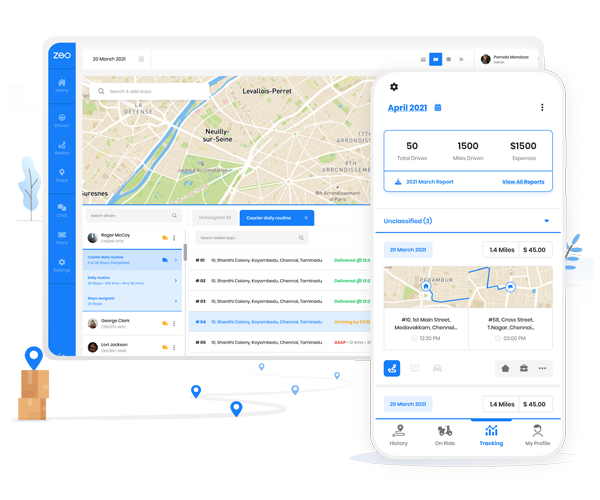
That route gets pushed instantly to each driver’s Zeo mobile app, with turn-by-turn navigation, customer details, and proof-of-delivery tools built in. If you’re a solo driver or independent sales rep, you skip this step entirely and just plan your own route directly in the Zeo app.
Step 6: Track and adjust in real time.

increase fuel savings
Save 2 Hours on Deliveries, Everyday!
Optimize routes with our algorithm, reducing travel time and costs efficiently.
Get Started for Free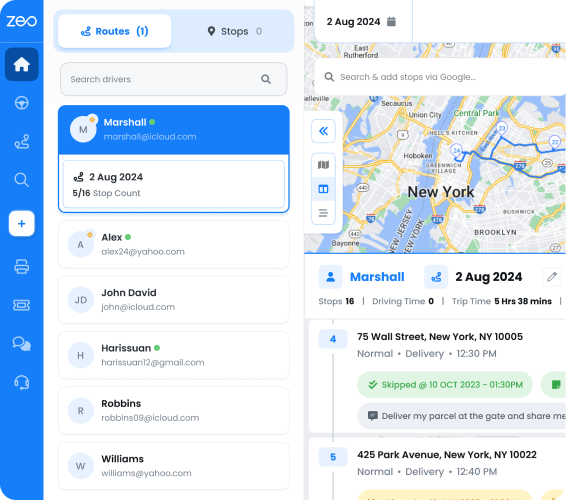
As the day unfolds, use live GPS tracking to see driver locations and updated ETAs. If a new urgent stop comes in, Zeo supports dynamic route adjustments mid-shift, so you’re not stuck with a rigid plan.
Step 7: Confirm and document.
When a driver completes a stop, they capture proof — a photo, signature, or delivery note — directly in the app. This gets logged automatically for your records.
Example: A pest control company with 8 technicians uses this exact flow. The office manager imports the day’s 60 appointments into Zeo’s web platform each morning, assigns them by technician zone and skill, and the routes land on each tech’s phone by 7 AM. Technicians navigate stop-to-stop, log completion with a photo, and the manager tracks progress live from the dashboard — no more phone calls asking “where are you now?”
Which Route Planner Is Right for You? Use Case Deep Dives
Solo drivers and independent contractors
If you’re a single driver, courier, or independent sales rep, you don’t need fleet management tools — you need fast, accurate route optimization on your phone. The Zeo mobile app lets you build your own route, reorder stops automatically, and navigate turn-by-turn using Google Maps, Waze, or Apple Maps. Zeo’s free plan supports up to 12 routes, which covers most solo users without a paid commitment.
Small delivery businesses (2-10 drivers)
At this size, you’re likely coordinating drivers by text message or a shared spreadsheet — and it’s starting to break down. A route planner app with driver assignment and live tracking replaces that guesswork. You plan routes once on the web platform, assign them to drivers, and each driver gets their stops pushed directly to their app. Customers get SMS notifications with live tracking links, which cuts down on “is my order here yet” calls.
Field service teams (HVAC, plumbing, pest control, landscaping)
Field service scheduling is different from delivery — jobs vary in length, and technicians need specific skills. Skill-based assignment matters here: you can route an HVAC certification job to the technician qualified for it, not just the nearest one. Zeo’s work hours and break time settings also help you avoid overbooking technicians on long service days.
Growing fleets (10-50+ drivers or technicians)
At this scale, manual dispatching isn’t sustainable. You need capacity-based routing, driver performance analytics, and integrations with your existing systems (Shopify for e-commerce orders, or Zapier to connect other tools). Fleet managers plan and assign routes from the web dashboard, and routes sync instantly to each driver’s app — giving you one system for planning, dispatching, tracking, and reporting, instead of juggling separate tools for each function. This kind of routing inefficiency is well documented — American Transportation Research Institute research on operational costs has repeatedly flagged inefficient dispatching as a major cost driver for fleets of all sizes.
E-commerce and retail delivery
If you run a Shopify or WooCommerce store and handle local delivery, manual order entry into a route planner wastes time you don’t have. Zeo’s Shopify integration and WooCommerce integrations auto-import orders, so new deliveries flow straight into your route planning without copy-pasting addresses.
Frequently Asked Questions About Route Planner Apps
Is a route planner app different from a GPS navigation app?
Yes. GPS apps like Google Maps and Apple Maps are built for point-to-point navigation. Route planner apps optimize the order of multiple stops, factor in time windows and vehicle capacity, and often include driver management and proof of delivery — features general navigation apps don’t offer.
Can I use a route planner app for free?
Many apps, including Zeo, offer a free tier for solo users or small route volumes. Zeo’s free plan supports up to 12 routes with no credit card required, which works well for testing the tool before committing to a paid fleet plan.
How many stops can a route planner app handle?
This varies by app and plan tier. Solo plans typically handle a smaller number of daily stops, while fleet plans are built to handle dozens of stops across multiple drivers simultaneously.
Do route planner apps work for both delivery and field service businesses?
Yes, though the features that matter differ slightly. Delivery businesses lean on capacity-based routing and customer notifications. Field service teams lean more on skill-based assignment and work-hour scheduling. A flexible tool like Zeo supports both.
What’s the difference between the Zeo app and Zeo’s web platform?
The Zeo mobile app is for drivers and technicians — it’s where they receive routes, get turn-by-turn navigation, and capture proof of delivery. The web platform is for fleet managers — it’s where routes get planned, optimized, and assigned across a team. Solo users can skip the web platform entirely and manage everything from the app.
How accurate is route optimization software, really?
Optimization accuracy depends on the quality of your address data and constraints entered (time windows, capacity, driver hours). According to research referenced by the U.S. Department of Transportation Federal Highway Administration’s freight data program, inefficient routing is a persistent cost driver in trucking and delivery operations — reinforcing why even modest optimization gains translate into real fuel and time savings at scale.
Do I need technical skills to set up a route planner app?
No. Most modern route planner apps, including Zeo, are built for non-technical users. Bulk address import from Excel or Google Sheets means you don’t need any coding or IT support to get started.
Frequently Asked Questions
Q: What’s the difference between a route planner app and a route optimizer?
The terms are often used interchangeably, but “route optimization” technically refers to the algorithm that calculates the most efficient stop order, while a “route planner app” is the full tool — the interface, mapping, tracking, and dispatch features built around that algorithm. In practice, most modern route planner apps include route optimization as a core feature rather than a separate product.
Q: Can a route planner app work without internet or cell signal?
Most route planner apps require an initial data connection to load maps and calculate routes, but many cache route data so drivers can continue navigating turn-by-turn if they briefly lose signal. Full offline functionality (planning new routes with zero connectivity) is limited across most apps in this category, so it’s worth testing in your actual coverage areas before relying on it for rural routes.
Q: How long does it take to set up a route planner app for a small team?
For a small delivery or field service team, most route planner apps can be set up the same day — the main time investment is importing your address list and adding drivers. Zeo’s bulk import supports Excel, CSV, and Google Sheets, so a team with 5-10 drivers can typically go from signup to their first optimized route within an hour.
Q: Will a route planner app reduce fuel costs?
Yes, indirectly — by cutting unnecessary mileage from inefficient stop sequencing and reducing backtracking, route optimization lowers the total miles driven per route. The exact savings depend on your current routing inefficiency, fleet size, and fuel prices, but businesses moving from manual planning to optimized routing commonly report meaningful mileage reductions.
Q: Can I switch route planner apps without losing my customer and address data?
Yes, most route planner apps let you export your data (customer lists, saved addresses, delivery history) as a CSV or Excel file, which you can then bulk import into a new platform. Zeo supports bulk import from Excel, CSV, and Google Sheets, plus a Favorites feature for frequently used stops, making migration from spreadsheets or another app straightforward.
—
If you’re still comparing options, the fastest way to know if a route planner app fits your business is to try one. Start a free trial of Zeo Route Planner — no credit card required — and plan up to 12 routes free. If you’re managing a growing team, book a demo to see fleet features like driver dispatch, live tracking, and performance analytics in action.
Are you a fleet owner?
Want to manage your drivers and deliveries easily?
Grow your business effortlessly with Zeo Routes Planner – optimize routes and manage multiple drivers with ease.
increase fuel savings
Save 2 Hours on Deliveries, Everyday!
Optimize routes with our algorithm, reducing travel time and costs efficiently.
Get Started for Free