


# Construction Delivery Management: A Logistics Guide
> TL;DR: Construction delivery management fails at most job sites because teams treat it as a scheduling problem when it’s really a routing and real-time visibility problem. Over 90% of contractors report project delays tied to supply chain and material delivery issues, and most trace back to coordination failures, not actual shortages. Route optimization tools like Zeo Route Planner address this with time window constraints and live GPS tracking, helping construction and field service teams save 2+ hours daily that would otherwise go to manual dispatching and status-check phone calls.
Trucks show up two hours late. Crews stand around waiting for materials. Two suppliers arrive at the same gate at the same time, and now nobody can unload.
If this sounds familiar, you already know that construction delivery management is broken at most job sites. The problem isn’t a lack of scheduling. It’s a lack of routing and real-time visibility.
This guide breaks down why phone calls and spreadsheets fail multi-site construction projects, and how route optimization software fixes the real issue: coordinating trucks, drivers, and dock windows across job sites in real time.
What Is Construction Delivery Management? (And Why It’s a Logistics Problem, Not Just a Scheduling One)
Construction delivery management means coordinating the flow of materials, equipment, and crews to active job sites. It covers who’s delivering what, when they’ll arrive, and where they need to go once they’re on site.
Most companies treat this as a calendar problem. They book a delivery window, send a text to the driver, and hope for the best.
But a delivery window is only useful if the truck actually arrives during it. That depends on traffic, route sequencing, other trucks competing for the same gate, and driver time management. That’s not scheduling. That’s routing and fleet coordination.
A general contractor running five active sites might have concrete trucks, lumber deliveries, and equipment haulers all converging in the same week. Without a system to sequence those arrivals, you get the same dock or gate booked twice, idle labor waiting on material that’s stuck in traffic, and no way to know where a delayed truck actually is.
According to the Associated General Contractors of America’s supply chain survey, over 90% of contractors report project delays tied to supply chain and material delivery issues. Most of those delays trace back to coordination failures, not actual material shortages.
The Hidden Costs of Poor Delivery Coordination on Job Sites
Late or mistimed deliveries cost more than the obvious delay. Here’s what adds up when construction delivery management runs on phone calls and guesswork.
Idle labor. A framing crew standing around for 90 minutes waiting on lumber isn’t free. At $35-$50 per hour per worker, a five-person crew idle for two hours costs $350-$500 in wasted labor, per incident, per site.
Site congestion and gate conflicts. When two suppliers arrive at once, someone has to wait. That backs up the access road, blocks equipment movement, and sometimes forces a truck to leave and come back, wasting fuel and driver hours. This same conflict shows up in other site-based logistics, like portable toilet delivery scheduling, where narrow access windows create similar bottlenecks.
No proof of delivery disputes. When a supplier says materials arrived on time and in good condition, and the site manager says otherwise, there’s often no documentation to settle it. That turns into finger-pointing, delayed payment, or a formal dispute.
Rescheduling costs. A missed delivery window often means rebooking the truck for the next day, pushing the whole project schedule back by 24 hours or more.
Lack of visibility. Site managers spend hours each week calling drivers and suppliers just to ask “where are you?” That’s time not spent managing the actual job.
The U.S. Bureau of Labor Statistics reports that transportation delays are among the top cited factors in construction project overruns, particularly on projects with multiple concurrent job sites. When you’re coordinating five sites instead of one, small delays multiply fast.
How Route Optimization Reduces Delivery Delays and Site Congestion
The fix isn’t a better calendar. It’s better routing.
Route optimization software plans the most efficient sequence and timing for every delivery, across every site, based on real variables: traffic, distance, time windows, and vehicle capacity. Instead of a dispatcher manually guessing when a truck should leave, the software calculates it.
This solves three specific problems construction teams face:
Gate and dock conflicts. By assigning specific arrival windows to each delivery and sequencing routes around them, you avoid two trucks hitting the same gate at once. Zeo Route Planner’s time window constraints let you lock in delivery slots per site, so drivers are routed to arrive when the site can actually receive them.
Site congestion. When deliveries are spread across the day based on real drive times instead of rough estimates, fewer trucks stack up waiting for access. This matters most on active sites with limited staging area or a single access road, a challenge OSHA also flags in its guidance on construction site safety and material handling.
Real-time visibility. Instead of calling drivers for updates, site managers see live GPS location and ETA updates as trucks move. If a supplier’s truck is running late because of traffic, the site manager knows before the crew starts waiting.
A concrete supplier delivering to four active pours in one morning can’t afford a 20-minute miscalculation. Route optimization accounts for actual road conditions and sequences deliveries so each site gets material inside its pour window, not after concrete trucks are already backed up on the street.
Key Features to Look For in Construction Delivery Management Software
Not every route planning tool is built for construction logistics. Here’s what actually matters for multi-site delivery coordination.
- Time window scheduling — Lock in delivery windows per site so trucks arrive when docks and gates are actually open.
- Real-time GPS tracking — See exactly where every truck is, not just where it was scheduled to be.
- Proof of delivery — Photo capture, digital signatures, and delivery notes document what arrived, when, and in what condition.
- Capacity-based routing — Match vehicle weight and volume limits to what’s actually being hauled, so trucks aren’t overloaded or underused.
- Priority stops — Flag urgent deliveries (like a same-day equipment repair part) as ASAP so they get routed ahead of standard drops.
- Customer/site notifications — Automated SMS or email updates with live tracking links, so site managers aren’t calling for status checks.
- Bulk address import — Load an entire week’s worth of site addresses from Excel or Google Sheets instead of entering them one by one.
- Driver mobile app — Drivers need turn-by-turn navigation and the ability to capture proof of delivery from their phone, not a printed manifest.
Zeo Route Planner includes all of these, built specifically to handle the kind of multi-stop, multi-site complexity construction logistics demands.
Step-by-Step: Setting Up a Delivery Scheduling & Dispatch System for Multi-Site Projects
Here’s how to move from phone-call chaos to a functioning delivery system.
Step 1: List every active site and its constraints.
Note gate hours, dock capacity, and any access restrictions (narrow roads, weight limits, permit hours) for each job site.
Step 2: Import your delivery list in bulk.
Instead of entering addresses one at a time, upload your site list and delivery details via Excel, CSV, or Google Sheets. Zeo’s bulk import handles this in minutes, not hours.
Step 3: Set time windows for each site.
Assign realistic delivery windows based on when each site can actually receive materials, not just when you’d like them to arrive.
Step 4: Optimize the route.
Let the software sequence deliveries based on drive time, priority, and vehicle capacity. This is the step that replaces manual guesswork with an actual calculated schedule.
Step 5: Assign drivers and vehicles.

increase fuel savings
Save $200 on fuel, Monthly!
Optimize routes with our algorithm, reducing travel time and costs efficiently.
Get Started for Free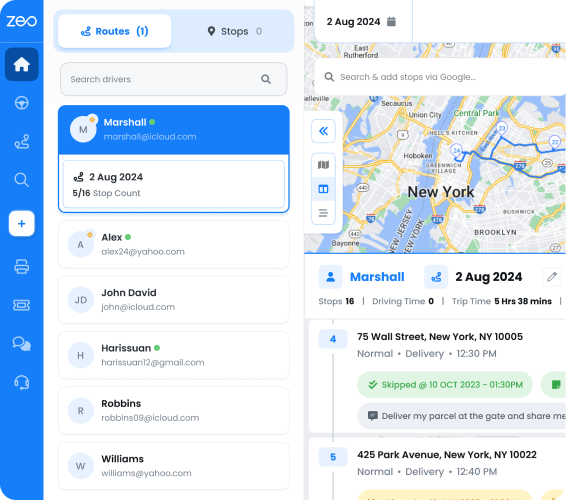
Match trucks to routes based on what they’re hauling and which driver has the right skills or equipment for that site.
Step 6: Dispatch to driver phones.
Routes go out through the mobile app with turn-by-turn navigation, so drivers aren’t relying on a printed sheet or a text message with an address.
Step 7: Track and adjust in real time.
If a site calls to push back a delivery, or a truck hits traffic, adjust the route mid-shift instead of waiting until the next day to fix it.
Step 8: Collect proof of delivery.
Drivers capture a photo, signature, or delivery note at drop-off, creating a record that both the supplier and site manager can reference if there’s ever a dispute.
Running this system for one week across five sites will surface exactly where your current process breaks down, usually at the handoff between dispatch and driver.
ROI Breakdown: Time, Fuel, and Labor Savings from Optimized Deliveries
The cost of switching to route optimization is small compared to what poor coordination already costs you. Here’s a realistic breakdown.
Time savings. Manually planning routes and calling drivers for status updates can eat 2+ hours a day for a dispatcher managing multiple sites. Zeo’s AI-powered route optimization saves 2+ hours daily by calculating efficient routes automatically instead of building them by hand.
Fuel savings. Poorly sequenced routes mean trucks drive further than necessary, sometimes doubling back to a site because a delivery was mistimed. Optimized routing reduces total miles driven, which shows up directly in fuel costs across a fleet of 10-20 vehicles.
Labor savings. If optimized scheduling eliminates even two idle-crew incidents per week at $400 each, that’s $800 a week, or over $40,000 a year, in labor that isn’t standing around waiting on a truck.
Dispute resolution time. Every delivery dispute that gets resolved with a timestamped photo instead of a week of back-and-forth calls saves administrative hours and protects supplier relationships.
Fewer rescheduled deliveries. Each missed delivery window that gets rebooked pushes a task back a full day. Reducing missed windows by even 15-20% keeps project timelines closer to plan.
None of this requires guessing. Zeo’s route analytics and reporting give you the actual numbers, miles driven, time per route, delivery success rate, so you can track whether the system is working, not just assume it is.
From Dispatch to Dock: How Site Managers and Drivers Stay in Sync
The disconnect between dispatch and the job site is where most construction delivery problems happen. A site manager plans a delivery schedule, but the driver never sees it in a format they can actually use on the road. That gap is where delays, missed gates, and disputes start.
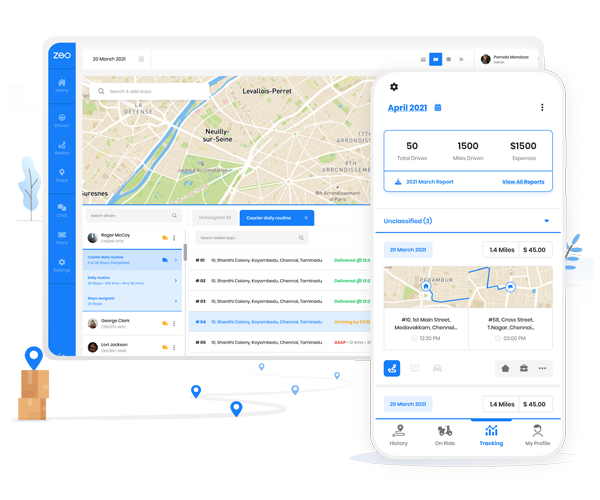
Zeo closes that gap with two connected tools. Site managers and logistics coordinators plan and assign multi-stop delivery routes from the Zeo web platform, setting time windows, sequencing stops, and matching vehicles to loads.
Drivers, whether they’re in-house fleet or subcontracted haulers, receive their routes directly on the Zeo mobile app. That gives them turn-by-turn navigation and live location sharing to each site, so they’re not relying on a text message with an address and a hope for the best.
At the gate or dock, drivers capture proof of delivery right from their phone, a photo of the delivered material, a signature from the site foreman, or a delivery note flagging a partial load or damage. That record syncs back to the site manager immediately.
Real-time status updates mean a site manager doesn’t have to call a subcontracted hauler to ask if they left yet. They can see it. If a truck is running behind because of traffic, the manager knows before the crew starts standing around waiting.
This closes the loop between dispatch and job site without a single phone call, which matters most when you’re juggling deliveries across five, ten, or twenty active sites at once.
Frequently Asked Questions
Q: How do you coordinate deliveries across multiple construction job sites?
Coordinating multi-site deliveries requires setting realistic time windows per site, sequencing routes based on actual drive times (not estimates), and giving site managers real-time visibility into truck locations. Route optimization software like Zeo Route Planner handles this by letting dispatchers set time window constraints per site and track live GPS location, so trucks arrive when a gate or dock can actually receive them.
Q: What causes most construction material delivery delays?
Most delivery delays trace back to coordination failures rather than actual material shortages, including poor route sequencing, gate conflicts when multiple trucks arrive at once, and lack of real-time visibility into where a truck actually is. Traffic and rough time estimates compound the problem when dispatchers rely on phone calls instead of live tracking.
Q: How much does idle crew time cost on a construction site?
A five-person crew standing idle for two hours waiting on delayed materials can cost $350-$500 in wasted labor per incident, based on typical hourly rates of $35-$50 per worker. Across multiple sites and repeated incidents, this adds up to tens of thousands of dollars a year in labor that isn’t producing work.
Q: Can route optimization software prevent gate and dock conflicts on job sites?
Yes. By assigning specific arrival windows to each delivery and sequencing routes around them, route optimization software reduces the chance of two trucks hitting the same gate or dock at once. Zeo Route Planner’s time window constraints let dispatchers lock in delivery slots per site so drivers are routed to arrive in sequence rather than all at once.
Q: Do subcontracted haulers need special software to work with a general contractor’s delivery system?
Subcontracted drivers just need access to a mobile app that gives them turn-by-turn navigation and a way to log proof of delivery, they don’t need to be added to a company’s internal systems. Drivers using Zeo’s mobile app receive routes directly on their phone and can capture photos, signatures, or delivery notes at drop-off, which syncs back to the site manager immediately.
Get Started
Construction delivery management isn’t a scheduling problem you can solve with a better spreadsheet. It’s a routing and coordination problem, and it needs software built for exactly that.
Start a free Zeo Route Planner trial to build your first optimized multi-site delivery schedule in minutes. Or book a demo to see how fleet dispatch on the web platform and driver tracking on the mobile app work together to keep your job sites moving.
Are you a fleet owner?
Want to manage your drivers and deliveries easily?
Grow your business effortlessly with Zeo Routes Planner – optimize routes and manage multiple drivers with ease.

increase fuel savings
Save 2 Hours on Deliveries, Everyday!
Optimize routes with our algorithm, reducing travel time and costs efficiently.
Get Started for Free