

# Financial Document Delivery: Compliance, Security, and Routing Guide
> TL;DR: Financial document delivery requires verifiable chain-of-custody, not just fast pickup and drop-off, since a missing loan package or delayed legal notice can trigger compliance violations, not just customer complaints. Route optimization tools like Zeo Route Planner address this with real-time GPS tracking, photo/signature proof of delivery, and time window constraints, helping bank and credit union courier teams save 2+ hours daily while building an audit-ready delivery record.
Every day, thousands of checks, signed loan packages, and legal notices travel between bank branches, title companies, and processing centers. If one document goes missing or arrives late, the cost isn’t just a delayed transaction. It’s a compliance violation waiting to be flagged.
Financial document delivery sits at a strange intersection. It looks like a simple pickup-and-drop job, but it carries the risk profile of moving cash. Operations managers running these routes need speed, security, and paperwork trails that hold up under audit.
This guide breaks down what financial document delivery actually requires, the compliance standards you can’t skip, and how route optimization tools like Zeo Route Planner turn a manual, error-prone process into a system you can prove works.
What Is Financial Document Delivery? (Types of Documents, Stakeholders, and Use Cases)
Financial document delivery is the scheduled or on-demand transport of sensitive paper and digital records between financial institutions and their partners. This isn’t standard parcel delivery. Every stop involves documents that carry legal weight or financial value.
Common document types include:
- Signed loan packages and mortgage closing documents
- Checks and negotiable instruments
- Legal notices and court filings
- Contracts and title documents
- Wire transfer authorizations
- Compliance and audit records
Stakeholders typically include bank branch staff, credit union operations teams, title companies, law firms, loan processing centers, and sometimes individual clients who need documents notarized or picked up directly. Many of the routing challenges here overlap with banking logistics route optimization more broadly, since branch-to-processing-center transport has similar time-sensitivity demands.
A typical daily route might connect a bank’s downtown branch to its regional processing center, stop at a title company to drop off closing documents, then swing by a law firm to collect signed contracts before returning to base. Miss one pickup window, and a loan closing gets delayed. That delay can mean lost interest, an angry client, or a compliance flag from an internal auditor.
The Consumer Financial Protection Bureau’s mortgage servicing rules require strict handling and disclosure timelines for mortgage documents, which means courier delays aren’t just operational headaches. They can trigger regulatory scrutiny. This is why financial document delivery needs tighter controls than typical last-mile logistics.
Security & Compliance Requirements Every Financial Courier Operation Must Meet
Financial institutions operate under a web of regulations that directly affect how documents move. Courier and operations teams need to understand these requirements before they can build a delivery process that satisfies auditors.
Chain-of-custody documentation. Every document handoff needs a timestamp, a location, and proof of who received it. Auditors want to see an unbroken record from pickup to final delivery, not a gap where the document’s location is a guess.
Data privacy compliance. The Gramm-Leach-Bliley Act requirements require financial institutions to protect customer financial information, which extends to how documents are physically transported and tracked. A lost check or exposed loan file is a privacy incident, not just a logistics failure.
Access controls. Only authorized drivers should handle sensitive documents, and institutions need a way to verify who touched what, when. Manual sign-in sheets and paper logs make this nearly impossible to enforce consistently.
Delivery window guarantees. Loan closings, court filings, and time-sensitive contracts often have legal deadlines attached. A missed window isn’t just late, it can void a transaction.
Insurance and liability coverage. Courier companies handling financial documents typically need higher liability coverage than standard delivery services, given the value and sensitivity of what they’re transporting.
According to the Federal Financial Institutions Examination Council’s third-party guidance, financial institutions are expected to maintain documented controls over any third party handling sensitive customer information, including courier services. That means your delivery process needs to be auditable, not just fast.
The problem is that most courier operations still rely on paper logs, driver memory, and manual dispatch sheets to prove any of this. That approach doesn’t scale past a handful of routes, and it falls apart the moment an auditor asks for a specific delivery record from three months ago.
In-House Fleet vs. Third-Party Courier vs. Route-Optimized Delivery: Choosing the Right Model
Operations managers typically choose between three models for financial document delivery. Each has tradeoffs worth understanding before you scale.
In-house fleet. You control drivers, vehicles, and schedules directly. This gives you the tightest security control since drivers are employees, not contractors. The downside is cost. Running 5-40 drivers with vehicles, insurance, and manual dispatch adds up fast, especially if routes are planned by hand.
Third-party courier services. Outsourcing to a specialized courier company reduces overhead and staffing headaches. But you lose direct visibility into how documents are handled, and proving chain-of-custody often depends on the third party’s own systems, which you don’t control. This tradeoff is similar to what operations teams face with medical courier routes, another regulated delivery category where custody visibility is non-negotiable.
Route-optimized delivery. This model keeps your in-house fleet or contracted drivers but adds a system for planning routes, tracking deliveries, and capturing proof at every stop. It combines the control of in-house delivery with the efficiency that manual dispatch can’t match.
For most credit unions and bank courier departments, the third option is where the real savings show up. A study by the American Transportation Research Institute found that inefficient routing is one of the largest controllable cost drivers in fleet operations. If you’re running the same 15-stop route every day but planning it by hand each morning, you’re likely burning driver hours and fuel on avoidable backtracking.
Zeo Route Planner fits into this model by taking the manual dispatch work out of the equation. Instead of a dispatcher mapping out stops on a whiteboard or spreadsheet, Zeo’s AI-powered route optimization builds the most efficient sequence automatically, factoring in time windows for loan closings and priority pickups for legal notices that can’t wait.
How Route Optimization Improves Reliability and Speed for Multi-Stop Financial Deliveries
Financial document routes are rarely simple point-A-to-point-B trips. A single driver might need to hit a downtown branch by 9 AM, a title company by 10:30, a processing center across town by noon, and a law firm before it closes at 5. Miss the sequencing, and you blow through delivery windows that carry real financial consequences.
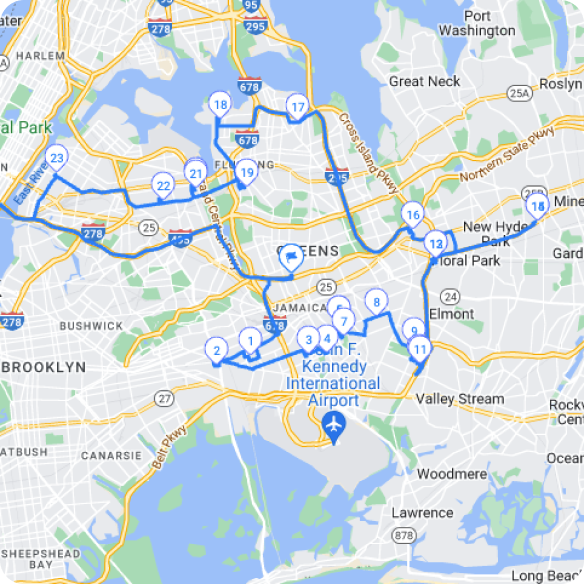
Route optimization software solves this by calculating the fastest, most logical sequence for every stop, factoring in time windows, traffic patterns, and priority levels. Zeo’s route optimization saves drivers 2+ hours daily by eliminating the guesswork and backtracking that comes with manual planning.
Here’s how this plays out for a financial courier operation:
Time window constraints ensure a loan closing document arrives before a title company’s cutoff, not after. You set the window, and the route respects it.
Priority stops let dispatchers flag urgent pickups, like a legal notice that has to move today, so drivers hit those stops first without a manager calling to remind them.
Capacity-based routing matters when a single vehicle is carrying document pouches for multiple branches. Zeo accounts for what a vehicle can reasonably carry and sequence in a day.
Dynamic route adjustments handle the reality of a courier’s day. A client calls in an urgent pickup mid-morning, and the route adjusts without requiring the driver to backtrack across town later.
Consider a credit union with 12 branches feeding into a single processing center. Without optimization, a dispatcher might manually assign routes based on rough geography, leading to overlapping territories and drivers crossing paths unnecessarily. With route optimization, the system assigns stops based on actual drive time and priority, cutting redundant mileage and getting documents to the processing center hours earlier in the day.
As branch networks grow or client lists expand, this efficiency compounds. Adding five new pickup locations to a manually planned route is a headache. Adding them to an optimized system takes minutes, and the software recalculates the most efficient sequence automatically.

increase fuel savings
Save 2 Hours on Deliveries, Everyday!
Optimize routes with our algorithm, reducing travel time and costs efficiently.
Get Started for Free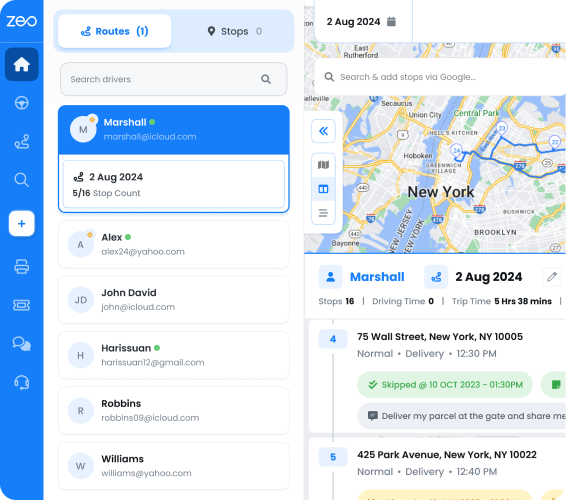
Real-Time Tracking & Proof of Delivery: Building an Audit Trail Financial Institutions Can Trust
Chain-of-custody isn’t optional in financial document delivery. It’s the entire point. If a bank auditor asks where a specific loan package was at 2 PM last Tuesday, “the driver probably remembers” isn’t an acceptable answer.
This is where real-time GPS tracking and proof of delivery replace paper logs with a verifiable digital record. Zeo’s real-time GPS tracking shows exactly where a driver and their documents are at any moment, giving operations managers visibility without needing to call drivers for status updates.
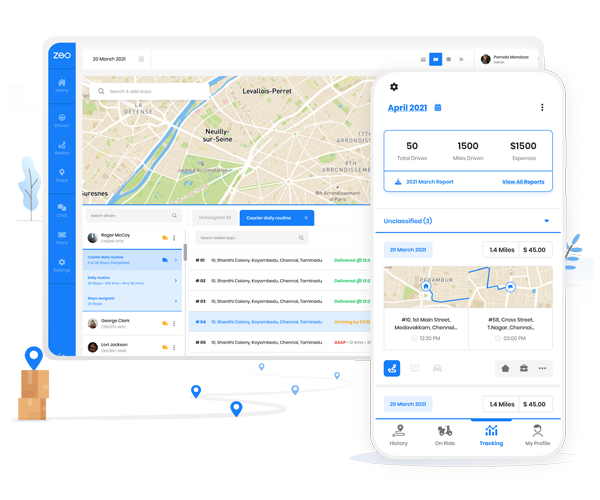
Here’s how the workflow actually looks day to day. Your couriers receive optimized routes directly on the Zeo mobile app, complete with turn-by-turn navigation and stop-by-stop details for every branch, title company, or law firm on the list. At each pickup or dropoff, the driver captures a photo of the document, collects a digital signature from the recipient, and adds delivery notes if needed. Zeo logs the timestamp and location automatically, no manual entry required.
For the operations manager back at the office, this means every stop generates its own proof of delivery record without any extra paperwork. If an auditor needs to verify that a loan package was delivered to a specific title company at a specific time with a specific person’s signature, that record already exists. No searching through paper logs or calling the driver to jog their memory.
Live ETA updates and branded tracking links also give receiving parties visibility into when their documents will arrive. A title company waiting on closing documents can see the courier’s live location instead of calling your dispatch line every twenty minutes asking for an update.
This system does more than satisfy auditors. It builds trust with clients and partner institutions who need confidence that their sensitive paperwork is handled correctly every time. According to Ponemon Institute’s Cost of a Data Breach research, incidents involving compromised financial records carry some of the highest average remediation costs across industries, which makes a documented, trackable delivery process a real risk-reduction tool, not just an operational nicety.
FAQ: Common Questions About Financial Document Delivery Services
What documents typically require secure courier delivery in financial services?
Signed loan packages, checks, legal notices, contracts, wire authorizations, and title documents are the most common. Any document with legal or financial weight that requires a verifiable chain-of-custody falls into this category.
How do financial institutions prove chain-of-custody for courier deliveries?
The most reliable method combines real-time GPS tracking with proof-of-delivery capture at each stop, including photos, signatures, and automatic timestamps. This creates a digital record that’s far more defensible in an audit than handwritten logs.
Can route optimization software handle time-sensitive financial deliveries?
Yes. Tools like Zeo Route Planner support time window constraints and priority stop flagging, which lets dispatchers guarantee that urgent documents, like legal notices with deadlines, get delivered before less time-sensitive stops.
Is it cheaper to run an in-house courier fleet or outsource financial document delivery?
It depends on volume and route complexity. In-house fleets offer more security control but higher fixed costs. Route optimization software helps in-house fleets cut costs by reducing wasted mileage and driver hours, often narrowing or closing the cost gap with outsourcing.
How does route optimization scale as a branch network grows?
Adding new pickup or delivery locations to an optimized system takes minutes, and the software recalculates efficient routes automatically. This avoids the manual replanning headache that comes with growing a route network by hand.
What’s the difference between proof of delivery and chain-of-custody documentation?
Proof of delivery confirms a document arrived and who received it. Chain-of-custody documentation goes further, tracking every handoff point from pickup to final delivery with timestamps and locations, which is what auditors typically require for financial documents.
Frequently Asked Questions
Q: How long should financial institutions retain courier delivery records?
Retention requirements vary by document type and regulator, but many financial institutions keep chain-of-custody and delivery records for at least three to seven years to align with audit and litigation timelines. Check with your compliance officer for document-specific retention schedules, since mortgage records, wire authorizations, and legal notices may fall under different rules.
Q: What happens if a signed loan package is lost in transit?
A lost loan package can delay or void a closing, trigger a compliance review, and in some cases require the borrower to re-sign documents, which pushes back funding dates. This is why chain-of-custody tracking with timestamps and signatures at every handoff point matters more for financial documents than for typical parcel deliveries.
Q: Can small credit unions justify route optimization software for a handful of courier routes?
Yes. Even a 3-5 route operation benefits from eliminating manual dispatch planning and gaining a digital proof-of-delivery trail for audits. Zeo Route Planner’s free mobile app tier supports up to 12 routes per month, making it accessible for smaller credit union courier operations before scaling to a paid plan.
Q: Do financial couriers need special insurance beyond standard commercial auto coverage?
Most courier operations handling checks, loan documents, or legal notices carry higher liability and cargo insurance than standard delivery services, given the financial value and legal weight of what’s being transported. Requirements vary by state and by the financial institution’s own vendor risk policies, so it’s worth confirming directly with your carrier and the institutions you serve.
Q: How do dispatchers handle urgent, same-day financial document pickups without disrupting the whole route?
Dynamic route adjustment features let dispatchers insert a new pickup mid-route without forcing the driver to backtrack through completed stops. Zeo Route Planner’s dynamic route adjustments recalculate the sequence automatically, so an urgent legal notice or wire authorization gets picked up without derailing the rest of the day’s deliveries.
—
Manual dispatch and paper logs weren’t built for the compliance pressure financial document delivery carries today. Start a free Zeo Route Planner trial to build secure, optimized routes for your financial document deliveries, with proof-of-delivery and live tracking built in for every stop.
Are you a fleet owner?
Want to manage your drivers and deliveries easily?
Grow your business effortlessly with Zeo Routes Planner – optimize routes and manage multiple drivers with ease.
increase fuel savings
Hassle Free Deliveries & Pickups!
Optimize routes with our algorithm, reducing travel time and costs efficiently.
Get Started for Free