


# Route Planner App: Complete Business Guide for 2026
> TL;DR: Route planner apps eliminate the daily chaos of manual route planning while reducing fuel costs by 15-25% and saving 2+ hours in planning time. According to the Bureau of Labor Statistics, businesses using route optimization technology achieve 25-30% improvements in delivery efficiency. Professional route planner apps like Zeo Route Planner address this with AI-powered optimization and real-time GPS tracking, helping delivery and service teams streamline operations from day one.
Managing routes for your delivery or service team shouldn’t eat up hours of your morning. Yet many small business owners still wrestle with pen-and-paper planning or basic mapping tools that leave drivers confused and customers frustrated.
The right route planner app transforms chaotic daily operations into streamlined processes with measurable returns. This guide breaks down everything you need to know to choose a mobile routing solution that actually works for your business.
Route Planner App vs Manual Planning: Why Mobile Solutions Win Every Time
Manual route planning creates a domino effect of problems that compound throughout your workday. When you plot routes by hand or use basic tools like Google Maps, you’re essentially guessing at the most efficient sequence of stops.
According to the Federal Highway Administration, inefficient routing increases commercial vehicle miles traveled by 25-30% on average. For a five-driver operation, that translates to roughly 12,500 extra miles annually – and the associated fuel, labor, and vehicle wear costs.
The Hidden Costs of Manual Planning
Manual planning burns 45-90 minutes each morning before your first driver even leaves. You’re juggling customer addresses, driver schedules, vehicle capacities, and time windows in your head or on spreadsheets that become outdated the moment a customer calls with changes.
Your drivers face the real consequences. They spend time calling for directions, backtracking through traffic, and arriving late to appointments. Without real-time updates, customers call your office asking where their delivery is – interrupting your planning for tomorrow’s routes.
How Mobile Route Planner Apps Solve This
A dedicated route planner app handles the complex mathematics of multi-stop optimization instantly. Advanced algorithms consider traffic patterns, driver locations, time windows, and vehicle constraints to generate efficient routes in seconds rather than hours.
Zeo Route Planner’s AI-powered optimization saves 2+ hours daily by automatically sequencing stops for maximum efficiency. Your drivers receive optimized routes directly on their phones, complete with turn-by-turn navigation and customer details.
The app adapts in real-time when customers reschedule or new urgent orders come in. Instead of radio calls or confused drivers, route adjustments happen automatically with updated ETAs sent to customers.
Essential Features Every Business Route Planner App Must Have
Not all route planner apps deliver the same value. The difference between a basic routing tool and a comprehensive business solution lies in specific features that address real operational challenges.
Multi-Stop Route Optimization
Your app must handle multiple stops efficiently, not just provide directions between two points. Look for algorithms that consider time windows, priority levels, and driver constraints when sequencing stops.
The optimization should account for real-world factors like lunch breaks, vehicle capacity limits, and driver skill requirements. Basic apps often ignore these constraints, creating routes that look efficient on paper but fail in practice.
Real-Time GPS Tracking and Communication
Fleet visibility prevents the constant “where are you?” phone calls that interrupt both managers and drivers. Your route planner app should provide live location tracking with accurate ETA updates.
Customer communication features eliminate most service calls. Automated notifications via SMS or email keep customers informed about arrival times, while live tracking links let them monitor progress independently.
Proof of Service Documentation
Service verification protects your business and satisfies customers. Essential documentation features include photo capture, digital signature collection, and detailed delivery notes.
This capability proves especially valuable for liability protection and dispute resolution. When customers claim non-delivery or service issues, timestamped photos and signatures provide clear evidence. Professional proof of delivery systems ensure you have the documentation needed to resolve disputes quickly.
Driver-Manager Communication Tools
Seamless communication between office and field operations prevents costly misunderstandings. Look for in-app messaging, route modification capabilities, and instant notification systems.
Your drivers need easy ways to report delays, request route changes, or communicate with customers. Managers require tools to broadcast updates, modify routes mid-day, and monitor progress across the entire fleet.
Integration Capabilities
Your route planner app should connect with existing business systems rather than creating data silos. Essential integrations include CRM platforms, e-commerce systems, and accounting software.
API access allows custom integrations with specialized business tools. This connectivity eliminates double data entry and ensures consistent information across all systems.
Free vs Paid Route Planner Apps: What You Actually Get for Your Money
The route planner app market spans from free basic tools to comprehensive enterprise platforms. Understanding the real differences helps you avoid choosing based solely on price – a decision that often costs more in lost efficiency.
Free Route Planner Limitations
Free apps typically limit you to 8-10 stops per route and lack business-essential features like customer notifications, proof of delivery, or fleet tracking. These constraints force workarounds that eliminate most efficiency gains.
Most free solutions also lack reliable customer support. When your drivers can’t access their routes or the app crashes during peak hours, you’re left troubleshooting technical issues instead of running your business.
Data export restrictions in free apps create vendor lock-in problems. Your route history, customer information, and performance data often can’t be extracted if you need to switch platforms.
Paid App Value Propositions
Paid route planner apps justify their cost through features that directly impact your bottom line. Unlimited stops, advanced optimization algorithms, and comprehensive tracking capabilities typically pay for themselves through fuel and labor savings.
Professional customer support becomes critical when routing issues affect customer satisfaction. Paid platforms usually offer phone support, dedicated account management, and guaranteed uptime commitments.
Calculating Your Break-Even Point
A simple calculation reveals whether a paid route planner app makes financial sense. If your operation wastes 30 minutes daily per driver on inefficient routing, and your loaded labor rate is $25/hour, you’re losing $12.50 per driver daily.
For a five-driver team, that’s $312.50 weekly in lost productivity. Most professional route planner apps cost $30-50 per driver monthly, creating clear positive ROI within the first week of implementation.
Industry-Specific App Requirements: Delivery vs Field Service vs Sales Routes
Different business models create unique routing challenges that generic apps often handle poorly. Understanding your industry’s specific requirements prevents choosing a route planner app that optimizes for the wrong priorities.
Delivery Operations: Speed and Proof
Delivery businesses prioritize stop density and quick turnaround times. Your route planner app must excel at tight geographic clustering while managing time-sensitive constraints like morning delivery windows.
Package volume and weight considerations become critical for delivery routing. The app should factor vehicle capacity limits and loading sequence to prevent situations where drivers can’t access packages buried under later deliveries.
Customer notification features prove essential for delivery operations. Missed deliveries cost time and fuel for reattempt trips. Zeo’s SMS and email notifications with live tracking links reduce missed deliveries by keeping customers informed about arrival times.
Field Service: Skills and Appointment Windows
Service businesses face more complex routing challenges than simple delivery operations. Your route planner app must consider technician skill sets, appointment durations, and equipment requirements when creating routes.
Time window management becomes critical when customers expect specific appointment slots. The app should optimize routes while respecting scheduled appointments and allowing buffer time for complex service calls.
Equipment and parts inventory considerations affect field service routing. Your app should account for vehicle capacity limits and potentially route technicians past supply warehouses for mid-day restocking. Implementing effective fleet management strategies becomes crucial for coordinating these complex operations.
Sales Routes: Relationship Building and Flexibility
Sales routing prioritizes relationship maintenance and opportunity maximization over pure efficiency. Your route planner app should support flexible scheduling that allows time for relationship building and unexpected opportunities.
Territory management features help sales teams maintain consistent customer contact without geographic conflicts. The app should support assigned territories while optimizing travel within each salesperson’s area.
Pipeline tracking integration becomes valuable for sales operations. Route planning should consider deal stages, customer priority levels, and follow-up requirements when sequencing visits.
How Fleet Managers and Drivers Work Together in Modern Route Planning Apps
Successful route planning requires seamless coordination between office planning and field execution. Modern route planner apps bridge this gap by connecting fleet managers’ strategic oversight with drivers’ real-time operational needs.

increase fuel savings
Hassle Free Deliveries & Pickups!
Optimize routes with our algorithm, reducing travel time and costs efficiently.
Get Started for Free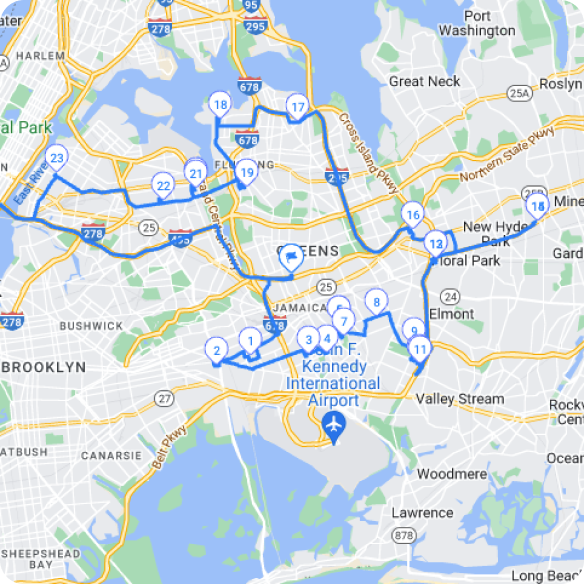
Manager Planning and Oversight
Fleet managers use web-based platforms to create optimized routes considering multiple drivers, vehicle constraints, and customer requirements. The planning interface should handle complex scenarios like multi-day routes, recurring service schedules, and last-minute additions.
Real-time fleet visibility allows managers to monitor progress across all drivers simultaneously. Map-based tracking shows current locations, upcoming stops, and estimated completion times for the entire operation.
Performance analytics help managers identify improvement opportunities and recognize top performers. Route efficiency metrics, on-time performance, and customer satisfaction scores provide data-driven insights for operational improvements.
Driver Mobile Experience
Drivers receive optimized routes through dedicated mobile apps that provide turn-by-turn navigation and customer information. The interface should be simple enough for gloved hands and bright enough for outdoor visibility.
Mid-route flexibility allows drivers to handle real-world situations like customer rescheduling or urgent additions. The app should enable route modifications while maintaining overall optimization.
Communication tools let drivers update managers about delays, service issues, or customer feedback without lengthy phone calls. In-app messaging and status updates keep information flowing efficiently. Professional driver tracking software ensures managers stay informed while drivers focus on their routes.
Seamless Information Flow
Customer updates flow automatically from drivers to managers and customers. When drivers mark stops complete or encounter delays, the system updates all stakeholders without manual intervention.
Proof of service documentation syncs immediately to central databases. Photos, signatures, and notes become available to customer service teams for immediate access during inquiry calls.
Route modifications propagate instantly across the system. When managers adjust routes or drivers request changes, updates appear immediately on mobile devices with revised navigation instructions.
Zeo Route Planner exemplifies this integration by connecting web-based fleet management with mobile driver apps. Managers plan and assign routes through the web platform while drivers receive and navigate those routes through the mobile app, creating seamless communication between office and field operations.
ROI Calculator: Measuring the Real Impact of Your Route Planner App Investment
Quantifying the return on your route planner app investment requires measuring both obvious savings and hidden efficiency gains. The most successful implementations track multiple metrics that reveal the true business impact.
Direct Cost Savings
Fuel consumption provides the most visible savings metric. According to the Department of Transportation, route optimization typically reduces commercial vehicle fuel consumption by 15-25%. For a fleet spending $800 monthly per vehicle on fuel, that’s $120-200 in monthly savings per driver.
Labor efficiency gains often exceed fuel savings in value. If route optimization saves 45 minutes daily per driver at a loaded rate of $25/hour, you’re saving $18.75 per driver per day, or approximately $375 monthly per driver.
Vehicle maintenance costs decrease with reduced mileage and more efficient driving patterns. The American Transportation Research Institute estimates commercial vehicle operating costs at $1.82 per mile, making every mile saved through better routing immediately valuable.
Hidden Efficiency Gains
Customer satisfaction improvements reduce service calls and increase retention rates. When route planner apps provide accurate ETAs and reduce late arrivals, customer service workload decreases measurably.
Administrative time savings compound daily. Managers who previously spent 90 minutes planning routes can redirect that time to business development, customer service, or operational improvements.
Driver satisfaction often improves with better routing tools, reducing turnover costs. The American Trucking Association estimates commercial driver replacement costs at $8,000-$15,000 per driver, making retention improvements financially significant.
Sample ROI Calculation
Consider a five-driver service business implementing a route planner app at $40 per driver monthly:
Monthly app cost: $200
Fuel savings (20% of $800/driver): $800
Labor savings (45 min/day per driver): $1,875
Reduced service calls (5 hours/week at $25/hour): $500
Total monthly savings: $3,175
Net monthly ROI: $2,975
Annual ROI: 1,785%
Tracking Your Results
Establish baseline metrics before implementing your route planner app. Track daily miles driven, fuel consumption, route planning time, customer complaints, and on-time performance for comparison.
Monitor both immediate and long-term impacts. Some benefits like improved customer satisfaction may take weeks to fully materialize, while fuel savings should appear immediately.
Document specific improvements for future decision-making. Detailed ROI data helps justify technology investments and guides future operational improvements.
The Bureau of Labor Statistics reports that businesses using route optimization software achieve 25-30% improvements in delivery efficiency within 90 days of implementation. Zeo Route Planner users report saving over 2 hours daily in route planning time while reducing fuel costs by an average of 20% through AI-powered optimization.
Frequently Asked Questions
Q: How much can a route planner app actually save my small business?
Most small businesses save 15-25% on fuel costs and 2+ hours daily in planning time when switching from manual routing to professional apps. Zeo Route Planner’s AI-powered optimization typically generates positive ROI within the first week through reduced mileage and improved driver efficiency.
Q: What’s the difference between using Google Maps and a dedicated route planner app?
Google Maps provides basic directions between two points, while route planner apps optimize multiple stops considering time windows, vehicle capacity, and driver constraints. Dedicated apps also offer business features like customer notifications, proof of delivery, and fleet tracking that Google Maps lacks.
Q: Do route planner apps work for field service businesses or just delivery companies?
Route planner apps serve both industries effectively, but with different priorities. Field service operations benefit from skill-based driver assignment, appointment scheduling, and equipment tracking features. Zeo Route Planner supports both models with time window management and real-time GPS tracking for service teams.
Q: How do drivers receive their optimized routes on mobile devices?
Professional route planner apps provide dedicated mobile applications where drivers receive turn-by-turn navigation, customer details, and route updates. The mobile interface syncs with the manager’s planning system, allowing real-time communication and route adjustments throughout the day.
Q: Can route planner apps handle last-minute changes and urgent orders?
Yes, modern route planner apps excel at dynamic adjustments. When customers reschedule or urgent orders arrive, the system can re-optimize routes instantly and send updated directions to drivers’ phones with revised ETAs automatically communicated to affected customers.
Choose the Right Route Planner App for Your Business
Selecting the right route planner app transforms daily chaos into streamlined operations with measurable returns. Focus on solutions that address your specific industry needs while providing room for business growth.
Evaluate apps based on optimization quality, ease of use, customer support, and integration capabilities rather than just price. The cheapest option often costs more in lost efficiency and limited functionality.
Start with a trial period to test real-world performance with your actual routes and drivers. Pay attention to driver adoption rates and customer feedback during the evaluation period.
Ready to see the difference a professional delivery route planner makes? Start your free trial of Zeo Route Planner and see how much time and fuel your business can save in the first week.
Are you a fleet owner?
Want to manage your drivers and deliveries easily?
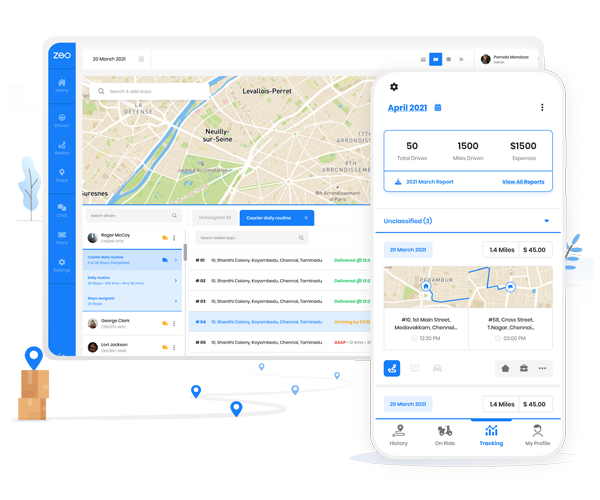
Grow your business effortlessly with Zeo Routes Planner – optimize routes and manage multiple drivers with ease.
increase fuel savings
Hassle Free Deliveries & Pickups!
Optimize routes with our algorithm, reducing travel time and costs efficiently.
Get Started for Free