



# How to Optimize Notary Routes
> TL;DR: Mobile notaries can increase daily appointment capacity by 40-60% through strategic route optimization that minimizes travel time between appointments. Professional route optimization reduces average travel time from 35 minutes to 18 minutes between stops. Tools like Zeo Route Planner address this with AI-powered optimization and time window management, helping mobile notary teams save 2+ hours daily.
Mobile notary businesses face a unique challenge that can make or break profitability: how to optimize notary routes across sprawling service areas while maximizing revenue per mile traveled. With fuel costs continuing to rise and clients spread across wide territories, efficient route planning has become the difference between thriving notary operations and those struggling to stay afloat.
The most successful mobile notary businesses don’t just react to appointment requests. They strategically plan routes that minimize travel time, reduce fuel costs, and create opportunities to serve more clients each day.
The Hidden Costs of Poor Route Planning in Mobile Notary Services
Most mobile notary business owners underestimate how much inefficient routing costs them. The obvious expense is fuel, but the hidden costs run much deeper.
Consider a typical scenario: Your notary accepts a 9 AM appointment in the north part of town, then takes an 11 AM job 25 miles south, followed by a 2 PM appointment back north again. This zigzag pattern doesn’t just waste fuel—it burns through the most valuable resource you have: time.
Time is literally money in the notary business. According to the National Notary Association, mobile notaries can earn $75-$200 per appointment depending on the service type and location. Poor routing that forces excessive travel time between appointments directly limits how many paying clients you can serve each day.
The real costs of inefficient routing include:
Lost opportunity revenue: Every extra hour spent driving is an hour you can’t spend with paying clients. If your notary could serve three additional appointments per day with better routing, that’s potentially $600+ in additional daily revenue.
Increased vehicle wear and depreciation: Excessive mileage accelerates vehicle maintenance needs and reduces resale value. The IRS allows a business mileage deduction of $0.67 per mile in 2026, recognizing the true cost of business vehicle use.
Notary burnout and turnover: Spending 4-5 hours daily in traffic instead of 2-3 hours leads to employee fatigue and higher turnover rates. Replacing experienced notaries costs time and money in recruiting and training.
Missed premium opportunities: When your notaries are stuck in inefficient routes, you’re forced to decline last-minute or premium-paying appointments that could significantly boost daily profits.
The cumulative effect of these hidden costs can reduce a mobile notary operation’s profitability by 30-40% compared to businesses that prioritize route optimization.
Strategic Territory Planning: Defining Profitable Service Areas
Smart mobile notary businesses don’t serve everywhere—they serve strategically. Territory planning starts with analyzing where your most profitable appointments cluster and building service areas that maximize efficiency.
Map your profit centers first. Review six months of appointment data to identify geographic areas that generate the highest revenue per mile traveled. Look for patterns: Do real estate closings cluster in certain neighborhoods? Are corporate clients concentrated in specific business districts?
Calculate your break-even radius. Determine the maximum distance you can travel for different appointment types while maintaining profitability. A $75 standard notarization might only be profitable within 15 miles of your base, while a $300 loan signing justifies traveling 45 miles.
Create overlapping zones for multiple notaries. Instead of assigning rigid territories, establish overlapping service zones that allow for flexible assignment based on daily demand patterns. This approach lets you batch appointments more effectively while ensuring coverage for premium last-minute requests. Professional route planning solutions help coordinate these overlapping zones efficiently.
Establish anchor points throughout your service area. Identify high-density locations like business parks, senior living communities, or real estate offices that generate regular appointments. Plan routes that connect these anchor points efficiently rather than serving random individual locations.
A successful mobile notary service in Phoenix restructured their territory planning this way and saw immediate results. Instead of having each notary cover the entire metro area, they created four overlapping zones centered around major business districts. This change allowed them to reduce average travel time between appointments from 35 minutes to 18 minutes while increasing daily appointment capacity by 40%.
Technology Solutions: Route Planning Tools That Actually Work for Notaries
Manual route planning using basic map applications doesn’t work for multi-appointment operations. Professional route optimization requires technology designed for the specific needs of mobile service businesses.
Modern route optimization goes beyond simple directions. The right technology considers multiple variables simultaneously: appointment time windows, travel time between locations, notary availability, and even traffic patterns throughout the day.
Zeo Route Planner transforms mobile notary operations by using AI-powered optimization that saves 2+ hours of travel time daily per notary. The platform handles the complex calculations needed to sequence multiple appointments optimally while accounting for real-world constraints like time windows and notary availability.
Fleet managers benefit from centralized planning capabilities. Using Zeo’s web platform, business owners can efficiently assign optimized routes to multiple notaries each morning. The system automatically considers each notary’s location, availability, and specializations when creating assignments.
Individual notaries receive seamless route execution. Notaries receive their optimized routes directly through the Zeo mobile app, complete with turn-by-turn navigation and all customer details. Real-time updates handle any appointment changes throughout the day without disrupting the overall route efficiency.
Key features that matter for notary businesses:
Time window optimization ensures notaries arrive within customer-specified appointment windows while minimizing total travel time. Priority assignment capabilities let you mark urgent or high-value appointments that must be completed first.
Real-time GPS tracking keeps business owners informed of notary locations and estimated arrival times. Customer notifications automatically send SMS updates with accurate arrival estimates, reducing no-shows and improving client satisfaction.
Proof of service documentation through photos and digital signatures creates professional records for each appointment. This feature proves especially valuable for loan signings and legal document services that require detailed completion records.
Integration capabilities streamline operations. Professional route optimization tools connect with scheduling software, CRM systems, and accounting platforms to eliminate manual data entry and reduce administrative overhead.
Multi-Appointment Optimization: Batching and Sequencing for Maximum Efficiency
The key to profitable mobile notary operations lies in serving multiple clients efficiently during each route. This requires strategic batching of appointments and intelligent sequencing that minimizes total travel time.
Batching starts with geographic clustering. Group appointments by location first, then optimize the sequence within each cluster. A notary might handle four appointments in the northwest suburbs during the morning, then move to downtown locations for afternoon appointments.
Time window management becomes critical. Unlike simple delivery routes, notary appointments often have strict time requirements. The challenge is sequencing appointments to minimize travel while respecting all time constraints.
Consider appointment duration variations. A simple acknowledgment might take 15 minutes while a loan signing requires 60-90 minutes. Smart sequencing accounts for these duration differences when calculating optimal routes. This approach mirrors sales route optimization principles where appointment types vary significantly.
Build buffer time strategically. Rather than padding every appointment equally, add buffer time before high-stakes appointments like real estate closings while keeping routine appointments tightly scheduled.
A mobile notary business in Dallas implemented systematic batching and saw remarkable results. Previously, each notary averaged 6-8 appointments daily with significant travel time. After optimizing batching and sequencing, the same notaries began completing 10-12 appointments daily while reducing total driving time by 35%.
Dynamic re-optimization handles changes. Throughout the day, appointment cancellations, additions, or delays require route adjustments. Professional optimization tools recalculate optimal sequences in real-time rather than forcing notaries to stick with outdated plans.
Capacity planning prevents overcommitment. Understanding your optimal appointment capacity for different geographic areas helps you avoid accepting more appointments than can be efficiently served. Better to serve fewer appointments profitably than to overcommit and provide poor service.

increase fuel savings
Hassle Free Deliveries & Pickups!
Optimize routes with our algorithm, reducing travel time and costs efficiently.
Get Started for Free
Cost-Benefit Analysis: When to Accept or Decline Appointments Based on Location
Not every appointment request should be accepted. Profitable mobile notary businesses develop clear criteria for evaluating appointment opportunities based on location, timing, and revenue potential.
Develop a minimum profit threshold per appointment. Calculate the true cost of serving appointments at various distances, including vehicle expenses, notary time, and opportunity costs. Use this analysis to establish minimum fees that justify travel to different locations.
Factor in route synergy benefits. An appointment that seems marginally profitable in isolation might become highly profitable when it enables serving additional clients in the same area. Always evaluate new requests in the context of existing route plans.
Premium pricing for inconvenient locations. Rather than declining all distant appointments, develop premium pricing for locations outside your core service areas. Many clients will pay higher fees for convenience, especially for time-sensitive services.
Time-of-day considerations affect profitability. Morning appointments in suburban areas might command premium pricing due to limited competition, while late-afternoon downtown appointments might be less profitable due to traffic delays.
According to industry data from the American Society of Notaries, mobile notary businesses that implement location-based pricing strategies see 25-30% higher profit margins compared to those using flat-rate pricing regardless of location.
Create decision frameworks for common scenarios:
Immediate requests: Accept if within 10 miles of current location or if premium pricing applies. Decline if acceptance would disrupt existing profitable route plans.
Next-day bookings: Accept if appointment fits efficiently into projected route plans or if revenue exceeds minimum profit thresholds for the required travel distance.
Recurring client opportunities: Consider longer-term relationship value when evaluating individual appointment profitability. A lower-margin appointment might be worthwhile for client retention.
Track and analyze acceptance decisions. Review monthly data on declined appointments to identify patterns. Are you consistently declining opportunities in specific areas that might justify expanding service zones? Could dynamic pricing capture more of these opportunities profitably?
Advanced Strategies: Using Data to Improve Profitability Per Mile
The most successful mobile notary operations continuously improve profitability by analyzing route performance data and identifying optimization opportunities. This data-driven approach separates growing businesses from those that plateau.
Track key performance metrics consistently. Monitor revenue per mile traveled, appointments completed per day, average travel time between appointments, and fuel costs as percentages of revenue. These metrics reveal trends and improvement opportunities that aren’t obvious from daily operations. Following a comprehensive route optimization guide helps establish these tracking systems.
Analyze seasonal demand patterns. Real estate activity, tax season requirements, and business cycles create predictable demand fluctuations. Understanding these patterns helps optimize territory coverage and staffing decisions throughout the year.
Zeo Route Planner provides comprehensive analytics that help mobile notary businesses track these critical metrics automatically. The platform’s reporting features show trends in route efficiency, identify your most profitable service areas, and highlight opportunities to improve daily scheduling patterns.
Identify your most profitable appointment types and locations. Use data to understand which services generate the highest revenue per mile traveled. Focus marketing efforts and route planning to maximize these high-value opportunities.
Benchmark against your own performance history. Compare current route efficiency against previous months and years. Look for gradual improvements in key metrics that indicate successful optimization efforts.
Use predictive analytics for capacity planning. Historical appointment data helps predict busy periods and optimal staffing levels. This prevents overcommitment during peak periods while ensuring adequate coverage during slower times.
A mobile notary service in Houston used data analysis to discover that loan signing appointments generated 300% higher revenue per mile than standard notarizations. They adjusted their marketing focus and appointment acceptance criteria accordingly, resulting in a 45% increase in monthly profitability within four months.
Continuous route refinement based on real results. Weekly analysis of route performance data identifies specific improvements: which areas consistently generate traffic delays, which appointment sequences work most efficiently, and which clients consistently create scheduling challenges.
Geographic expansion decisions supported by data. Rather than expanding service areas based on intuition, use data to identify locations with optimal client density and profit potential. This prevents costly expansion into unprofitable territories.
Professional route optimization that maximizes earnings per mile isn’t just about getting from point A to point B efficiently. It’s about transforming your mobile notary operation into a strategic, data-driven business that consistently delivers profitable growth.
The mobile notary businesses thriving in 2026 are those that treat route optimization as a core competency rather than an afterthought. They use professional tools, analyze performance data consistently, and make strategic decisions about which appointments to accept based on clear profitability criteria.
Frequently Asked Questions
Q: How many notary appointments can I realistically complete in one day with optimized routing?
With proper route optimization, most mobile notaries can complete 10-12 appointments daily compared to 6-8 with manual planning. Professional route optimization tools like Zeo Route Planner help notaries save 2+ hours of travel time daily, allowing them to serve more clients while reducing fuel costs and vehicle wear.
Q: What’s the minimum fee I should charge for distant notary appointments?
Calculate your true cost per mile (including fuel, vehicle depreciation, and time) and add your desired profit margin. Most successful mobile notaries use a base rate plus mileage fees, with premium pricing for appointments beyond their core service area to ensure profitability.
Q: Should I accept last-minute notary requests that disrupt my planned route?
Only accept last-minute requests if they offer premium pricing or fit efficiently into your existing route without significantly increasing total travel time. Disrupting well-planned routes for standard-rate appointments often reduces overall daily profitability.
Q: How do I determine my most profitable service areas for mobile notary work?
Analyze six months of appointment data to identify geographic clusters with the highest revenue per mile traveled. Track metrics like appointment density, average fees, and travel time between stops to identify your most profitable territories and focus marketing efforts accordingly.
Q: What technology features are essential for mobile notary route planning?
Essential features include time window optimization for appointment scheduling, real-time GPS tracking for accurate arrival estimates, and digital proof of service documentation. Zeo Route Planner provides all these capabilities plus customer notifications and route analytics to help notary businesses maximize daily efficiency.
Start your free trial of Zeo Route Planner to see how much time and fuel your notary business can save with professional route optimization.
Are you a fleet owner?
Want to manage your drivers and deliveries easily?
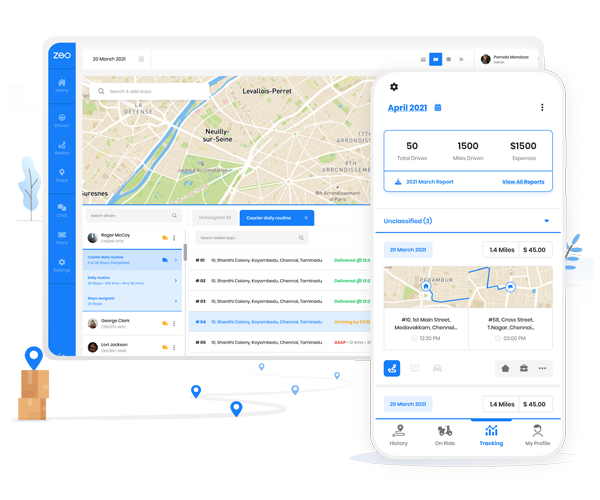
Grow your business effortlessly with Zeo Routes Planner – optimize routes and manage multiple drivers with ease.
increase fuel savings
Hassle Free Deliveries & Pickups!
Optimize routes with our algorithm, reducing travel time and costs efficiently.
Get Started for Free