


# 7 Pool Service Fleet Management Challenges That Are Costing You Money (And How to Fix Them)
Managing a pool service fleet feels like juggling flaming torches while riding a unicycle. One dropped route disrupts your entire day, leaving customers frustrated and technicians scrambling.
If you’re running 3-15 technicians across recurring weekly and monthly routes, you know the daily struggle. Pool service fleet management challenges don’t just create headaches – they drain your profits and limit your growth. According to Bureau of Labor Statistics data on service industry efficiency, operational inefficiencies are the leading cause of reduced profitability in grounds maintenance and pool service businesses.
The good news? These challenges aren’t inevitable. Let’s break down the seven biggest problems pool service companies face and the practical solutions that transform chaos into smooth operations.
The Real Cost of Pool Service Fleet Management Problems: Why Small Issues Become Big Losses
That “minor” routing inefficiency costs you more than you think. When your technician drives an extra 20 minutes between stops, you’re not just burning fuel.
You’re paying overtime wages, reducing daily capacity, and creating scheduling delays that ripple through the entire week. A single inefficient route can cost $50-75 daily in wasted time and fuel across just one vehicle. The Small Business Administration study on operational costs shows that transportation inefficiencies can account for up to 15% of total operational expenses in service-based businesses.
Multiply that across your fleet, and you’re looking at thousands in monthly losses. Poor fleet management also creates invisible costs: missed appointments damage customer relationships, rushed jobs hurt service quality, and stressed technicians increase turnover.
Consider this scenario: Your technician finishes his morning route 30 minutes late due to poor routing. His afternoon appointments get delayed, forcing you to reschedule three customers. Two of those customers switch to competitors who offer more reliable service windows.
The real cost isn’t just one delayed route – it’s lost customers, damaged reputation, and reduced team morale.
Challenge #1: Route Chaos – When Recurring Routes Become Routing Nightmares
Pool service routes look simple on paper. Visit the same customers weekly, follow a logical sequence, and maintain consistent schedules. Reality proves much messier.
Customer requests change constantly. Mrs. Johnson needs her pool cleaned Tuesday instead of Wednesday this week. The Henderson property requires extra chemical treatment after their pool party. Your regular route that worked perfectly last month now includes three new customers and two cancellations.
Manual route planning means starting from scratch every week. You spend hours shuffling stops, estimating drive times, and trying to balance workloads across technicians. By the time you finish planning, half your morning is gone.
The Solution: Dynamic Route Optimization
Smart pool service route optimization handles the complexity automatically. Instead of manual planning, you input customer locations, time windows, and service requirements. The system calculates optimal routes in minutes.
Route optimization considers real-world factors like traffic patterns, service duration, and technician skills. Your weekly routes adapt automatically when customers request changes or you add new accounts.
Modern routing platforms let managers plan routes on their computers while technicians receive optimized daily schedules directly on their mobile devices, creating seamless coordination between office planning and field execution.
Challenge #2: The Visibility Gap – Not Knowing Where Your Technicians Are or What They’re Doing
“Where’s Mike?” becomes your most-asked question. Customers call asking when their technician will arrive. You have no idea if Mike finished his previous stop or got stuck in traffic.
The visibility gap creates constant fire-drill management. You spend time calling technicians for status updates instead of focusing on business growth. Customers get frustrated with vague arrival estimates.
Without real-time tracking, you can’t optimize on the fly. If a technician finishes early, you miss opportunities to add same-day service calls. If someone gets delayed, you can’t proactively notify affected customers.
The Solution: Real-Time GPS Tracking and Communication
Real-time GPS tracking shows exactly where each technician is and their estimated arrival times. You see completed stops, current locations, and automatic ETAs for remaining appointments.
Live tracking enables proactive customer communication. Instead of customers calling you, you call them with accurate arrival windows. “Mike will be there in 15 minutes” sounds much better than “sometime this afternoon.”
Real-time visibility also helps with daily decisions. When an emergency service call comes in, you know which technician is closest and available.
Challenge #3: Seasonal Scaling Struggles – Managing Demand Spikes and Workforce Fluctuations
Pool service demand swings wildly with seasons. Spring opening season floods you with requests. Summer maintains steady volume. Fall brings closings and reduced frequency.
Your biggest challenge isn’t just managing seasonal volume – it’s efficiently scaling your workforce and routes. Hiring temporary technicians for peak season means training new people and restructuring established routes.
Existing routes get disrupted when you add capacity. Your regular technicians lose familiar territories. New hires struggle with unfamiliar customer locations and preferences. Route efficiency plummets just when you need maximum productivity.
The Solution: Flexible Route Planning and Territory Management
Territory management features let you quickly reassign customers and rebalance workloads. When demand spikes, you can split busy territories and assign overflow to new technicians.
Smart territory planning maintains route efficiency even with workforce changes. The system suggests optimal customer assignments based on location, service requirements, and technician capabilities.
For temporary staff, you can create simplified routes with clear navigation and customer notes. This reduces training time and helps new technicians serve customers professionally from day one.
Challenge #4: Customer Communication Breakdowns During Service Delays and Changes
Your technician gets stuck at a problem pool for two hours. Four afternoon customers wait without updates. Your phone rings constantly with “Where’s my pool guy?” calls.
Poor communication damages customer relationships faster than any service issue. Customers understand that delays happen – they don’t understand why nobody tells them. Implementing effective customer retention strategies requires transparent communication throughout the service process.
Manual communication doesn’t scale. Calling every affected customer takes time you don’t have. By the time you reach everyone, more delays have occurred, requiring additional calls.
The Solution: Automated Customer Notifications
Automated customer notifications handle customer communication without manual effort. When routes change or delays occur, affected customers receive immediate updates via text or email.
Customers get proactive notifications: “Your pool technician is running 30 minutes late due to a previous service taking longer than expected. New estimated arrival: 2:30 PM.”
Some systems provide live tracking links so customers can monitor their technician’s progress. This transparency reduces anxiety and phone calls to your office.
The notification system works both ways – customers can respond with gate codes, special instructions, or rescheduling requests that automatically update the technician’s mobile app.
Challenge #5: Proof of Service and Billing Accuracy Issues That Hurt Your Bottom Line
Billing disputes waste time and strain customer relationships. “You charged me for chemicals you didn’t add.” “My pool wasn’t serviced last Tuesday.” Without solid proof of service, these arguments become he-said, she-said battles.

increase fuel savings
Hassle Free Deliveries & Pickups!
Optimize routes with our algorithm, reducing travel time and costs efficiently.
Get Started for Free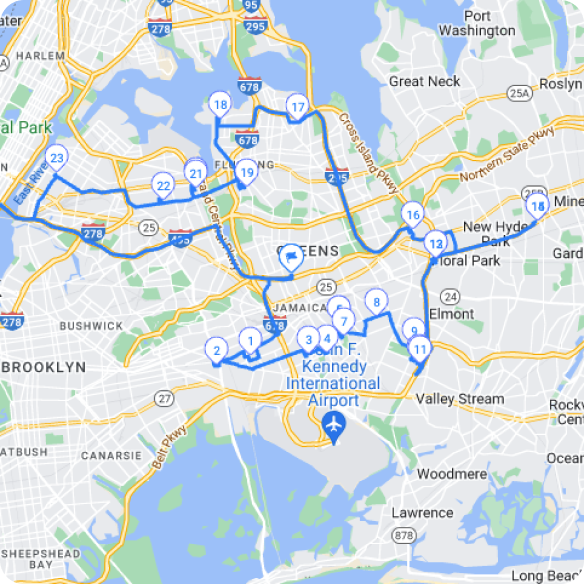
Paper service tickets create problems. Technicians forget to fill them out completely. Handwriting becomes illegible. Tickets get lost or damaged. Your billing department struggles to interpret incomplete information.
Incomplete documentation also hurts your service quality. If a technician notices a developing equipment issue but doesn’t document it properly, the next service visit might miss critical maintenance needs.
The Solution: Digital Proof of Service Capture
Mobile apps with proof of delivery features let technicians document service completion in real-time. Before and after photos show work performed. Digital signatures confirm customer satisfaction. Chemical readings and equipment notes create detailed service records.
Digital documentation eliminates billing disputes. When customers question charges, you show timestamped photos and detailed service notes. Most disputes disappear when customers see clear proof of work completed.
Digital records also improve service consistency. Technicians see notes from previous visits, chemical reading trends, and equipment maintenance history. This information helps provide better customer service and catch problems early.
Challenge #6: Vehicle and Equipment Management Across Multiple Service Routes
Each technician needs the right chemicals, tools, and equipment for their daily routes. Residential pools require different chemicals than commercial accounts. Some customers need specialized equipment for salt water systems or automated cleaners.
Inventory management becomes complex with multiple vehicles. You can’t afford to stock every truck with every possible item – that ties up too much capital. But technicians can’t complete jobs without proper supplies.
Vehicle maintenance scheduling adds another layer of complexity. When a service vehicle needs repair, you must redistribute that technician’s route across other team members. This disrupts established schedules and may require customer rescheduling.
The Solution: Intelligent Inventory and Vehicle Management
Route-based inventory planning ensures technicians carry appropriate supplies for their specific customers. The system analyzes historical usage patterns and suggests optimal truck stock levels.
Some platforms integrate with inventory management systems to track chemical usage by route and automatically generate reorder alerts. This prevents stockouts while minimizing carrying costs.
For vehicle maintenance, smart scheduling helps minimize disruption. The system identifies which routes can be easily redistributed and suggests optimal maintenance timing based on route complexity and customer preferences. Following Department of Transportation fuel efficiency guidelines can also help reduce overall fleet operating costs.
Technology Solutions That Solve Pool Service Fleet Challenges: From Route Planning to Customer Communication
The right technology platform addresses all these challenges through integrated solutions rather than piecemeal fixes. Route optimization, GPS tracking, customer communication, and proof of service work together seamlessly.
Cloud-based fleet management platforms let you manage everything from one dashboard. You see real-time technician locations, customer communications, completed services, and route performance metrics.
Technicians use mobile apps that combine navigation, customer information, service documentation, and communication tools. They receive optimized routes each morning and can update job status, capture service photos, and communicate with customers without switching between multiple apps.
Integration capabilities connect your fleet management platform with existing business systems. Customer data synchronizes with your CRM. Service completion triggers billing workflows. Chemical usage updates inventory management systems.
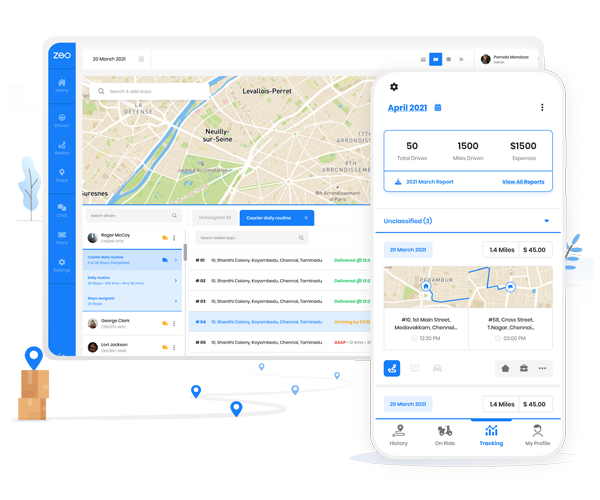
Zeo Route Planner exemplifies this integrated approach. Fleet managers use the web platform to plan and assign routes to multiple technicians, while drivers receive their daily routes, navigate efficiently, and capture proof of service completion directly through the mobile app.
The platform’s AI-powered optimization handles the complexity of recurring pool service routes, including customer time windows, technician skill requirements, and vehicle capacity constraints. Real-time tracking and automated customer notifications keep everyone informed without manual communication effort.
Most importantly, the technology scales with your business. Whether you’re managing 3 technicians or 15, the system handles increased complexity without requiring additional administrative overhead.
Getting Started with Pool Service Fleet Management Technology
Begin by identifying your biggest pain point. If routing takes too much time, start with route optimization. If customer communication creates daily headaches, prioritize automated notifications.
Look for platforms that offer free trials so you can test functionality with your actual routes and customers. The best systems show immediate results – you should see routing improvements and time savings within the first week.
Plan for team training and adoption. Technology only helps if your technicians use it consistently. Choose platforms with intuitive mobile interfaces that don’t require extensive training.
Consider integration requirements early. If you use specific CRM, billing, or inventory systems, ensure your fleet management platform can connect with existing workflows.
Frequently Asked Questions
Q: What are the most common pool service fleet management challenges?
The most common pool service fleet management challenges include inefficient routing that wastes fuel and time, poor visibility into technician locations, difficulty scaling operations during peak seasons, customer communication breakdowns during delays, and lack of proper service documentation for billing disputes. These challenges typically cost pool service companies thousands of dollars monthly in lost efficiency and customer churn.
Q: How much money do pool service fleet management problems typically cost businesses?
Poor fleet management can cost pool service companies $50-75 daily per vehicle in wasted time and fuel from inefficient routing alone. Across a fleet of 5-10 vehicles, this translates to $7,500-22,500 in monthly losses, not including the hidden costs of customer churn, overtime wages, and reduced service capacity that result from operational inefficiencies.
Q: What technology solutions help solve pool service fleet management challenges?
Modern route optimization software like Zeo Route Planner addresses multiple fleet management challenges through integrated solutions including AI-powered route planning, real-time GPS tracking, automated customer notifications, and digital proof of service capture. These platforms help pool service companies reduce drive time by 30-40% while improving customer satisfaction and operational visibility.
Q: How do seasonal demand fluctuations affect pool service fleet management?
Seasonal demand creates significant challenges for pool service fleet management, particularly during spring opening and fall closing seasons when service requests spike dramatically. Companies must efficiently scale their workforce and restructure routes without disrupting service quality, which often requires flexible territory management and streamlined training processes for temporary staff.
Q: What’s the best way to track pool service technicians in the field?
Real-time GPS tracking systems provide the most effective way to monitor pool service technicians, offering live location data, estimated arrival times, and completion status updates. Zeo Route Planner’s tracking features allow managers to see exactly where each technician is, proactively communicate delays to customers, and optimize daily schedules based on real-time progress, eliminating the constant “Where’s my technician?” phone calls.
Start your free trial of Zeo Route Planner to see how route optimization can transform your pool service operations in just 7 days.
Are you a fleet owner?
Want to manage your drivers and deliveries easily?
Grow your business effortlessly with Zeo Routes Planner – optimize routes and manage multiple drivers with ease.
increase fuel savings
Hassle Free Deliveries & Pickups!
Optimize routes with our algorithm, reducing travel time and costs efficiently.
Get Started for Free