



# How to Optimize Pressure Washing Routes for Maximum Profit
> TL;DR: Optimize pressure washing routes by implementing geographic clustering, strategic time windows, and automated route planning to increase daily job capacity by 25-30% while cutting fuel costs significantly. Poor route planning costs pressure washing businesses 2-3 hours per crew daily in unnecessary travel time. Route optimization tools like Zeo Route Planner address this with AI-powered optimization and real-time GPS tracking, helping pressure washing teams save 2+ hours daily.
Running a pressure washing business means juggling equipment, crews, and customer schedules every single day. But if you’re still planning routes manually, you’re likely burning through profits with every zigzag trip across town.
Poor route planning costs pressure washing businesses 2-3 hours per crew daily in unnecessary travel time. That’s time you could spend completing more jobs and growing revenue instead of sitting in traffic. Learning how to optimize pressure washing routes effectively is crucial for maximizing profitability in this competitive industry.
The good news? Smart route optimization can increase your daily job capacity by 25-30% while cutting fuel costs significantly. Here’s how to transform your chaotic scheduling into a profit-maximizing system.
The Hidden Costs of Poor Route Planning in Pressure Washing
Manual route planning creates invisible profit drains that compound throughout your business. When technicians crisscross service areas randomly, fuel costs spike by 30-40% compared to optimized routes.
Consider this scenario: Your crew starts in the north part of town, drives south for a driveway cleaning, then back north for a deck wash, then south again for a house exterior. That’s three unnecessary trips that eat into your margins.
According to the Bureau of Labor Statistics, transportation costs represent 15-20% of total operating expenses for service businesses. For pressure washing companies, inefficient routing can push this percentage even higher.
Vehicle wear and tear accelerates with poor routing. Extra miles mean more frequent oil changes, tire replacements, and maintenance. Your equipment trailer also takes a beating from constant highway driving between distant jobs.
Labor costs multiply when crews spend hours driving. You’re paying technicians to sit in traffic instead of operating pressure washers. This reduces the number of billable hours per day and limits your revenue potential.
Customer satisfaction drops with unpredictable arrival times. When routes aren’t optimized, providing accurate time windows becomes nearly impossible. Late arrivals damage your reputation and lead to cancellations.
Scaling becomes difficult without route efficiency. Adding more crews to cover inefficient routes requires exponentially more vehicles and overhead costs. Optimized routing lets you serve more customers with existing resources.
Geographic Clustering: How to Group Jobs for Maximum Daily Efficiency
Geographic clustering forms the foundation of efficient pressure washing routes. Instead of booking jobs randomly across your service area, group appointments by location to minimize travel time between stops.
Start with neighborhood-based scheduling. When a customer books a driveway cleaning in Maple Heights, actively promote services to surrounding streets. Offer slight discounts for same-day bookings in the immediate area to encourage clustering.
Create service zones within your territory. Divide your coverage area into 4-6 distinct zones based on drive time, not just distance. A zone might include neighborhoods that are 15-20 minutes apart but connected by efficient routes.
Plan weekly zone rotations. Instead of serving all areas daily, focus each crew on 1-2 zones per day. Monday might be the northwest zone, Tuesday the downtown area, and so on. This approach dramatically reduces travel time and demonstrates effective field service management principles.
Map out traffic patterns and road conditions. Some areas become inaccessible during rush hour or school pickup times. Plan your zones around these constraints to avoid getting trapped in slow-moving traffic with a trailer full of equipment.
Consider job duration when clustering. A large commercial property cleaning might take 4-6 hours, making it perfect as an anchor point for a day’s schedule. Group smaller residential jobs around these longer appointments.
Account for water access and disposal. Some neighborhoods have restrictions on water usage or runoff. Cluster jobs that require similar water management approaches to streamline your setup process.
Zeo Route Planner automates this clustering process using AI-powered optimization that considers traffic patterns, job duration, and geographic constraints to create the most efficient daily routes.
Time Windows and Customer Scheduling: Balancing Convenience with Route Optimization
Customer preferences and route efficiency don’t always align perfectly. The key is finding the sweet spot between service flexibility and operational efficiency.
Offer structured time windows instead of exact appointment times. Instead of promising arrival at 2:00 PM, offer windows like “early afternoon (12-3 PM)” or “late morning (9 AM-12 PM).” This gives you routing flexibility while meeting customer expectations.
Price time windows strategically. Charge premium rates for specific time requests that disrupt optimal routing. Early morning or late afternoon slots can command 10-15% higher prices to offset the routing inefficiency.
Identify your most profitable time windows. Track which time slots consistently fill with minimal routing disruption. These become your standard offering, while less efficient windows require premium pricing.
Plan for job duration variations. Pressure washing times vary significantly based on surface condition, size, and complexity. Build 15-30 minute buffers between appointments to prevent cascading delays.
Communicate proactively with customers about arrival times. Send updates when crews finish jobs early or encounter delays. Real-time communication maintains satisfaction even when schedules shift.
Group time-sensitive jobs strategically. Commercial properties often require specific timing due to business hours or customer traffic patterns. Use these as anchor points and schedule flexible residential jobs around them.
The most successful pressure washing businesses train their customer service team to guide bookings toward route-friendly time slots without appearing rigid or difficult to work with.
Seasonal Route Planning: Adapting Your Service Areas Throughout the Year
Pressure washing demand shifts dramatically with seasons, requiring flexible route planning that adapts to changing customer needs and weather patterns.
Spring surge planning requires expanded capacity. The spring cleaning season creates 3-4 times normal demand in most markets. Plan routes that can handle increased volume without sacrificing efficiency. Consider temporary route adjustments that serve high-demand areas more frequently.
Summer heat affects both scheduling and routing. Plan morning-heavy schedules that complete most outdoor work before peak heat. Routes should minimize afternoon concrete and asphalt work that becomes uncomfortable for crews and potentially less effective. The EPA’s vehicle emissions guidelines also show how heat increases fuel consumption during extended driving periods.
Fall focuses on preparation and maintenance cleaning. Customers prioritize deck staining prep and pre-winter house cleaning. Route planning should account for longer setup times and potential weather delays that could push jobs to the next day.
Winter opportunities in milder climates. Even cold-weather markets have winter pressure washing opportunities for covered areas, commercial properties, and emergency cleaning. Maintain smaller, more flexible routes that can adapt to weather windows.
Weather contingency routing becomes critical. Develop backup indoor routes (garages, covered patios, commercial interiors) that crews can pivot to when outdoor conditions deteriorate. This keeps teams productive and revenue flowing.
Seasonal service area adjustments. Some neighborhoods may become temporarily inaccessible due to seasonal factors (flooding, construction, tourist traffic). Plan alternative routes that maintain service coverage without getting caught in predictable delays.
Monitor local weather patterns and seasonal trends to anticipate route adjustments before they impact your schedule. Proactive planning prevents reactive scrambling when conditions change.

increase fuel savings
Save $200 on fuel, Monthly!
Optimize routes with our algorithm, reducing travel time and costs efficiently.
Get Started for Free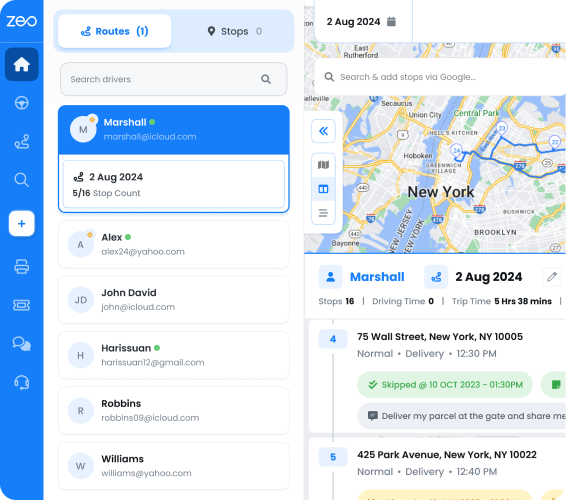
Technology Solutions: From Manual Planning to Automated Route Optimization
Manual route planning with paper maps or basic GPS apps can’t compete with modern optimization technology designed specifically for service businesses.
Route optimization software eliminates human error and bias. Even experienced managers struggle to visualize the most efficient sequence for 8-12 daily stops across a complex service area. AI-powered systems calculate thousands of possible combinations instantly.
Real-time adjustments handle unexpected changes. When customers reschedule or cancel last-minute, optimization software instantly recalculates the most efficient route for remaining stops. Manual planning requires starting over completely. Implementing automated route planning eliminates this time-consuming manual work.
Integration with customer management systems streamlines operations. The best route optimization platforms connect directly with your scheduling system, automatically importing new jobs and updating routes without manual data entry.
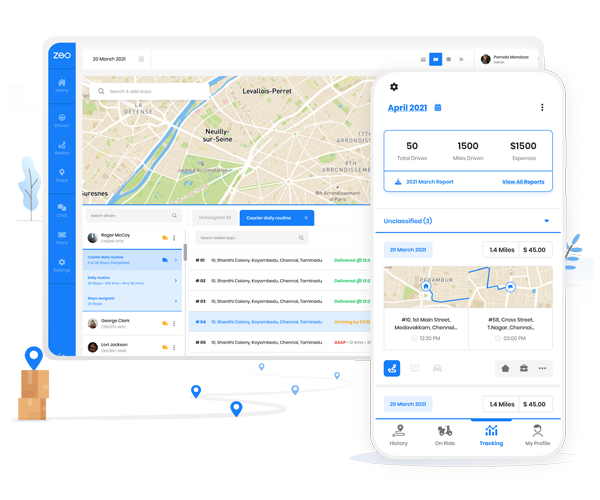
Here’s how the technology works in practice: Your office manager uses Zeo’s web platform to create optimized routes each morning, then instantly sends them to crews’ mobile apps. Technicians receive turn-by-turn navigation and can update job status in real-time, keeping everyone informed of progress and any delays.
GPS tracking provides accountability and customer communication. Customers receive automatic updates about crew arrival times, reducing phone calls to your office and improving satisfaction. Managers can see exactly where crews are and intervene if routes aren’t being followed efficiently. Real-time GPS tracking becomes essential for managing multiple crews effectively.
Proof of delivery features protect your business. Photo documentation, digital signatures, and timestamped completion records provide evidence of work completed and help resolve any customer disputes quickly. These proof of delivery features create accountability and professional documentation.
Analytics identify improvement opportunities. Modern route optimization platforms track metrics like miles per job, time between stops, and fuel efficiency to identify patterns and optimization opportunities that manual planning would never reveal.
Mobile accessibility ensures crews stay connected. Technicians access optimized routes, customer details, and navigation directly on their smartphones, eliminating paper route sheets and reducing confusion.
The transition from manual to automated route planning typically shows results within the first week, with most pressure washing businesses seeing immediate improvements in daily efficiency.
Measuring Route Performance: KPIs Every Pressure Washing Business Should Track
You can’t improve what you don’t measure. Successful pressure washing businesses track specific metrics that reveal routing efficiency and profitability.
Miles per completed job shows routing efficiency. Calculate total daily miles divided by jobs completed. Track this weekly to identify trends and improvement opportunities. Efficient routes typically achieve 8-12 miles per job in suburban markets.
Travel time percentage reveals productivity. Measure time spent driving versus time spent actually pressure washing. Target 20-25% travel time for optimal efficiency. Higher percentages indicate routing problems or service area issues.
Fuel costs per job directly impact profitability. Track fuel expenses divided by completed jobs to identify cost trends. This metric quickly reveals when routes become inefficient or fuel prices require pricing adjustments.
Jobs completed per crew per day measures capacity utilization. Count total jobs finished divided by number of crews deployed. Improving routes should increase this number without reducing service quality.
On-time arrival percentage affects customer satisfaction. Track how often crews arrive within promised time windows. Route optimization should improve this metric by making travel times more predictable.
Revenue per mile driven shows overall efficiency. Calculate total daily revenue divided by miles traveled. This comprehensive metric combines routing efficiency with pricing effectiveness.
Customer complaint rates related to scheduling issues. Monitor complaints about late arrivals, missed appointments, or poor communication. Effective routing reduces these problems significantly. Following route optimization best practices helps maintain customer satisfaction.
Zeo Route Planner provides detailed analytics and reporting that automatically tracks these metrics, giving you clear visibility into route performance and improvement opportunities without manual calculation.
Weekly route reviews identify patterns. Analyze your best and worst performing days to understand what factors contribute to efficiency or problems. Look for patterns related to specific neighborhoods, job types, or crew assignments.
Seasonal comparisons guide planning improvements. Compare current metrics to the same period last year to measure improvement and identify seasonal optimization opportunities. The Small Business Administration provides valuable benchmarking data for service businesses to track performance.
Set realistic targets for each metric and review progress monthly. Small improvements in routing efficiency compound into significant profit increases over time.
Frequently Asked Questions
Q: How much fuel can pressure washing businesses save with optimized routes?
Pressure washing companies typically reduce fuel costs by 25-30% through proper route optimization. This translates to savings of $200-500 monthly for single-crew operations, with larger fleets seeing proportionally greater benefits.
Q: What’s the ideal number of pressure washing jobs per day for one crew?
Most pressure washing crews can efficiently handle 6-8 residential jobs or 3-4 commercial properties daily with optimized routing. Zeo Route Planner’s AI-powered optimization helps crews achieve 25-30% more daily capacity by minimizing travel time between stops.
Q: How do weather delays affect pressure washing route planning?
Weather contingencies require flexible routing with indoor backup options like garages and covered areas. Smart scheduling involves monitoring forecasts 48-72 hours ahead and maintaining alternative route plans for weather disruptions.
Q: What factors should pressure washing businesses consider when setting service zones?
Service zones should be based on 15-20 minute drive times rather than just distance, considering traffic patterns, water access, and local restrictions. Zeo Route Planner automatically factors in these constraints using real-time traffic data and geographic clustering.
Q: How can pressure washing companies handle last-minute schedule changes efficiently?
Successful pressure washing operations build 15-30 minute buffers between appointments and use route optimization software that can instantly recalculate routes when customers reschedule or cancel last-minute.
Start your free 7-day trial of Zeo Route Planner to see how much time and fuel you can save with optimized pressure washing routes.
Are you a fleet owner?
Want to manage your drivers and deliveries easily?
Grow your business effortlessly with Zeo Routes Planner – optimize routes and manage multiple drivers with ease.

increase fuel savings
Save 2 Hours on Deliveries, Everyday!
Optimize routes with our algorithm, reducing travel time and costs efficiently.
Get Started for Free