


Running a pool service company means juggling dozens of properties, multiple crews, and constantly changing schedules. You’re probably spending hours each morning figuring out who goes where, only to watch your technicians drive across town multiple times per day.
Manual route planning is quietly draining your profits. Pool service route scheduling software can change that by automating your daily planning, handling seasonal fluctuations, and keeping your entire operation running smoothly. According to the Pool & Hot Tub Alliance industry statistics, the pool service industry serves over 10.4 million residential pools nationwide, creating massive opportunities for businesses that can optimize their operations.
Why Pool Service Companies Are Ditching Manual Route Planning (The Hidden Costs)
The Real Cost of Manual Scheduling
Every morning spent planning routes costs you money. Pool service companies typically waste 2-3 hours daily on route planning alone.
That’s 15 hours per week you could spend growing your business instead of moving pins around a map. At $50 per hour, you’re losing $750 weekly just on planning time.
But the hidden costs run deeper.
Fuel Waste from Inefficient Routes
Manual routing creates zigzag patterns across your service area. Your technicians drive 20-30% more miles than necessary because routes aren’t optimized.
If each truck drives 100 extra miles weekly at current fuel prices, you’re burning through $600-800 monthly in unnecessary fuel costs. Scale that across 5 trucks, and you’re looking at $4,000 monthly. The Bureau of Labor Statistics transportation costs data shows that fuel represents 24% of total vehicle operating costs for service businesses.
Customer Service Problems
Missing time windows frustrates customers. When routes aren’t optimized, technicians run late throughout the day.
Late arrivals lead to complaints, cancellations, and negative reviews. One cancelled account costs you $2,000-4,000 annually in lost revenue.
Technician Productivity Issues
Inefficient routes mean fewer stops per day. Your technicians could service 8-10 pools instead of 6-7 with better routing.
That’s 20-30% lost productivity per technician. For a company with 10 technicians averaging $200 revenue per stop, poor routing costs $8,000-12,000 monthly.
Essential Features Pool Service Route Software Must Have (Beyond Basic Scheduling)
Recurring Service Management
Pool maintenance runs on weekly, bi-weekly, or monthly cycles. Your software needs to handle recurring appointments automatically.
Look for systems that let you set service frequencies for each customer. The software should automatically schedule recurring visits without manual input. Advanced recurring routes scheduling systems also handle service variations. Some customers need weekly cleaning but monthly chemical balancing. Your software should track different service types for each property.
Time Window Optimization
Many pool owners have specific time preferences. Mrs. Johnson wants service before 10 AM because she works from home. The community pool needs service after hours.
Effective pool service route scheduling software optimizes around these constraints. It finds the most efficient route while respecting customer time windows.
Chemical and Equipment Tracking
Pool service involves carrying specific chemicals and equipment to each job. Your software should track what’s needed at each stop.
This prevents technicians from arriving without the right supplies. It also helps with inventory management and chemical ordering.
Weather Integration
Rain affects pool service schedules. Smart software integrates weather data and suggests schedule adjustments.
If storms are forecast, the system can recommend rescheduling outdoor work or prioritizing covered pools.
Customer Communication Tools
Customers want updates on service arrival times. Modern route software includes automatic customer notifications.
These systems send SMS or email updates when technicians are on their way. Customers receive realistic arrival windows and can track service progress.
Photo Documentation
Pool service requires visual proof of work completed. Technicians need to document before/after conditions, chemical readings, and equipment issues.
Quality software includes photo capture and storage tied to each service record. This protects you from disputes and helps with quality control.
Solving Seasonal Scheduling: How to Handle Summer Rush vs Winter Maintenance
Understanding Seasonal Demand Patterns
Pool service demand fluctuates dramatically throughout the year. Summer brings daily cleaning requests and emergency calls. Winter shifts to weekly maintenance and equipment prep.
Smart scheduling software adapts to these patterns. It helps you manage capacity during peak season while maintaining efficiency during slower months.
Summer Rush Management
Peak season brings challenges. Customer pools need more frequent cleaning due to heavy usage and weather conditions.
Your software should handle increased service frequency automatically. If a customer normally gets bi-weekly service, the system should easily shift them to weekly during summer months.
Emergency calls also spike in summer. Pool parties, storms, and equipment failures create urgent service needs. Quality route software allows real-time schedule adjustments without disrupting entire daily routes.
Winter Maintenance Optimization
Winter brings different challenges. Service frequency drops, but each visit becomes more complex. Winterization, equipment maintenance, and chemical balancing take longer.
Your scheduling software needs longer time slots for winter services. It should also track seasonal service types and ensure technicians bring appropriate equipment.
Transition Period Planning
Spring and fall transitions require careful planning. You’re ramping service up or down while managing equipment changes.
Effective software helps plan these transitions weeks in advance. It can gradually adjust schedules and help forecast staffing needs.
Staff Scheduling Flexibility
Seasonal businesses often adjust crew sizes. You might run 10 crews in summer but only 6 in winter.
Your route software should handle team size changes smoothly. It needs to redistribute territories and customers as your workforce scales up or down.
Multi-Crew Territory Management: Optimizing Routes Across Your Entire Fleet
Territory Design That Works
Effective pool service operations divide service areas into logical territories. Each crew gets a geographic zone with roughly equal workload and revenue potential.
Smart territory design considers drive times, not just property counts. A territory with 50 pools spread across 20 miles is less efficient than 40 pools in a 5-mile radius.
Your route software should help analyze territory performance. Look for systems that show average drive time, daily revenue, and customer density per territory. Modern pool service route optimization tools provide detailed analytics to help you make data-driven territory decisions.
Crew Specialization and Skill Matching
Not every technician handles every service type. Some specialize in equipment repair, others in chemical balancing or commercial properties.
Advanced scheduling software includes skill-based assignment. It ensures customers requiring specific expertise get matched with qualified technicians.
For example, if a customer needs equipment repair, the system assigns that stop to your repair specialist rather than a general maintenance crew.
Coordinating Multiple Crews Daily
Managing 5-25 crews requires coordination. You need visibility into each team’s progress throughout the day.
Modern route software provides real-time tracking. Managers see where each crew is located, how many stops they’ve completed, and their estimated finish time.
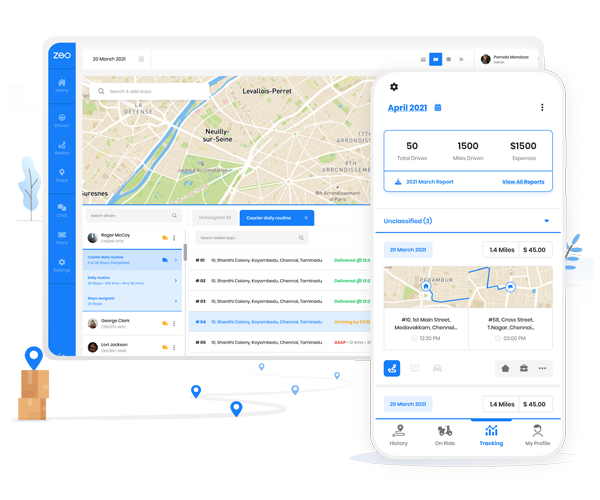
With platforms like Zeo Route Planner, managers plan and assign routes through the web platform while technicians receive optimized routes directly on their mobile devices. When emergency calls come in, managers can adjust routes in real-time, and technicians get updated directions instantly. This integration between web-based fleet management software and mobile apps ensures seamless coordination across your entire operation.
Load Balancing Across Teams
Some days, crews finish early while others run late. Effective software helps balance workloads in real-time.
If one crew gets backed up, the system can suggest reassigning nearby stops to available teams. This prevents overtime while maintaining service quality.
Backup Coverage Planning
Technicians call in sick or equipment breaks down. Your route software should handle coverage scenarios quickly.
Quality systems let you reassign an entire route to backup crews with a few clicks. Customer notifications go out automatically with new arrival times.

increase fuel savings
Save 2 Hours on Deliveries, Everyday!
Optimize routes with our algorithm, reducing travel time and costs efficiently.
Get Started for Free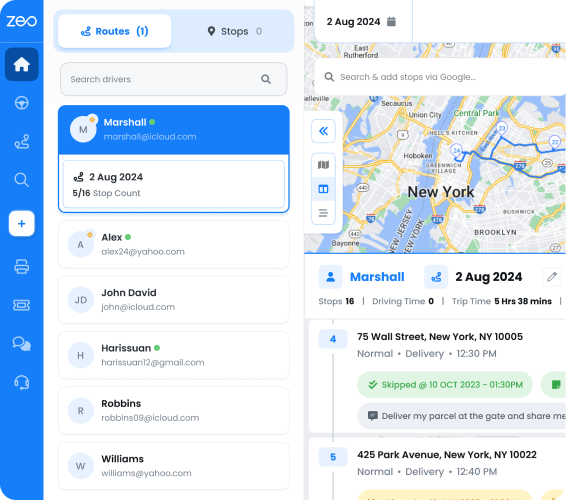
ROI Analysis: What Pool Service Companies Actually Save with Route Optimization
Time Savings Breakdown
Pool service companies typically save 2-3 hours daily on route planning. That’s 500-750 hours annually worth $25,000-37,500 in management time.
Technicians save 30-45 minutes daily on driving. Across 10 technicians, that’s 5-7.5 additional service hours daily. At $75 per hour, that’s $97,000-146,000 in additional annual capacity.
Understanding these savings requires following a comprehensive route optimization guide that outlines best practices for measuring and maximizing efficiency gains.
Fuel Cost Reductions
Optimized routing reduces driving by 20-30%. For a fleet spending $8,000 monthly on fuel, that’s $1,600-2,400 monthly savings.
Annual fuel savings range from $19,200-28,800. Over three years, you’re looking at $57,600-86,400 in fuel cost reductions alone. The EPA fuel economy guidelines provide benchmarks for tracking these improvements across your fleet.
Customer Retention Improvements
Better scheduling improves customer satisfaction. Companies typically see 15-25% fewer complaints about missed appointments or late arrivals.
Reducing customer churn by just 5% can increase annual revenue by 10-15%. For a company generating $500,000 annually, that’s $50,000-75,000 in retained revenue.
Revenue Growth Through Capacity
Efficient routing lets you serve more customers without adding crews. Most companies can increase daily stops by 20-25% through better routing.
If you’re averaging 60 stops daily at $75 each, that’s $4,500 daily revenue. A 20% increase adds $900 daily or $234,000 annually.
Real-World Example: Coastal Pool Services
Take Coastal Pool Services, a Florida company running 8 crews across 400 customers. Before route optimization, they spent 3 hours daily planning routes and averaged 7 stops per crew daily.
After implementing route software, planning time dropped to 30 minutes. Each crew now averages 9 stops daily. That’s 16 additional stops across all crews.
At $80 per stop, those extra 16 daily stops generate $1,280 additional daily revenue. Annually, that’s $332,800 in new revenue from the same labor force.
Their fuel costs dropped 25% saving $2,100 monthly. Customer complaints about late arrivals virtually disappeared, improving retention.
Total annual benefit: $358,000 in additional revenue plus $25,200 in fuel savings, minus $3,600 in software costs equals $379,600 net benefit.
Implementation Guide: Choosing and Deploying Pool Service Route Software
Evaluating Software Options
Start by listing your specific needs. Do you need chemical tracking? Customer notifications? Multi-location support?
Test each platform with real data. Most providers offer free trials. Upload 50-100 of your actual customer addresses and create sample routes.
Pay attention to ease of use. Your office staff and technicians need to adopt the system quickly. Complicated software creates resistance and implementation delays. Look for solutions that offer comprehensive field service management capabilities beyond just routing.
Data Migration Planning
You’ll need to transfer customer data, service histories, and route preferences. Clean up your data before migration.
Standardize address formats and remove duplicate customers. Verify service frequencies and special instructions. Good data going in means better routes coming out.
Plan for a gradual transition. Start with one or two crews before rolling out company-wide. This lets you work out issues without disrupting your entire operation.
Training Your Team
Office staff need training on route planning and customer management features. Technicians need mobile app training and proof-of-service procedures.
Schedule training sessions rather than trying to learn while working. Budget 2-4 hours for office staff and 1-2 hours for field technicians.
Create simple reference guides for common tasks. Laminated cards in trucks help technicians remember mobile app procedures during the first few weeks.
Setting Up Territories and Preferences
Define your service territories in the software. Upload customer lists for each territory and assign crews.
Configure service types, time requirements, and special equipment needs. Set up customer communication preferences and time windows.
Test territory assignments with historical data. Run sample weeks to verify route efficiency and crew workloads.
Measuring Success
Track key metrics before and after implementation. Monitor planning time, average daily miles, stops per technician, and customer complaints.
Set realistic improvement targets. Most companies see 15-20% efficiency gains within 30 days and 25-30% gains within 90 days.
Review weekly reports with crew leaders. Identify routing issues and optimization opportunities. Continuous improvement maximizes your investment.
Common Implementation Mistakes
Don’t rush the rollout. Taking time to properly configure the system prevents frustration later.
Avoid over-customization initially. Start with standard features and add complexity gradually as your team adapts.
Don’t skip training. Proper training prevents user resistance and ensures you get full value from the software investment.
Frequently Asked Questions
Q: What is pool service route scheduling software?
Pool service route scheduling software is a specialized tool that automates the planning and optimization of routes for pool maintenance companies. It handles recurring appointments, optimizes driving routes to minimize travel time, and manages customer communications automatically. Zeo Route Planner offers these features specifically designed for pool service businesses with both web-based fleet management and mobile apps for technicians.
Q: How much can pool service companies save with route optimization software?
Pool service companies typically save 2-3 hours daily on route planning and reduce fuel costs by 20-30% through optimized routing. Most businesses see a 20-25% increase in daily service capacity, which can translate to $200,000+ in additional annual revenue for mid-sized operations. The software investment usually pays for itself within the first month through time and fuel savings alone.
Q: Can route scheduling software handle seasonal changes in pool service demand?
Yes, quality pool service route scheduling software automatically adjusts to seasonal demand patterns. It can increase service frequency during summer months, handle emergency calls without disrupting daily routes, and manage longer winter maintenance appointments. Zeo Route Planner’s AI-powered optimization adapts to these seasonal variations while maintaining efficient routing throughout the year.
Q: What features should I look for in pool service scheduling software?
Essential features include recurring service management, time window optimization, chemical and equipment tracking, weather integration, and customer communication tools. Look for software that offers photo documentation for proof of service, real-time GPS tracking, and the ability to handle skill-based technician assignments. Mobile app compatibility is crucial for technicians in the field.
Q: How long does it take to implement pool service route scheduling software?
Most pool service companies can implement route scheduling software within 2-4 weeks. This includes data migration, territory setup, team training, and gradual rollout across crews. Start with one or two crews for testing before expanding company-wide. Proper training typically requires 2-4 hours for office staff and 1-2 hours for field technicians to ensure smooth adoption.
Pool service route scheduling software transforms chaotic daily planning into streamlined operations. The time savings, fuel reductions, and improved customer satisfaction quickly justify the investment.
Start your free 7-day trial of Zeo Route Planner and see how much time and fuel your pool service company can save with automated route optimization.
Are you a fleet owner?
Want to manage your drivers and deliveries easily?
Grow your business effortlessly with Zeo Routes Planner – optimize routes and manage multiple drivers with ease.
increase fuel savings
Save 2 Hours on Deliveries, Everyday!
Optimize routes with our algorithm, reducing travel time and costs efficiently.
Get Started for Free