

# How to Reduce HVAC Technician Drive Time by 30-40%
Your HVAC technicians are burning money on the road. While they’re stuck in traffic between service calls, your labor costs skyrocket and customer satisfaction plummets.
Most HVAC companies lose 2-3 hours of billable time daily to excessive drive time. Learning how to reduce HVAC technician drive time isn’t just an operational improvement—it’s a profit multiplier that can save you thousands every month.
The good news? You can cut technician drive time by 30-40% with the right approach. Here’s how to transform your routing from a cost center into a competitive advantage.
The Hidden Cost of Excessive HVAC Drive Time (Why Every Extra Hour Costs You $75+)
Every hour your technician spends driving instead of working costs you more than you think. Let’s break down the real numbers.
A typical HVAC technician costs $35-45 per hour in wages and benefits. Add vehicle expenses—fuel, maintenance, insurance—and you’re looking at $15-20 per hour. That’s $50-65 per hour just to have someone on the road.
But here’s the kicker: lost opportunity cost. That same hour could generate $150-300 in billable revenue. So every excess drive hour actually costs you $75-100 in lost profit potential.
Consider this scenario: You have 10 technicians driving an extra hour daily due to poor routing. That’s $750-1,000 in daily losses, or $195,000-260,000 annually. For a mid-sized HVAC company, that’s often the difference between growth and stagnation.
Excessive drive time also triggers overtime costs. When technicians spend half their day driving, they need extra hours to complete service calls. This pushes labor costs 50% higher and burns out your best people.
Customer satisfaction takes a hit too. Long drive times mean delayed appointments, rushed service calls, and frustrated customers who switch to competitors with more reliable scheduling.
Strategic Territory Planning: Geographic Zones That Minimize Travel Distance
Smart territory planning is your first line of defense against excessive drive time. Most HVAC companies assign calls randomly or based on technician availability. This approach guarantees inefficiency.
Start by mapping your service area and identifying natural clusters of customers. Look for neighborhoods, commercial districts, or geographic boundaries that create logical zones.
Assign each technician to a specific territory based on their home location and skillset. A technician living in the north suburbs should handle calls in that area, not across town. This simple change can cut 30-60 minutes of daily drive time per technician.
Consider customer density when drawing territories. High-density areas should be smaller geographic zones, while rural territories can be larger. The goal is roughly equal workload, not equal geography.
Account for traffic patterns too. A territory that looks compact on a map might span multiple highways during rush hour. Use real driving times, not straight-line distances, when planning territories.
Review and adjust territories quarterly. Customer bases shift, new developments open, and traffic patterns change. What worked six months ago might be costing you money today.
For emergency calls, establish backup protocols. When a customer needs immediate service outside their technician’s territory, identify the two closest available technicians. This prevents sending someone from across town for urgent repairs.
Understanding HVAC service routes across different regions can help you benchmark your territory planning against industry best practices.
How to Reduce HVAC Technician Drive Time with Route Optimization Technology
Manual route planning is like trying to solve a 1,000-piece puzzle blindfolded. Route optimization software does the heavy lifting, finding the most efficient path between all your service calls.
The best route optimization tools consider multiple factors simultaneously. Time windows matter—Mrs. Johnson needs her AC fixed before 2 PM, while the office building accepts service until 6 PM. Priority levels help too, distinguishing between emergency repairs and routine maintenance.
Real-time traffic integration is crucial for HVAC work. A route that looks perfect at 7 AM might be a disaster by 10 AM when traffic builds up. Modern platforms adjust routes automatically based on current conditions.
Look for software that handles last-minute changes smoothly. When a customer reschedules or adds an emergency call, the system should recalculate the entire day’s route in seconds, not hours.
Skills-based routing ensures the right technician handles each call. Your commercial refrigeration specialist shouldn’t waste time driving to residential furnace repairs. AI route optimization matches jobs to technician capabilities automatically.
Vehicle capacity matters for HVAC companies carrying heavy equipment. The system should account for truck space, ensuring technicians don’t need return trips to the warehouse for parts.
Zeo Route Planner handles all these factors while serving over 1.5 million users worldwide. Companies typically see 30-40% drive time reduction within the first month of implementation.
Dynamic Scheduling: Handling Emergency Calls Without Destroying Your Routes
Emergency calls are part of HVAC life. A broken AC unit in July can’t wait until tomorrow. But emergency calls don’t have to destroy your carefully planned routes.
The key is dynamic rescheduling. When an emergency comes in, evaluate all available technicians, not just the closest one. Sometimes sending a technician who’s 15 minutes farther away preserves two other optimized routes.
Create buffer time in daily schedules. Instead of booking technicians solid from 8 AM to 5 PM, leave 30-60 minute gaps for unexpected calls. This prevents the domino effect where one emergency ruins the entire day.
Establish clear emergency criteria. Not every “urgent” call is truly urgent. A consistent air conditioner during mild weather isn’t the same as a heating system failure in winter. Train your dispatch team to categorize calls appropriately.
Use mobile communication to keep technicians informed. When routes change due to emergencies, technicians need updates immediately. Sitting in a customer’s driveway without knowing about the new call wastes precious time.
Consider partnerships with other local HVAC companies for overflow emergency work. If your nearest technician is two hours away, it might be more profitable to refer the call and maintain your existing routes.
Plan for seasonal emergency patterns. Summer brings AC failures, winter brings heating emergencies. Historical data helps predict busy periods and adjust scheduling accordingly.
Effective field service management requires balancing planned routes with emergency response capabilities.
Mobile Tools That Keep Technicians Efficient Between Stops
The time between service calls is where efficiency lives or dies. Mobile tools can eliminate the small delays that add up to hours of wasted time daily.

increase fuel savings
Hassle Free Deliveries & Pickups!
Optimize routes with our algorithm, reducing travel time and costs efficiently.
Get Started for Free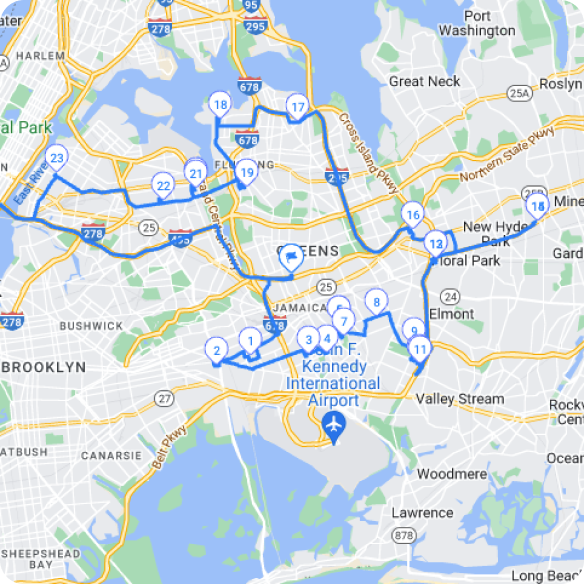
GPS navigation might seem basic, but many technicians still rely on outdated systems or phone apps that don’t account for commercial vehicle restrictions. Professional routing includes truck-friendly roads and avoids low bridges or weight restrictions.
Customer information at their fingertips eliminates phone calls to the office. Technicians should see service history, equipment details, and special instructions before arriving. This prevents return trips for forgotten parts or tools.
Digital work orders streamline documentation. Instead of paper forms that get lost or damaged, technicians complete everything on mobile devices. Photos, signatures, and notes sync automatically with your office system.
Parts inventory integration helps technicians check warehouse stock before leaving job sites. If they need a specific part for the next call, they’ll know whether to swing by the warehouse or call for delivery.
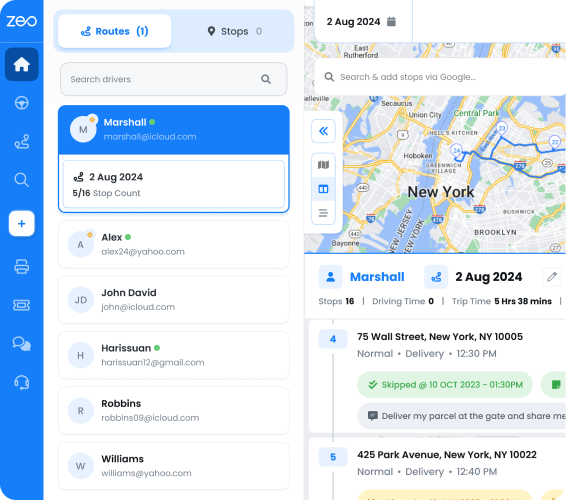
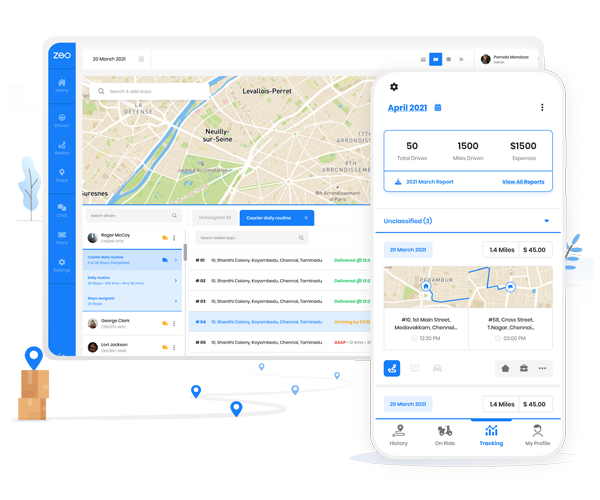
While managers use web platforms to optimize routes and assign calls, technicians receive these optimized routes directly through mobile apps like Zeo’s. The app provides turn-by-turn navigation, customer details, and proof of service collection—eliminating time-wasting tasks between stops.
Offline functionality matters for areas with poor cell coverage. Technicians should access customer information, maps, and work orders even without internet connectivity.
Payment processing capabilities reduce office workload and improve cash flow. When technicians can accept credit cards and electronic payments on-site, you get paid faster and eliminate billing delays.
Measuring Success: KPIs to Track Drive Time Reduction and ROI
You can’t improve what you don’t measure. Tracking the right metrics shows exactly how much drive time reduction improves your bottom line.
Start with total drive time per technician per day. Measure this before implementing changes, then track weekly improvements. Most companies see 20-30% reduction in the first month with proper route optimization.
Average time between stops reveals routing efficiency. If technicians consistently spend 45 minutes between calls, there’s room for improvement. Optimized routes should average 15-20 minutes between nearby stops.
First-call completion rate indicates whether technicians arrive prepared. When they have the right parts and information, fewer return trips mean less drive time. Aim for 85%+ first-call completion.
Customer satisfaction scores often improve alongside drive time reduction. On-time arrivals and prepared technicians create happier customers. Track this correlation to show the full value of routing improvements.
Overtime hours directly reflect routing efficiency. When technicians spend less time driving, they complete more calls during regular hours. Monitor overtime costs as a percentage of total labor costs.
Revenue per technician per day shows the profit impact. More billable hours mean higher revenue, even with the same number of technicians. This metric demonstrates ROI most clearly to ownership.
Fuel costs per vehicle provide another concrete measurement. Better routing means fewer miles driven and lower fuel expenses. Track this monthly to show ongoing savings.
Vehicle maintenance costs decrease with better routing too. Fewer miles mean less wear and tear, reducing repair and replacement expenses over time.
Calculate your return on investment by comparing drive time reduction costs against labor savings, overtime reduction, and revenue increases. Most companies see 300-500% ROI within six months.
Review these metrics monthly and adjust strategies accordingly. What works in summer might need tweaking for winter conditions. Continuous improvement ensures lasting results.
Modern fleet management software provides dashboards and analytics to track these KPIs automatically.
Frequently Asked Questions
Q: What’s the average drive time reduction HVAC companies can expect with route optimization?
Most HVAC companies see 30-40% drive time reduction within the first month of implementing proper route optimization strategies. Companies using dedicated route optimization software like Zeo Route Planner often achieve these results faster due to AI-powered routing that considers traffic, time windows, and technician skills simultaneously.
Q: How much money can reducing HVAC technician drive time actually save?
For a typical HVAC company with 10 technicians, reducing drive time by just one hour per day can save $195,000-260,000 annually. This includes direct labor costs, vehicle expenses, and most importantly, the opportunity cost of lost billable revenue that could range from $150-300 per hour.
Q: Should HVAC companies invest in route optimization software or handle routing manually?
Manual route planning becomes inefficient once you have more than 3-4 technicians with multiple daily stops. Route optimization software considers dozens of variables simultaneously – traffic patterns, time windows, technician skills, and vehicle capacity – which is impossible to do manually. Solutions like Zeo Route Planner can recalculate entire daily routes in seconds when emergencies arise.
Q: How do you handle emergency HVAC calls without ruining optimized routes?
The key is dynamic rescheduling and buffer time. Build 30-60 minute gaps into daily schedules and evaluate all available technicians when emergencies arise, not just the closest one. Sometimes sending a technician who’s 15 minutes farther away preserves two other optimized routes.
Q: What mobile tools do HVAC technicians need to minimize time between service calls?
Essential mobile tools include GPS navigation with commercial vehicle routing, digital work orders with customer history, parts inventory integration, and offline functionality for areas with poor cell coverage. These tools eliminate phone calls to the office and prevent return trips for forgotten parts or information.
Ready to see how much drive time you can eliminate from your HVAC operations? Start a free trial of Zeo Route Planner and discover why over 1.5 million users trust us to optimize their routes across 150+ countries.
Are you a fleet owner?
Want to manage your drivers and deliveries easily?
Grow your business effortlessly with Zeo Routes Planner – optimize routes and manage multiple drivers with ease.
increase fuel savings
Save 2 Hours on Deliveries, Everyday!
Optimize routes with our algorithm, reducing travel time and costs efficiently.
Get Started for Free