

Updated on: March 22, 2026
Reading Time: 3 minutes
TL;DR: Strategic use of advanced route optimization features like time windows, priority settings, and skill-based assignments can dramatically improve delivery efficiency beyond basic routing. Companies using these features typically reduce failed deliveries by 30-40% and improve customer satisfaction through accurate ETAs. Route optimization tools like Zeo Route Planner address this with AI-powered route optimization and skill-based driver assignment, helping delivery teams save 2+ hours daily.
If you are already using a route planner or looking to use one for optmizing delivery routes – Congratulations! For taking a step towards saving time and money for your business.
What if we told you that you can optimize delivery routes for even better efficiency using different features of Zeo route planner?
5 Ways you can optimize delivery routes with our route planner:
- Add delivery time slots
- Add ‘Stop Priority’ status
- Add stop duration
- Assign drivers as per skills
- Add ‘Stop Type’ and pickup linked deliveries
Let’s have a look at each of these in more detail:
1. Add delivery time slots
While adding stops to the route, you can add specific time slots for delivery as per the customer’s requirement. The route will be optimised considering the time slots. Adding the delivery window ensures that your driver doesn’t reach a customer only to find that the customer is not available. It will be inefficient for the driver to visit the same stop multiple times.
According to the U.S. Department of Transportation, failed delivery attempts cost the logistics industry billions annually in wasted fuel and labor. Time window constraints help eliminate these costly redeliveries by ensuring drivers arrive when customers are available to receive deliveries.

2. Add ‘ Stop Priority’ status
In case there’s a delivery or a client service request that has to be fulfilled on priority then you can update the ‘stop priority’ status accordingly. You can set the priority status as ‘Normal’ or as ‘ASAP’. If the status is marked as ‘ASAP’ then while optimising the route the stop will be given priority. If the status is marked ‘Normal’ then the optimisation will happen as per the usual process.
Priority routing becomes especially critical in service industries where emergency calls or high-value customers require immediate attention. The ability to dynamically adjust routes mid-shift ensures that urgent deliveries don’t disrupt the entire day’s schedule while still maintaining overall efficiency.

3. Add stop duration
When planning a route, it’s important to consider the time that will be spent at each stop. The driver may be required to spend more time at a stop depending on the number of boxes or the load to be delivered. Correct estimation of stop duration will help in correctly determining the delivery time for each customer on the route. If the stop duration is not estimated correctly, then it will lead to delayed deliveries for the subsequent customers.
Research shows that accurate stop duration estimates are crucial for maintaining customer satisfaction. When customers receive realistic ETAs based on actual service times, they’re more likely to be available for delivery and less likely to file complaints about late arrivals.

4. Assign drivers as per skills
Make use of skill-based optimisation if you are in such an industry that requires different drivers to have different skills. For example, construction & maintenance, utilities, healthcare, etc. In Zeo route planner you can update the skills of your drivers. While updating the stops, you can add the skill requirement at each stop. It will then optimise the route by matching the skills of the drivers as per the skill requirement at each stop. This ensures that the correct driver goes to each stop on the first go. Read more about skill-based job assignment in our blog.
The Bureau of Labor Statistics tracks over 800 occupational specialties, many requiring specific certifications or training. In field service operations, sending the wrong technician to a job site can result in callbacks, customer dissatisfaction, and significant cost overruns. Skill-based routing eliminates these mismatches from the start.


increase fuel savings
Save $200 on fuel, Monthly!
Optimize routes with our algorithm, reducing travel time and costs efficiently.
Get Started for Free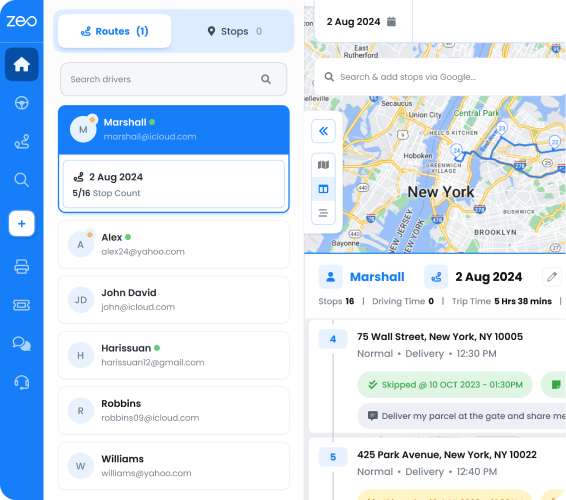
5. Add ‘Stop type’ and pickup linked deliveries
You can further optimise the route by adding details like stop type – pickup or delivery. You can also use the pickup linked deliveries feature which is exclusive to Zeo. The deliveries can be linked to the corresponding pickup address. This helps the driver to efficiently track which picked-up parcel is to be delivered at which address. Learn more about pickup linked deliveries.
This feature becomes invaluable for businesses handling same-day deliveries, return logistics, or courier services where items must be collected from one location and delivered to another on the same route. The linked delivery system prevents mix-ups and ensures accurate tracking throughout the entire pickup-to-delivery process.
How Vehicle Capacity Constraints Maximize Efficiency
Beyond the five core optimization features, vehicle capacity planning plays a crucial role in route efficiency. Weight and volume constraints ensure that drivers aren’t overloaded and that deliveries can be completed in a single trip. When capacity limits are properly configured, the routing algorithm automatically distributes stops based on what each vehicle can realistically handle.
This prevents the common scenario where a driver reaches their last few stops only to discover they don’t have enough space for remaining packages, forcing them to return to the depot and make a second trip. Capacity-based routing eliminates these inefficiencies while ensuring driver safety and vehicle longevity.
Real-Time Adjustments and Customer Communication
Modern delivery operations require flexibility to handle unexpected changes throughout the day. Traffic delays, customer cancellations, and urgent add-on requests can derail even the most carefully planned routes. The ability to make dynamic route adjustments mid-shift allows dispatchers to respond to these changes without compromising overall efficiency.
Equally important is keeping customers informed through real-time communication. Live ETA updates and customer notifications via SMS or email reduce the number of “where is my delivery?” calls that tie up customer service resources. When customers can track their deliveries in real-time, they’re more likely to be available when drivers arrive.
To create the most efficient routes book a demo call now or sign up for a free trial of Zeo Route Planner!
In a nutshell
Each and every minute that you save leads to savings in costs as well. Using features like delivery time windows, stop priority status, stop type, pickup linked deliveries and skill-based job assignment help in optimizing delivery routes with the best efficiency. Adding stop duration is important for arriving at the correct ETA for each stop in the delivery route. Route optimization helps in improving the bottomline of your business!
Frequently Asked Questions
How much time can advanced route optimization features actually save?
Advanced route optimization features typically reduce daily planning time by 2-4 hours while cutting total drive time by 15-25%. The combination of time windows, priority settings, and capacity constraints eliminates failed deliveries and reduces the need for return trips, which are the biggest time wasters in delivery operations.
What’s the difference between stop priority and delivery time windows?
Stop priority determines the order of importance (ASAP vs Normal), while delivery time windows specify when a customer is available to receive deliveries. Priority settings help manage urgent requests, whereas time windows prevent failed deliveries due to customer unavailability. Both work together to optimize route efficiency.
Why is accurate stop duration estimation so critical for delivery routes?
Inaccurate stop duration estimates create a cascading effect of late arrivals throughout the entire route. If you underestimate service time at early stops, every subsequent customer receives delayed deliveries, leading to complaints and potential redeliveries. Proper time estimation ensures realistic ETAs and better customer satisfaction.
How does skill-based driver assignment improve first-time completion rates?
Skill-based assignment matches driver qualifications with job requirements before dispatch, eliminating scenarios where technicians arrive without proper certifications or tools. This prevents callbacks and reschedules that waste time and fuel while damaging customer relationships.
Can route optimization software handle same-day pickup and delivery requests?
Yes, modern route optimization platforms support linked pickup-delivery pairs where items collected at one location must be delivered to specific addresses on the same route. Advanced systems like Zeo Route Planner with pickup linked deliveries and dynamic route adjustments can accommodate these complex logistics requirements while maintaining overall efficiency across 150+ countries.
Are you a fleet owner?
Want to manage your drivers and deliveries easily?
Grow your business effortlessly with Zeo Routes Planner – optimize routes and manage multiple drivers with ease.

increase fuel savings
Hassle Free Deliveries & Pickups!
Optimize routes with our algorithm, reducing travel time and costs efficiently.
Get Started for Free