

Updated on: April 22, 2026
Reading Time: 3 minutes
TL;DR: Route optimization problems are solved by using algorithms that determine the most efficient sequence of stops while considering constraints like time windows, vehicle capacity, and driver assignments. Modern logistics companies face increasingly complex routing challenges as customer expectations for same-day delivery continue to rise. Route optimization tools like Zeo Route Planner address this with AI-powered route optimization and auto-assignment of stops to drivers, helping delivery teams save 2+ hours daily.
Effective logistics are critical to ensure the steady movement of products and services. Nowadays companies strive to enhance operations and reduce costs, and optimizing vehicle routes has become a top priority. The route optimization problem involves determining the most efficient routes for a fleet of vehicles to visit a specific set of locations.
In this blog post, we will discuss what are route optimization problems, how to solve route optimization problems, and explore methods for finding better routes.
What are Route Optimization Problems?
Route optimization is the process of determining the most cost-efficient route, considering factors like stops, arrival or departure time gap, and effective loading. The Route Optimization Problems (ROP) are crucial issues in logistics, supply chain management, and delivery operations, requiring the identification of the most efficient routes for a fleet of vehicles.
The complexity of route optimization problems has grown significantly in 2026, with businesses managing larger delivery volumes and tighter time windows. According to the U.S. Bureau of Transportation Statistics, freight transportation activity continues to increase, making efficient routing more critical than ever for maintaining competitive advantage.
How to Solve Route Optimization Problems?
To increase the efficiency of last-mile delivery solving the Route Optimisation Problem is critical. The purpose is to identify the most efficient sequence of stops for a fleet of vehicles. By solving route optimization problems you can save costs such as fuel, time, and distance while adhering to constraints such as delivery windows, vehicle capacity, and customer requirements.
While solving route optimization problems, there are many restrictions to consider such as vehicle capacity, delivery time windows, and geographical variables including distance, traffic patterns, road conditions, fuel costs, and pollution. Businesses also strive to reduce fuel usage and their environmental impact.
Mathematical Approaches to Route Optimization
The most common mathematical formulation of route optimization is the Vehicle Routing Problem (VRP), which extends the classic Traveling Salesman Problem. VRP considers multiple vehicles with capacity constraints, time windows, and various operational requirements. Advanced algorithms like genetic algorithms, simulated annealing, and machine learning approaches are now being used to solve these complex optimization challenges.
Modern route optimization also incorporates real-time data such as traffic conditions, weather patterns, and customer availability. The U.S. Department of Transportation reports that congestion costs the freight industry billions annually, highlighting the importance of dynamic routing strategies.
Key Constraints in Route Optimization
Successful route optimization must balance multiple constraints simultaneously:
- Vehicle Capacity: Weight and volume limitations of delivery vehicles
- Time Windows: Customer-specified delivery or pickup times
- Driver Skills: Specialized requirements for certain deliveries
- Geographic Restrictions: Road limitations, traffic zones, and accessibility
- Service Time: Time required at each stop for loading/unloading
How to Create Better Routes Using Zeo Route Planner?
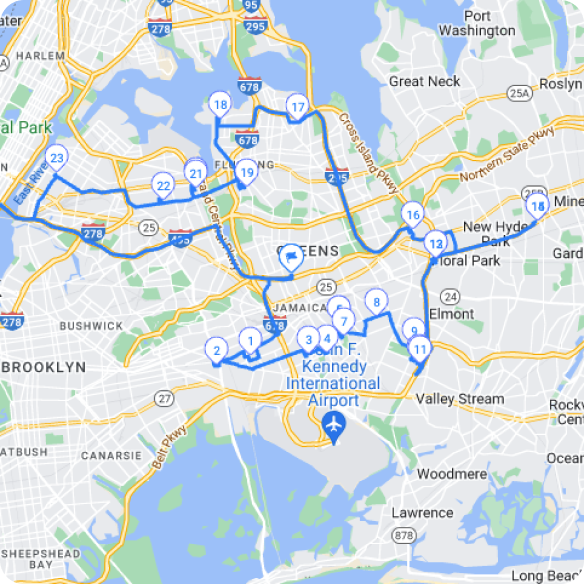
Zeo can optimize a route for the shortest distance and can assist if the user wants to prioritize certain stops over others; route optimization takes this into account while constructing the route.
Now let’s see how to create routes in Zeo
- Create an account, if you already have an account, just sign in.
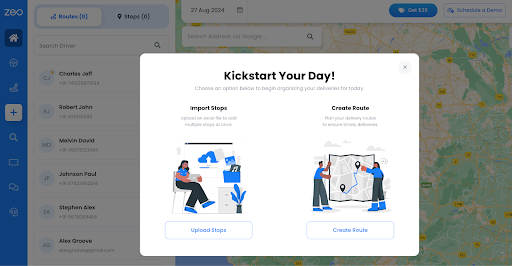
- Open Zeo’s dashboard and click on ‘Create Route‘.
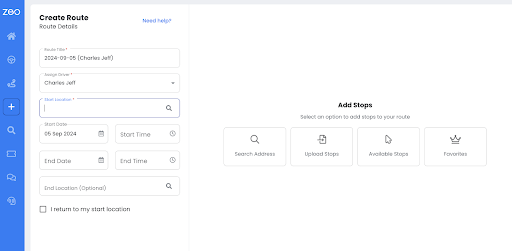
- ‘Assign driver‘, ie the driver’s name to the task. Add the ‘Start Location‘, Start Date‘, ‘Start Time‘, ‘End Date‘, and ‘End Time‘.
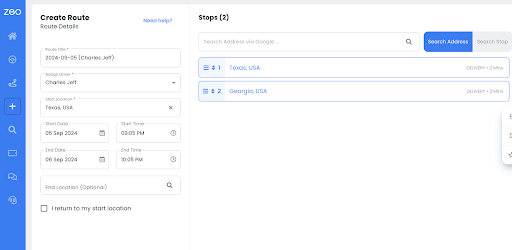
- Mark the ‘Start Location‘ (Texas) and the ‘End Location‘ (Georgia), or you can add more stops according to your requirements.
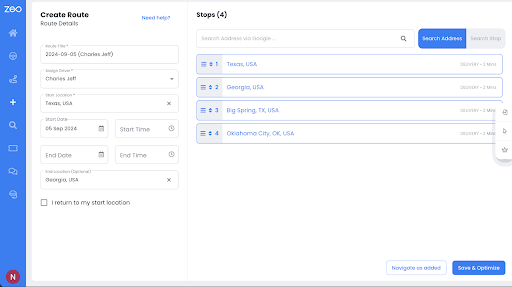
- After that, click ‘Save & Optimize’.
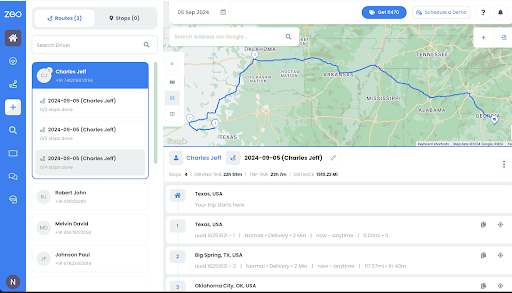
By following these steps, you can easily create better routes with Zeo Route Planner. The customer may optionally specify the preferred time windows for the driver to arrive at the stop, ensuring smoother and more efficient delivery operations.

increase fuel savings
Save 2 Hours on Deliveries, Everyday!
Optimize routes with our algorithm, reducing travel time and costs efficiently.
Get Started for Free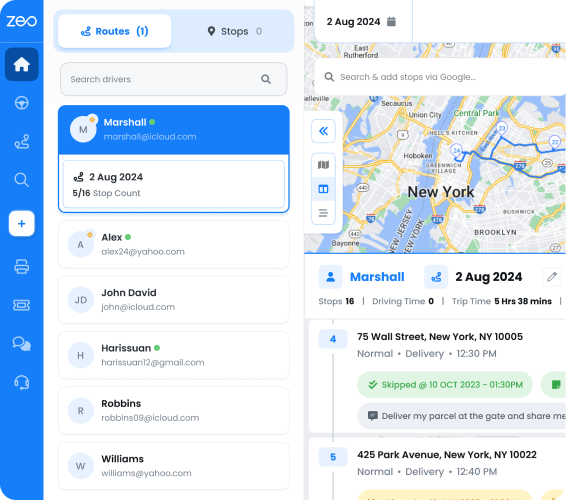
Benefits of Creating Better Routes with Zeo Route Planner
Let’s look at some benefits of creating optimized routes with Zeo Route Planner,
- Zeo Route Planner has an efficient algorithm that optimizes routes and shares delivery paths in seconds, allowing dispatchers and drivers to add or delete stops, recalculate the fastest routes, and update ETAs and recipient notifications.
- The routes created in the Zeo app, designed for drivers, facilitate direct communication between drivers and dispatchers through messaging and real-time route tracking.
- It allows for efficient optimization of up to 500 stops per day, offering a reasonable rate and features compared to other delivery management software.
- Its route optimization feature enables faster delivery of packages to customers, enhancing their satisfaction and loyalty.
How Route Optimization Impacts Business Operations
Implementing effective route optimization strategies delivers measurable improvements across multiple business metrics. Companies typically see reductions in fuel costs, vehicle wear and tear, and driver overtime expenses. Additionally, optimized routes improve customer satisfaction through more reliable delivery windows and real-time tracking capabilities.
The environmental benefits are equally significant. Reduced mileage directly translates to lower carbon emissions, helping companies meet sustainability goals. Many organizations are finding that route optimization is one of the most cost-effective ways to reduce their environmental footprint while simultaneously cutting operational costs.
For specialized services like mobile healthcare and nurse visits, optimized routing allows practitioners to maximize patient contact time by minimizing travel between appointments. Similar benefits apply to other field services that require efficient territory management and appointment scheduling.
Conclusion
To solve route optimization problems, you can select the best route optimization software to create optimized routes, assign drivers, and manage issues in real-time. When determining the best routes, Zeo takes into account several variables, such as the distance between locations, expected time of arrival, traffic patterns, the order of stops, and delivery constraints including time windows and vehicle capacities.
Zeo aims to provide routes that minimize travel time and distance while satisfying all delivery requirements. For more information, you can schedule a free demo with us!
Frequently Asked Questions
What factors should be considered when solving vehicle routing problems?
Key factors include vehicle capacity constraints, delivery time windows, driver work hours, traffic patterns, fuel costs, and customer priorities. Geographic considerations like road restrictions, toll roads, and accessibility also play crucial roles in creating efficient routes.
How does real-time traffic data improve route optimization?
Real-time traffic data allows routing algorithms to avoid congested areas and adjust delivery sequences dynamically. This reduces delays, improves on-time performance, and helps maintain accurate customer ETAs throughout the day.
What is the difference between static and dynamic route optimization?
Static optimization creates routes based on historical data and remains fixed throughout the day, while dynamic optimization continuously adjusts routes based on real-time conditions like traffic, weather, and new orders. Dynamic optimization provides better adaptability but requires more computational resources.
How can small businesses implement route optimization without large software investments?
Small businesses can start with cloud-based route planning applications that offer scalable pricing and require minimal upfront investment. These solutions typically provide essential features like multi-stop optimization, GPS tracking, and customer notifications without the complexity of enterprise systems.
What role does machine learning play in modern route optimization?
Machine learning algorithms analyze historical delivery data to predict optimal routes, estimate service times more accurately, and identify patterns in customer behavior. These insights help create more reliable routing decisions and continuously improve optimization performance over time.
Are you a fleet owner?
Want to manage your drivers and deliveries easily?
Grow your business effortlessly with Zeo Routes Planner – optimize routes and manage multiple drivers with ease.
increase fuel savings
Hassle Free Deliveries & Pickups!
Optimize routes with our algorithm, reducing travel time and costs efficiently.
Get Started for Free