


# Best Delivery Route Planner Software to Cut Costs & Save Time
> TL; DR : Delivery route planner software eliminates manual planning inefficiencies that waste 2-4 hours daily and increase delivery costs by 20-40%. Studies by the 미국 교통부 show optimized routing reduces fuel consumption by 15-25% while improving on-time performance. AI-powered platforms like Zeo Route Planner automate complex route optimization with time windows and capacity constraints, helping delivery businesses save 2+ hours daily in planning time.
Running a delivery business without proper route planning software is like trying to navigate a maze blindfolded. You know where you need to go, but you’re wasting time, fuel, and money getting there.
If you’re manually planning routes for 5-50 drivers every morning, you already know the pain. Hours spent staring at maps, constant phone calls about traffic delays, frustrated customers asking where their deliveries are, and fuel costs that keep climbing.
좋은 소식은? Delivery route planner software transforms this chaos into streamlined operations that actually make money instead of burning it.
수동 배송 경로 계획이 수익을 저해하는 이유
Manual route planning doesn’t just waste your morning. It destroys your profit margins in ways you might not even realize.
Time is your most expensive resource. Operations managers spend 2-4 hours daily planning routes manually. At $30 per hour, that’s $15,600-$31,200 annually just in planning time. Add the cost of suboptimal routes, and you’re looking at massive hidden expenses.
Poor routes waste serious money. 이에 따르면 미국 교통부, inefficient routing increases delivery costs by 20-40%. For a business spending $50,000 annually on fuel and driver wages, that’s $10,000-$20,000 in preventable waste.
Here’s what happens when you plan routes manually:
Drivers waste fuel on inefficient routes. Without optimization, drivers zigzag across territories, hit traffic hotspots, and backtrack unnecessarily. Your fuel budget disappears into routes that make no logical sense.
Labor costs spiral out of control. Longer routes mean overtime pay, frustrated drivers, and higher turnover. When routes take 10-12 hours instead of 8, you’re paying premium wages for poor planning.
고객 불만이 증가합니다. Late deliveries, missed time windows, and poor communication create angry customers. One study by the 전국 소매 연맹 found that 69% of customers won’t order again after a poor delivery experience.
Scaling becomes impossible. Adding more drivers to a manual system multiplies the chaos. What takes 2 hours for 10 drivers takes 6+ hours for 30 drivers. You hit a ceiling where growth actually decreases profitability.
How Delivery Route Planner Software Actually Works (And What to Look For)
현대 경로 최적화 소프트웨어 uses algorithms that consider dozens of variables simultaneously. Think of it as having a GPS system that knows about traffic, driver skills, vehicle capacity, customer preferences, and time constraints all at once.
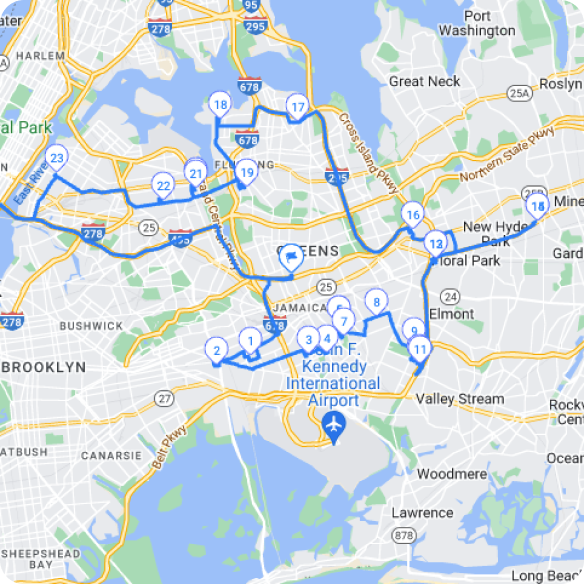
The optimization process happens in seconds. You upload addresses, set constraints like time windows or vehicle capacities, and the software calculates the most efficient sequence. What took hours of manual work gets done before you finish your coffee.
Real-time adjustments keep routes optimal. When traffic hits or customers reschedule, the software recalculates instantly. Drivers get updated routes on their phones without calling dispatch.
Every variable gets considered. Vehicle capacity, driver skills, customer time windows, traffic patterns, fuel costs, and service times all factor into route decisions. Human planners can’t juggle this many variables effectively.
Here’s what separates good delivery route planner tools from basic mapping applications:
Multi-stop optimization beyond 10 stops. Google Maps handles a few stops, but delivery businesses need routes with 20, 50, or 100+ stops optimized as a single sequence.
Vehicle and driver constraints. Different trucks have different capacities. Some drivers have special skills or certifications. The software assigns stops based on these real-world limitations.
Time window management. When customers specify delivery windows, the software sequences stops to hit those windows while minimizing drive time.
실시간 추적 및 커뮤니케이션. Managers see where every driver is, customers get accurate ETAs, and everyone stays informed without phone calls.
ROI Calculator: The Real Cost Savings of Automated Route Planning
The numbers don’t lie. Route optimization software pays for itself within weeks for most delivery businesses.
Time savings translate directly to profit. Automated planning saves 2-3 hours daily for operations staff. At $30/hour, that’s $60-90 daily or $15,600-$23,400 annually. Most route planning software costs under $3,000 annually, creating immediate positive ROI.
Fuel savings add up fast. Optimized routes reduce driving distance by 10-30% according to studies by the 미국 교통 연구소. A business spending $30,000 annually on fuel saves $3,000-$9,000 just from better routing.
Labor cost reductions compound monthly. Shorter routes mean less overtime, fewer driver hours, and higher productivity. Drivers complete more deliveries in less time, increasing revenue per driver by 15-25%.
Let’s look at a real example. A 20-driver delivery company spending:
- $40,000 annually on planning time
- $60,000 on fuel
- $800,000 on driver wages
With route optimization software costing $2,400 annually, they typically save:
- $26,000 in planning time (65% reduction)
- $12,000 in fuel costs (20% reduction)
- $40,000 in labor costs (5% efficiency gain)
- 연간 총 절감액: $78,000
- ROI : 3,150 %
Customer retention improves dramatically. On-time deliveries increase by 20-40% with optimized routing. Retaining existing customers costs 5-7x less than acquiring new ones, making delivery reliability a profit multiplier.
Essential Features Every Delivery Business Needs in a Route Planner
Not all route planning software works for delivery businesses. Consumer apps like Google Maps optimize for a few stops, but delivery operations need industrial-strength features.
Bulk address import and processing. You need to upload 50, 100, or 500 addresses from Excel files or your order management system. Manual address entry defeats the purpose of automation.
Vehicle capacity constraints. Trucks have weight and volume limits. The software must assign stops based on what actually fits in each vehicle, not just geographic proximity.
Time windows and priority stops. Some deliveries must happen by specific times. Others are flexible. The software should optimize around these constraints while minimizing total drive time.
Driver skill-based assignment. Certain deliveries require special equipment, certifications, or experience. Smart assignment matches the right driver to the right delivery automatically.
Real-time tracking and customer communication. Customers want to know where their delivery is. Drivers need to update delivery status. Managers need visibility into the entire operation without constant phone calls.
배송 증명 캡처. Photos, signatures, and delivery notes document successful completion. This protects against disputes and provides customer service data.

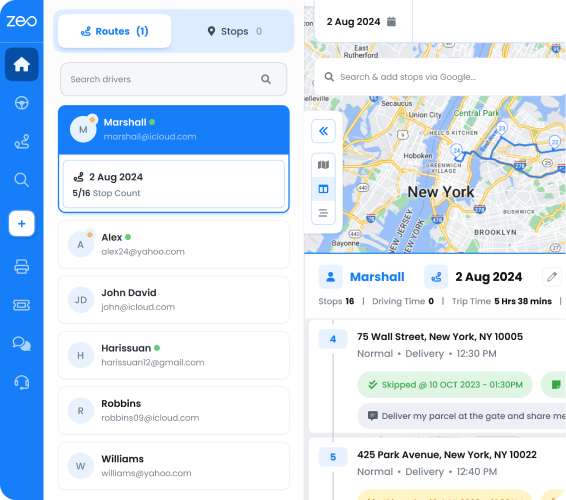
기존 시스템과의 통합. Your route planner should connect to your order management, accounting, or e-commerce systems. Manual data entry between systems wastes the time you’re trying to save.
Zeo Route Planner includes all these features in a platform designed specifically for delivery operations. The AI-powered optimization saves 2+ hours daily while handling complex constraints like time windows, vehicle capacity, and driver skills automatically.
Implementation Strategy: From Manual Planning to Automated Routes
Moving from manual to automated route planning doesn’t require shutting down operations. The transition happens gradually over 1-2 weeks.
Week 1: Parallel testing. Run your manual routes alongside software-generated routes for the same addresses. Compare drive times, fuel usage, and delivery completion rates. Most businesses see 15-25% improvement immediately.
Week 2: Full implementation. Switch to software-generated routes while keeping manual backup plans. Train dispatchers on the web platform and drivers on the mobile app for route navigation.
The 차량 관리 소프트웨어 coordination advantage. Operations managers plan and assign routes through the web platform each morning. Drivers receive their optimized routes directly on the Zeo mobile app, complete with turn-by-turn navigation, customer contact information, and delivery instructions. This creates seamless workflow from dispatch to delivery without paper route sheets or constant phone communication.
Training requirements are minimal. Modern route planning software works intuitively. Upload addresses, click optimize, assign routes to drivers. Most teams master the basics in 30 minutes.
Start with high-volume days. Implement automated planning on your busiest days first. These show the biggest immediate impact and build team confidence in the system.
Measure everything. Track route completion times, fuel usage, customer complaints, and driver satisfaction. Document the improvements to justify the investment and identify further optimization opportunities.
Integration comes next. Once basic routing works smoothly, connect your order management system, add customer notification features, and implement proof of delivery capture.
The key is treating implementation as process improvement, not technology installation. Focus on workflow changes that make everyone’s job easier.
Scaling Your Delivery Operation with Smart Route Planning Technology
Route planning software doesn’t just optimize current operations. It removes the barriers that prevent profitable growth.
Adding drivers becomes simple math. Instead of exponentially complex planning, each new driver just increases capacity linearly. The software handles assignment and optimization automatically.
Geographic expansion works systematically. Enter new service area addresses and the software calculates optimal territories, driver assignments, and service capacity. No guesswork about whether expansion will be profitable.
Seasonal demand fluctuations get managed automatically. Peak seasons that used to require temporary managers and chaotic overtime become smooth capacity adjustments. The software scales planning complexity without scaling management overhead.
Data-driven decision making replaces gut instincts. Route analytics show exactly which areas are profitable, which drivers perform best, and where operational improvements create the biggest impact.
Customer service becomes a competitive advantage. Accurate ETAs, proactive delay notifications, and consistent on-time performance turn delivery from a commodity service into a differentiator.
Consider a regional delivery company that grew from 12 to 45 drivers using route optimization software. Instead of hiring additional dispatchers and operations managers, they handled 3x the volume with the same planning staff. Revenue per employee increased by 180% while customer satisfaction scores improved by 35%.
The compounding effect of optimization. Small daily improvements in route efficiency, fuel usage, and customer service compound into massive competitive advantages. Companies using advanced route planning typically achieve 20-40% higher profit margins than competitors using manual methods.
Zeo Route Planner supports this scaling by serving 1.5M+ users across 150+ countries, from single-driver operations to enterprises with hundreds of vehicles. The platform grows with your business without requiring system changes or data migration.
Smart route planning technology doesn’t just solve today’s inefficiencies. It builds the operational foundation for sustainable, profitable growth in an increasingly competitive delivery market through 라스트마일 배송 최적화 전략들.
자주 묻는 질문들 (FAQ)
Q: How much fuel can optimized delivery routes save my business?
Optimized delivery routes typically reduce fuel consumption by 15-25% according to transportation research studies. This translates to $3,000-$9,000 in annual savings for businesses spending $30,000 on fuel. Route optimization algorithms eliminate unnecessary backtracking and consider real-time traffic patterns.
Q: What’s the difference between Google Maps and professional delivery route planner software?
Google Maps handles up to 10 stops but lacks features essential for delivery businesses like vehicle capacity constraints, time windows, and driver skill assignments. Professional delivery route planner software like Zeo Route Planner optimizes 100+ stops simultaneously while managing complex business requirements, saving 2+ hours daily in planning time.
Q: How long does it take to implement route planning software?
Most businesses fully implement route planning software within 1-2 weeks. The first week involves parallel testing alongside existing manual processes, while the second week focuses on full implementation and driver training. Modern platforms require minimal training as most teams master basic functions within 30 minutes.
Q: Can route optimization software handle time-sensitive deliveries?
Yes, advanced route optimization software manages time windows by prioritizing deliveries with specific deadlines and sequencing stops to meet customer requirements. Zeo Route Planner’s AI-powered optimization considers priority stops, time windows, and real-time traffic to ensure on-time performance while minimizing total drive time.
Q: What ROI can I expect from delivery route planning software?
Most delivery businesses see 300-3000% ROI within the first year from route planning software. A typical 20-driver operation saves $78,000 annually through reduced planning time ($26,000), fuel costs ($12,000), and labor efficiency gains ($40,000), while software costs under $3,000 annually.
Ready to transform your delivery operations from chaotic manual planning to automated optimization? Start your free trial of Zeo Route Planner and see how much time and money you can save on your first week of optimized routes.
당신은 차량 소유자입니까?
드라이버와 배송을 쉽게 관리하고 싶으신가요?
Zeo Routes Planner로 손쉽게 사업을 성장시키세요. 경로를 최적화하고 여러 운전자를 손쉽게 관리하세요.