


# Uniform Pickup Delivery Route Planning: Cut Costs 25% in 2026
> TL; DR: Uniform pickup delivery route planning requires specialized optimization that handles dual-purpose stops, capacity constraints, and competing time windows at the same locations. Optimized routes typically reduce operational costs by 25% through fuel savings and improved driver productivity. AI-alapú útvonaloptimalizálás tools like Zeo Route Planner address this complexity with dynamic routing algorithms, helping uniform service teams save 2+ hours daily.
Uniform rental services face a unique challenge that separates them from standard delivery operations. Every route must handle both dirty uniform pickups and clean uniform deliveries, often at the same location but with different timing requirements.
This dual-purpose uniform pickup delivery route planning creates operational complexity that traditional routing methods simply can’t handle. The result? Drivers waste hours backtracking, customers receive late deliveries, and operational costs spiral out of control.
Szerint Bureau of Labor Statistics, textile rental services employ over 180,000 workers across the United States, with route efficiency directly impacting profitability in this competitive market.
Why Traditional Route Planning Fails for Uniform Pickup Delivery Route Planning Operations
Most uniform service companies still plan routes manually or use basic delivery software designed for single-purpose trips. These approaches ignore the fundamental challenge of dual-purpose routing.
The Hidden Costs of Manual Route Planning
When you plan pickup and delivery routes manually, each driver typically covers the same geographic area twice. First for pickups, then again for deliveries. This approach doubles your fuel costs and wastes driver time.
Consider a typical scenario: Your driver visits ABC Manufacturing on Monday to pick up dirty uniforms, then returns Thursday to deliver clean ones. Without proper optimization, they might drive past three other customers on both trips, missing opportunities to consolidate stops.
Inventory Timing Complications
Clean uniforms must arrive before employees start their shifts. Dirty uniforms need collection before they create hygiene issues or storage problems. These competing time pressures make route sequencing critical.
Traditional planning methods treat each stop independently. They can’t calculate the optimal sequence when Stop A needs a morning delivery but afternoon pickup, while Stop B requires the reverse.
Járműkapacitási korlátok
Uniform service vehicles have limited capacity for both clean and dirty inventory. Manual planning rarely considers how pickup volume affects remaining delivery capacity throughout the route.
A driver might collect large volumes early in their route, leaving insufficient space for remaining deliveries. This forces costly return trips to the depot or emergency vehicle swaps.
Mathematical Models for Uniform Pickup/Delivery Route Optimization
Modern uniform pickup delivery route planning relies on sophisticated algorithms that consider multiple variables simultaneously. Understanding these mathematical foundations helps you evaluate routing solutions effectively.
The Pickup and Delivery Problem (PDP)
Uniform services operate under a specialized version of the Pickup and Delivery Problem. Unlike standard VRP (Vehicle Routing Problem), PDP algorithms must account for:
Load balancing throughout routes: Each pickup increases vehicle load while each delivery decreases it. The algorithm must ensure vehicles never exceed capacity at any point.
Precedence constraints: Clean uniforms must be loaded before delivery. Dirty uniforms must be picked up before return to depot for cleaning.
Time window coordination: Pickup and delivery time windows at the same location must be synchronized with business operations and cleaning cycles.
Capacity-Constrained Routing Models
Effective algorithms use dynamic programming to calculate optimal stop sequences. They consider current vehicle load, remaining capacity, and upcoming pickup/delivery volumes.
The mathematical complexity increases exponentially with each additional stop. A 50-stop route has over 3 × 10^64 possible sequences. Only AI-powered optimization can evaluate these combinations in practical timeframes.
Zeo Route Planner’s AI algorithms solve these complex calculations automatically, reducing route planning time from hours to minutes while finding mathematically optimal solutions.
Többcélú optimalizálás
Uniform service routing must balance multiple competing objectives:
- Minimize total route time and distance
- Maximize on-time delivery performance
- Balance workload across drivers
- Minimize vehicle capacity violations
- Reduce fuel consumption and emissions
Advanced algorithms use weighted scoring to balance these objectives based on your business priorities. You can adjust parameters to emphasize customer service over cost reduction, or vice versa.
Integration Guide: Connecting Route Planning with Uniform Inventory Management
Effective uniform pickup delivery route planning requires seamless integration between routing software and inventory management systems. This integration eliminates data silos that cause routing errors and customer service problems.
Essential Data Integration Points
Your routing system needs real-time access to inventory data to make accurate optimization decisions. Key integration points include:
Customer inventory levels: How many uniforms each location currently has, both clean and dirty. This determines pickup urgency and delivery quantities.
Cleaning cycle status: Which uniforms are currently in cleaning, their expected completion times, and quality control status.
Különleges kezelési követelmények: Uniforms requiring special cleaning, sizing changes, or replacement items that affect delivery planning.
API Integration Strategies
Modern inventory systems offer API connections that enable automated data sharing. Zeo Route Planner integrates with popular business systems through Zapier, connecting to over 1,000 applications including inventory management platforms.
Set up automated workflows that trigger route updates when inventory status changes. If a large uniform order completes cleaning ahead of schedule, the system can automatically adjust delivery routes to accommodate early delivery opportunities.
Valós idejű útvonal-módosítások
Integration enables dynamic route modifications based on changing inventory conditions. When customers request emergency uniform deliveries or cancel pickup appointments, integrated systems can recalculate optimal routes instantly.
Your drivers receive updated routes directly through the mobile app, with clear pickup quantities and delivery manifests for each stop. This eliminates communication errors and ensures accurate inventory handling throughout the day. Kézbesítési igazolás features like photo capture and digital signatures help document each transaction.
Advanced Scheduling: Handling Mixed Pickup/Delivery Routes with Time Windows
Time window management separates successful uniform services from struggling competitors. Your customers depend on receiving clean uniforms before shift changes and having dirty uniforms collected before storage becomes problematic.
Multi-Window Route Optimization
Many uniform service locations have multiple time windows throughout the day. A manufacturing facility might accept deliveries from 6-8 AM before shift start, then allow pickups from 4-6 PM after shift end.
Advanced scheduling algorithms evaluate all possible combinations of time windows across your entire customer base. They identify opportunities to serve multiple customers during overlapping windows, reducing total route time.
Prioritásalapú leállítási sorrend
Not all uniform deliveries carry equal importance. Hospital uniforms require higher priority than office cleaning uniforms due to safety implications. Restaurant uniforms need precise timing to meet health department requirements.
Zeo’s priority stop feature ensures critical deliveries receive optimal routing placement, while normal-priority stops fill in around these constraints. This systematic approach prevents customer service failures while maintaining operational efficiency.
Buffer Time Management
Experienced uniform service operators know that pickup times vary significantly. Some locations have uniforms ready for immediate collection, while others require waiting for employees to change.
Build buffer times into your scheduling model based on historical data from each customer. Factor in extra time for locations with complex pickup procedures, restricted access, or high uniform volumes. Valós idejű GPS nyomkövetés helps monitor actual pickup times and adjust future schedules accordingly.
Holiday and Seasonal Adjustments
Uniform demand fluctuates based on business cycles, seasonal employment changes, and holiday schedules. According to the US Department of Labor, textile rental services experience 15-20% demand variation throughout the year.
Your scheduling system should accommodate these patterns automatically. Increase delivery frequencies during busy seasons, adjust pickup schedules around holiday closures, and modify route timing for seasonal hour changes.
ROI Calculator: Cost Savings from Optimized Uniform Service Routes
Understanding the financial impact of improved uniform pickup delivery route planning helps justify investment in optimization technology and measure ongoing performance improvements.

növeli az üzemanyag-megtakarítást
Problémamentes kiszállítás és átvétel!
Optimalizálja az útvonalakat algoritmusunkkal, így hatékonyan csökkenti az utazási időt és a költségeket.
Get Started ingyen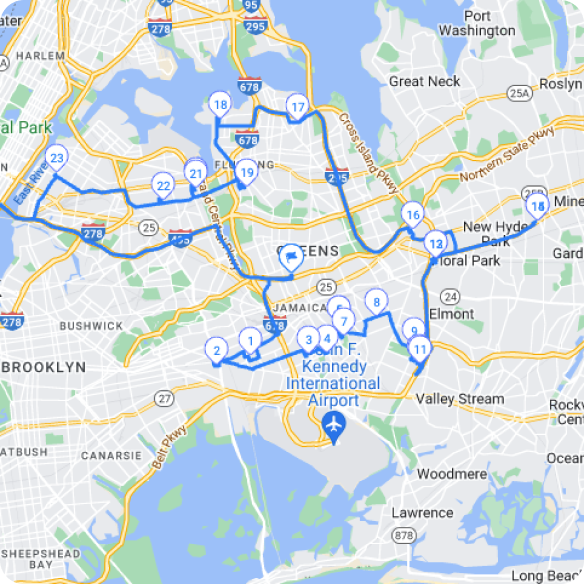
Direct Cost Reduction Areas
Üzemanyag megtakarítás: Optimized routes typically reduce total driving distance by 15-25%. With commercial vehicle fuel costs averaging $4.20 per gallon in 2026, a fleet of 15 vehicles saving 50 miles daily generates $4,725 monthly fuel savings.
Munkaerőköltség csökkentése: Efficient routing saves 1-2 hours per driver daily. For drivers earning $18/hour including benefits, this represents $270-540 daily savings per driver.
Jármű karbantartás: Reduced mileage extends vehicle life and decreases maintenance frequency. Commercial vehicles cost approximately $0.15 per mile in maintenance expenses.
Revenue Enhancement Opportunities
Increased route capacity: Better optimization allows each driver to handle 15-20% more stops without overtime. This increased capacity translates directly to additional revenue without proportional cost increases.
Jobb ügyfélmegtartás: On-time delivery performance above 95% significantly reduces customer churn in the uniform service industry. Ügyfélmegtartás eliminates costly acquisition expenses and maintains stable revenue streams.
Premium service offerings: Optimized operations enable guaranteed delivery windows and same-day service options that command higher pricing.
Minta ROI-számítás
Consider a uniform service with 12 drivers covering 180 stops daily:
- Fuel savings: $3,780 monthly (20% distance reduction)
- Labor savings: $6,480 monthly (1.5 hours per driver)
- Maintenance savings: $1,215 monthly (reduced mileage)
- Revenue increase: $8,100 monthly (15% capacity improvement)
Teljes havi juttatás: 13 500 dollár
Éves megtérülés: 83 400 dollár
Investment in professional routing software typically pays for itself within 60-90 days through these combined savings.
Performance Analytics: Key Metrics for Uniform Service Route Efficiency
Measuring route performance provides insights for continuous improvement and validates the effectiveness of your uniform pickup delivery route planning strategies.
Core Efficiency Metrics
Average stops per route: Track how many locations each driver serves daily. Increases indicate improved route density and efficiency.
Miles per stop: Calculate total route miles divided by number of stops. Decreasing ratios demonstrate better geographic clustering.
Időben történő kézbesítés százalékos aránya: Measure deliveries arriving within promised time windows. Uniform services should target 96%+ performance.
Pickup completion rate: Track percentage of scheduled pickups completed without requiring return visits.
Ügyfél-elégedettségi mutatók
Delivery window adherence: Monitor how consistently you meet promised delivery times. Late arrivals damage customer relationships and create operational problems for their businesses.
Pickup reliability: Measure frequency of missed pickups or incomplete collections that require follow-up visits.
Customer complaints per route: Track service issues reported by customers along each route to identify problem areas.
Operational Performance Tracking
Driver productivity scores: Compare individual driver performance on similar routes to identify training opportunities and best practices.
Vehicle utilization rates: Monitor how effectively you use vehicle capacity throughout routes. Low utilization indicates optimization opportunities.
Route completion times: Track when drivers finish assigned routes to identify capacity for additional stops.
Zeo Route Planner provides comprehensive analytics dashboards that track these metrics automatically, giving you real-time visibility into route performance and improvement opportunities.
Benchmark összehasonlítások
Industry research by the Textile Rental Services Association shows top-performing uniform services achieve:
- 18-22 stops per driver per day
- 2.1-2.8 miles per stop average
- 97%+ on-time delivery rates
- 94%+ first-attempt pickup success
Compare your metrics against these benchmarks to identify improvement areas and set realistic performance targets. A comprehensive útvonaloptimalizálási útmutató can help you understand which metrics matter most for your operation.
Folyamatos fejlesztési folyamat
Establish monthly performance reviews that analyze routing metrics and identify optimization opportunities. Look for patterns in late deliveries, missed pickups, or customer complaints that indicate systematic problems.
Use historical data to predict seasonal variations and adjust routes proactively. Summer uniform demand typically increases 12-15% due to expanded business hours and seasonal employment.
Gyakran ismételt kérdések
Q: How do you optimize routes for both pickup and delivery at the same locations?
Advanced route optimization software uses mathematical algorithms that consider dual-purpose stops, vehicle capacity constraints, and time windows simultaneously. Zeo Route Planner’s AI-powered optimization handles these complex calculations automatically, reducing route planning time from hours to minutes while ensuring vehicles never exceed capacity at any point during their routes.
Q: What’s the average fuel savings from optimized uniform service routes?
Optimized uniform pickup delivery routes typically reduce total driving distance by 15-25%, translating to significant fuel cost savings. With commercial vehicle fuel costs averaging over $4 per gallon, a fleet of 15 vehicles can save approximately $4,725 monthly through route optimization.
Q: How do time windows affect uniform pickup and delivery scheduling?
Time windows create scheduling complexity because clean uniforms must arrive before shift starts while dirty uniforms need collection after shifts end. Effective scheduling systems must coordinate multiple time windows across customer locations, often requiring buffer times based on historical pickup data from each customer.
Q: What metrics should uniform services track to measure route efficiency?
Key metrics include average stops per route (target 18-22 daily), miles per stop (2.1-2.8 average), on-time delivery percentage (aim for 97%+), and first-attempt pickup success rates (94%+). Zeo Route Planner provides comprehensive analytics dashboards that automatically track these performance indicators in real-time.
Q: How does vehicle capacity planning work for mixed pickup/delivery loads?
Vehicle capacity planning requires dynamic calculations throughout the route, as pickups increase load while deliveries decrease it. The optimization algorithm must ensure vehicles never exceed weight or volume limits at any stop, considering both current load and upcoming pickup volumes when sequencing stops.
Ready to transform your uniform pickup delivery route planning? Start your free trial of Zeo Route Planner to optimize your uniform service routes and see immediate cost savings. Join over 1.5 million users across 150+ countries who rely on Zeo’s AI-powered optimization to streamline their operations.
Ön flottatulajdonos?
Könnyen szeretné kezelni a járművezetőket és a szállításokat?
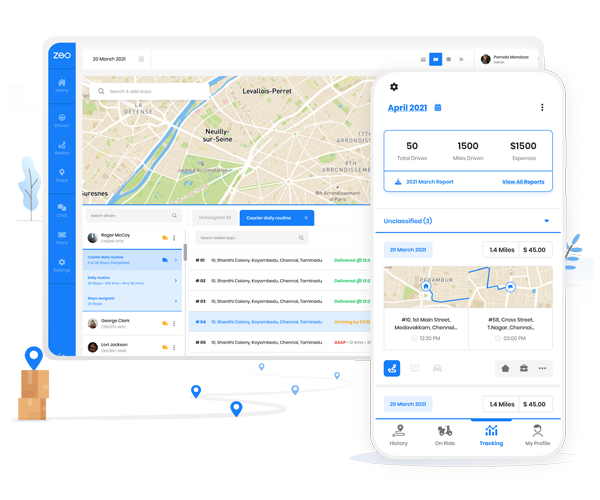
Fejlessze vállalkozását erőfeszítés nélkül a Zeo Routes Planner segítségével – optimalizálja az útvonalakat és kezeljen könnyedén több járművezetőt.
növeli az üzemanyag-megtakarítást
Problémamentes kiszállítás és átvétel!
Optimalizálja az útvonalakat algoritmusunkkal, így hatékonyan csökkenti az utazási időt és a költségeket.
Get Started ingyen