

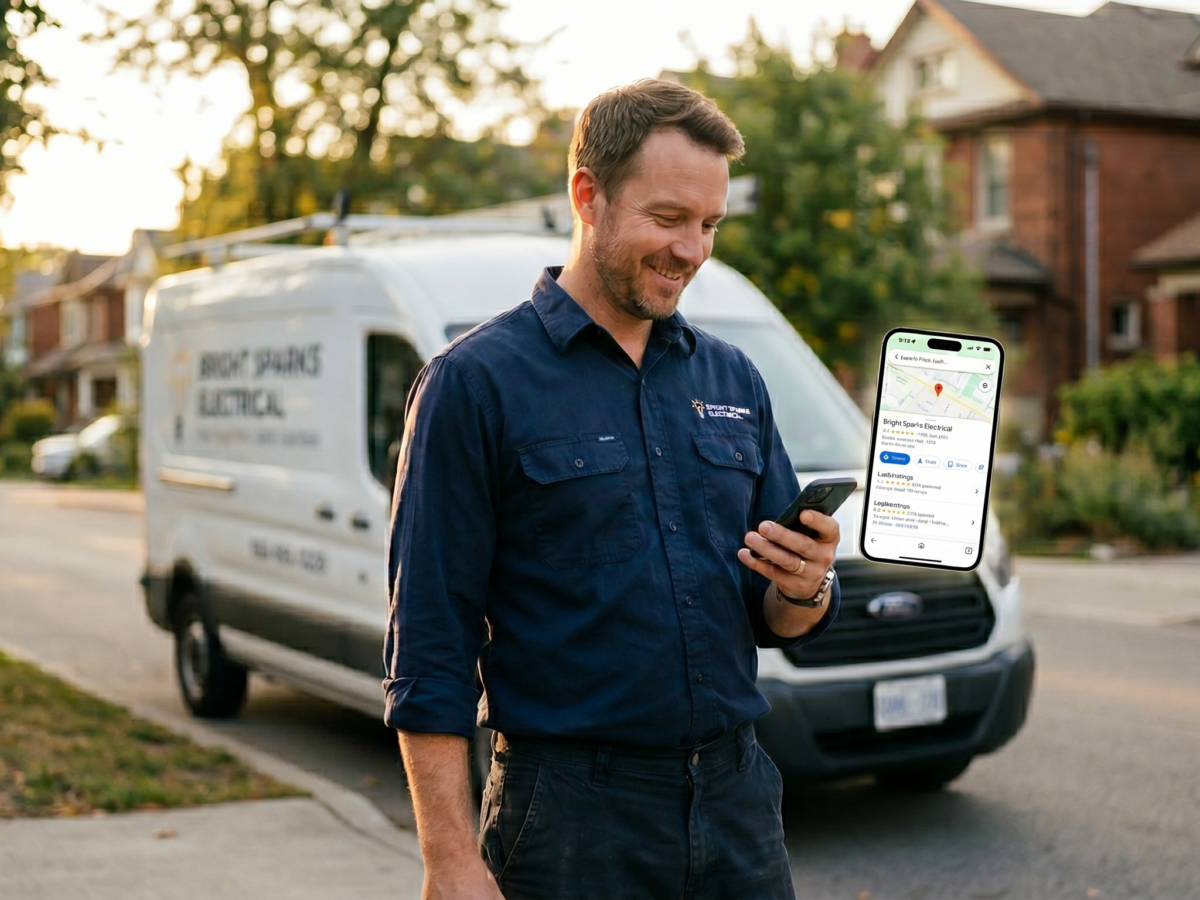
A practical guide for plumbers, electricians, HVAC pros, cleaners, landscapers, and every local service owner who’s tired of being invisible on Google.
Most local service businesses still don’t get found online — not because they aren’t good at the work, but because the way customers search has changed faster than
the way most businesses market themselves. In 2026, getting discovered means showing up on Google’s local pack, ranking in AI search engines like ChatGPT and
Perplexity, having an active Google Business Profile, and consistently publishing content that answers the questions your customers actually type. This guide walks through
each of those layers — what changed, what works now, and the 30-day plan that fits a busy service business.
By the Zeo Content Team. Last updated: May 4, 2026.
Ceev navigation
- Why are most local service businesses invisible online?
- How does Google decide which local services to show?
- What role does your website play in 2026?
- Why does content marketing matter for service businesses?
- How do AI search engines find local service businesses?
- Reviews: the still-undervalued lever
- Quick wins for the next 30 days
- Lus nug cov lus nug
Why are most local service businesses invisible online?
Most local service businesses are invisible online because they treat their digital presence as a one-time setup rather than an ongoing operation. A static website, a half-filled Google Business Profile, and a logo on a service van will not move a service business up Google’s local pack in 2026 — Google’s local ranking factors changed dramatically over the last two years and now reward businesses that publish content, accumulate reviews on a consistent cadence, and demonstrate ongoing
kev ua si.
The numbers: 46% of all Google searches have local intent, and 76% of people who search for something nearby on their phone visit a related business within 24 hours (Google’s own data, 2025). The opportunity is enormous. The problem is that the businesses competing for those searches now treat online discovery the way they treat customer service — as a daily practice, not a setup task.
Three failure patterns explain why many service businesses still fall short:
- Setup-and-forget websites — built once in 2019, never updated, no fresh content for Google to index.
- Half-filled or unverified Google Business Profile — missing categories, missing service areas, no posts, no Q&A activity, photo gallery from 2021.
- No structured content for AI search engines — ChatGPT, Perplexity, and Google’s AI Overviews now drive a meaningful share of “best plumber near me” type queries, and their citation behavior favors structured, recently-updated content.
The good news: each of these is fixable in hours, not months. The order matters.
How does Google decide which local services to show?
Google’s local pack — the three businesses that show up in a map at the top of local search results — is decided by three factors: relevance, distance, and prominence. “Relevance” is whether your business categories and content match the search. “Distance” is your physical or service-area proximity to the searcher. “Prominence” is how well-known and well-reviewed your business is across the web. The first two are largely fixed by what you do and where you operate. The third is the lever you can actually pull.
Prominence in 2026 is calculated from a mix of:
- Review count and recency. Google heavily favors businesses with reviews from the last 30 days, not just historic totals.
- Review response rate and speed. Responding to reviews — both positive and negative — within 24–48 hours signals active management.
- Citation consistency — your business name, address, and phone number (NAP) appearing identically across Yelp, BBB, Angi, HomeAdvisor, Facebook, Apple Maps, and industry directories.
- Google Business Profile activity — posts, Q&A responses, photos uploaded in the last 30 days, services listed and updated.
- Backlinks from local sources — local newspapers, chamber of commerce, neighborhood blogs, supplier websites.
The single highest-leverage action for most service businesses: claim and fully complete your Google Business Profile. Add every service. Add all service areas. Upload at least 10 photos of recent work. Ask every happy customer for a review and respond to every one within 48 hours. Most local businesses skip half of this — doing it well is enough to outrank competitors who have been around longer but haven’t kept up.
What role does your website play in 2026?
Your website’s job in 2026 is not to be a brochure — it’s to be the place Google and AI engines can verify that your Google Business Profile claims are true. When a searcher types “best electrician in Tampa,” Google checks the local pack, then immediately cross-references each listed business’s website to confirm services, service areas, hours, and reviews. A thin, slow, or out-of-date website breaks that verification step and quietly demotes you behind competitors with stronger sites.
The 2026 baseline for a service business website:
- Mobile-thawj tsim — over 70% of local-service searches happen on phones. If your site is not mobile-fast, you lose.
- Page speed under 2.5 seconds — Google’s Core Web Vitals are now a confirmed ranking factor for local results.
- Schema markup for LocalBusiness — tells Google explicitly what kind of business you are, your hours, your service area, your reviews. Tools like Yoast or Rank Math handle this automatically on WordPress.
- A real services page for each service you offer — not just a single “Services” page with a bullet list. A plumber should have separate pages for water heater repair, leak detection, drain cleaning, etc. Each page becomes a separate landing surface for a different long-tail search.
- Hloov kho tsis tu ncua — at minimum, a new blog post or service-area page every 2–4 weeks. Stale sites lose ranking. This is also where most service businesses give up.
That last point is the bottleneck for most owners. They know they should publish content. They don’t have time. We come back to that in the content marketing section below — including tools that have made this dramatically easier in 2026.
Why does content marketing matter for service businesses?
Content marketing matters for local service businesses because every service question your customers type into Google is a chance for your website to be the answer — and most of those questions are not commercial searches like “plumber near me,” they’re informational searches like “why is my water heater making a clicking sound.” Businesses that answer those questions on their website with structured, useful blog content get found weeks or months before the customer is ready to call.
By the time they need a plumber, they already trust your business because you helped them understand the problem.
A few examples that work well for service businesses:
- A plumber writing “How to tell if you need to replace your water heater” gets discovered by anyone Googling that exact phrase.
- An HVAC company writing “Why does my AC freeze up in summer?” captures every searcher with that problem.
- A landscaper writing “When to overseed your lawn in [city]” captures local seasonal traffic.
- An electrician writing “What does a flickering light mean?” reaches anxious homeowners before they call anyone.
Each of these articles, ranked on Google, brings in customers who didn’t know your business existed before they searched. Multiply that across 30–50 articles over a year, and you have a passive customer-acquisition channel that doesn’t depend on Google Ads or referrals.
The honest barrier is time. A 1,500-word, well-structured article takes 4–6 hours to write properly. Most service business owners don’t have that kind of time, and outsourcing to freelance writers or content agencies costs $200–$500 per post. There’s a category of tools that have emerged in 2025–2026 that automate this entirely — discovering keywords for your business, writing the post, optimizing it for SEO, and publishing to your WordPress site on a schedule. One Blog a Day1 is one example built for this exact use case for local service businesses; there are others. The point is that “I don’t have time to blog” is no longer a reason to skip content marketing in 2026.
For broader customer retention and engagement strategies once those customers find you, our retention guide goes deeper.

nce roj txuag
Txuag 2 teev ntawm kev xa khoom, Txhua hnub!
Txhim kho txoj kev nrog peb cov algorithm, txo cov sij hawm mus ncig thiab cov nqi zoo.
Pib Tau Dawb
How do AI search engines find local service businesses?
AI search engines like ChatGPT, Perplexity, and Google’s AI Overviews discover local service businesses by extracting structured information from websites and reviews — and they cite businesses that have clear, well-organized content over those with thin or unorganized sites. When someone asks ChatGPT “find me a reliable HVAC company in Austin that handles commercial work,” the AI doesn’t just look at Google Business Profiles. It crawls websites, reads reviews, and extracts answers from structured content — FAQ sections, comparison tables, services lists, and clearly-labeled service-area pages.
What this means practically for your website:
- Use FAQ sections on service pages. AI engines disproportionately cite from FAQ structures because the question-answer format is easy to extract.
- Use semantic HTML — proper headings, lists, and tables. Don’t use div soup.
- Be specific and quotable. “We service all of Tampa Bay including St. Petersburg, Clearwater, and Brandon” beats “We serve the local area.”
- Include schema markup — LocalBusiness, Service, FAQPage. Tells AI engines exactly what your content represents.
- Update content with dates. “As of May 2026” or “Last updated 2026” signals freshness, which AI engines reward heavily.
This is the layer most service businesses haven’t even started on yet. Doing it now puts you ahead of competitors for at least the next 12–18 months while the rest of the industry catches up.
Reviews: the still-undervalued lever
Reviews remain the single most powerful signal for local service business discovery in 2026 — and they’re underweighted by most businesses because the work feels low-status compared to running ads or building websites. A business with 200 reviews averaging 4.7 stars ranks consistently above a business with 30 reviews averaging 4.9 stars in the same category. The volume matters; the recency matters more.
A review-system playbook that actually works:
- Ask every paying customer. Not “if you’re happy please leave us a review” — ask directly: “If our team did good work today, would you mind leaving a quick Google review? Here’s the link.” About 30% of asked customers will follow through; under 5% of unasked customers will.
- Make the link one tap. A QR code on the invoice. A link in the post-service text message. A “leave a review” button in the email confirmation. Each step removed = ~15% more reviews.
- Respond within 48 hours. Both positive and negative. The response is read by future customers and Google’s local algorithm both.
- Don’t filter or game it. Don’t only ask the customers you think are happy. Don’t pay for reviews. Google’s review fraud detection in 2026 is far more aggressive than it was — businesses caught get review counts wiped or suspended entirely.
- Diversify across platforms. Google first, then Yelp, then Facebook, then industry-specific (Angi for home services, HomeAdvisor for trades, etc.).
Done consistently, this single practice will outperform most paid acquisition for local service businesses with budgets under $5,000/month.
Quick wins for the next 30 days
If you read this far and want a 30-day starting plan for a local service business, here it is:
Week 1 — Foundation
- Claim and fully verify your Google Business Profile if you haven’t.
- Fill every category, service, and service area completely.
- Upload at least 10 recent photos of your team, vehicles, and completed work.
- Set up a single review-request automation (QR code on invoices, or a post-job text with a Google review link).
Week 2 — Content baseline
- Write or commission 3 service-specific landing pages on your website (one per major service).
- Add a FAQ section with 5 questions to each page.
- Add LocalBusiness schema markup if your site doesn’t already have it (Yoast or Rank Math do this automatically).
Week 3 — Momentum
- Ask every customer from the last 90 days for a Google review.
- Respond to every existing review (positive and negative) you haven’t responded to.
- Publish one blog post answering a common customer question. (If time is the blocker, automated blog-publishing tools like One Blog a Day can carry this from week 3 onwards.)
Week 4 — Compounding
- Audit your business’s name, address, and phone number across Yelp, BBB, Apple Maps, Facebook, and the top 3 industry directories. Make all entries identical.
- Schedule weekly Google Business Profile posts (offers, completed jobs, seasonal notes).
- Set a recurring 30-day review of new reviews + new content.
After 30 days, most local service businesses see measurable lift in Google Business Profile views, direction requests, and inbound calls. The compounding effect kicks in around month 3.
For the operational side of running the actual jobs efficiently once those customers are coming in, Zeo’s route planner for service businesses covers how the better-organized service businesses cut travel time and fit more jobs into a day.
Lus nug cov lus nug
Yuav siv sijhawm ntev npaum li cas rau ib lub lag luam kev pabcuam hauv zos kom pib pom hauv online?
Most local service businesses see initial improvement in Google Business Profile views and direction requests within 30–45 days of starting a consistent practice (reviews, content, profile updates). Meaningful organic traffic — the kind that delivers steady inbound calls — takes 90–180 days. SEO compounds; consistency beats sporadic effort.
Do I really need a blog if I’m a local service business?
For purely transactional businesses (one-off emergency services), maybe not. For any service business with repeat customers or seasonal demand cycles — plumbing, HVAC, landscaping, cleaning, electrical — yes. A blog answers the questions your customers Google before they’re ready to call, which means they find you weeks before they need you. That trust converts at much higher rates than cold ad clicks.
Kuv puas yuav tsum siv Google Ads los yog tsom mus rau kev tshawb pom organic?
Both — but with sequencing. Google Ads are immediate but stop the moment you stop paying. Organic discovery (Business Profile + content + reviews) is slow but compounds and keeps working without ongoing spend. The right play for most service businesses under $20K/month revenue: 80% effort on organic (compounds), 20% on targeted Google Ads for high-intent emergency keywords (“emergency plumber [city]”). After organic kicks in, reduce ad spend.
What’s the single most important thing if I can only do one thing?
Tau txais kev tshuaj xyuas. Tshwj xeeb: nug txhua tus neeg siv khoom them nyiaj hauv 90 hnub tom ntej kom tau txais kev tshuaj xyuas Google nrog ib qho txuas uas tsuas yog kov ib zaug xwb, thiab teb rau txhua qhov kev tshuaj xyuas hauv 48 teev. Tsis muaj lwm yam kev coj ua uas muaj qhov cuam tshuam zoo ib yam rau Google qhov kev qeb duas pob hauv zos, kev ntseeg siab ntawm cov neeg siv khoom, thiab kev hais txog AI tshawb nrhiav ua ke.
Kev tshawb nrhiav AI txawv ntawm Google rau cov kev pabcuam hauv zos li cas?
AI engines like ChatGPT and Perplexity don’t just rank websites — they extract answers from them. When a user asks “find a good electrician in Houston who does panel upgrades,” the AI synthesizes a recommendation from website content, reviews, and structured data. Businesses with FAQ sections, clearly-labeled service pages, and schema markup get cited more often than competitors with thin sites.
Kuv puas ua tau qhov no kuv tus kheej los yog kuv puas yuav tsum ntiav ib tug neeg ua?
The Google Business Profile setup, review-request system, and basic content can be done by a service business owner in a few hours per week. Where most owners hit a wall is consistent content publishing — the time cost of a 1,500-word blog post is real. Either set aside dedicated time, hire a freelance writer, or use one of the automated tools mentioned earlier. The discovery results don’t depend on who does the work; they depend on whether the work happens consistently.
Koj puas yog tus tswv nkoj?
Koj puas xav tswj hwm koj cov tsav tsheb thiab xa khoom yooj yim?
Loj hlob koj txoj kev lag luam tsis muaj zog nrog Zeo Routes Planner - txhim kho txoj hauv kev thiab tswj ntau tus neeg tsav tsheb yooj yim.
nce roj txuag
Hassle Free Deliveries & Pickups!
Txhim kho txoj kev nrog peb cov algorithm, txo cov sij hawm mus ncig thiab cov nqi zoo.
Pib Tau Dawb